
TL;DR:
- Ad spend optimisation focuses on improving performance without increasing budget.
- Regular testing and data analysis are essential for sustained ad campaign success.
- Optimisation enhances ROI by targeting the right audience and continuously refining strategies.
Spending more on ads is not the same as spending smarter. Many marketing managers and business owners fall into the trap of scaling budgets without first understanding where their money is actually working. The result is bloated campaigns with mediocre returns. Ad spend optimisation changes that equation entirely. It is about squeezing more performance from every pound you invest, whether you are running a Shopify store targeting fashion buyers or an assisted living facility trying to generate consistent family enquiries. This article breaks down what ad spend optimisation really means, why it matters for your sector, and exactly how to put it into practice.
Table of Contents
- Understanding ad spend optimisation
- Why ad spend optimisation matters for your business
- Core strategies and techniques for optimising ad spend
- Tools, metrics, and frameworks for measuring ad spend optimisation
- Why ‘optimisation’ is more mindset than maths
- Supercharge your results with expert optimisation
- Frequently asked questions
Key Takeaways
| Point | Details |
|---|---|
| Boost ROI efficiently | Ad spend optimisation ensures every pound delivers maximum possible return. |
| Data-driven improvements | Applying metrics and regular reviews leads to smarter, more effective campaigns. |
| Practical strategies matter | Simple tactics like targeted ads, creative testing, and AI tools make real business impact. |
| Continuous optimisation | Business growth depends on ongoing improvement, not set-and-forget ad management. |
Understanding ad spend optimisation
At its core, ad spend optimisation means making your paid advertising budget work harder without necessarily increasing it. It is the process of continuously refining your campaigns so that each pound spent generates more value, whether that means more purchases, more enquiries, or lower cost per result.
The key distinction from simply increasing spend is intent. Pouring more money into a broken campaign amplifies the problem. Optimising a campaign means identifying what is underperforming, understanding why, and making targeted improvements. As ad spend optimisation boosts ROI by targeting the right audience with the right message, not by throwing more budget at the wall.
What ad spend optimisation actually involves:
- Audience targeting: Reaching the people most likely to convert, not just the broadest possible audience
- Bidding strategy: Choosing the right bid type for your goal, whether that is cost per click, target ROAS, or cost per acquisition
- Creative testing: Systematically testing ad copy, imagery, and formats to find what resonates
- Budget allocation: Distributing spend across campaigns, ad sets, and channels based on performance data
- Conversion tracking: Ensuring every meaningful action is measured so decisions are grounded in real data
To illustrate the difference between an optimised and unoptimised campaign, consider this:
| Factor | Unoptimised campaign | Optimised campaign |
|---|---|---|
| Audience | Broad, untargeted | Segmented by intent and behaviour |
| Bidding | Manual, unchanged | Automated and regularly reviewed |
| Creative | Single ad variation | Continuous A/B testing |
| Budget split | Even across all campaigns | Performance-weighted allocation |
| Tracking | Basic click data | Full conversion and attribution tracking |
The results speak clearly. An optimised campaign typically delivers a lower cost per acquisition and a higher return on ad spend, even if the total budget stays exactly the same. If you are also considering how paid advertising fits alongside your organic efforts, SEO strategies for businesses can complement your paid channels and reduce overall dependence on ad spend over time.
Why ad spend optimisation matters for your business
Knowing what optimisation is and understanding why it matters for your specific business are two different things. Let us look at the direct impact it can have on your bottom line.
For e-commerce brands, the margin between profitable and unprofitable often comes down to a few percentage points on your cost per acquisition. A campaign that converts at 1.5% is roughly half as efficient as one converting at 3%, yet both might be spending the same daily budget. Optimised ad spend can deliver conversion uplift of up to 50%, which can be the difference between a campaign that scales and one that stalls.
For assisted living operators, the stakes are even more specific. A single qualified enquiry can represent tens of thousands of pounds in annual revenue per resident. Wasting budget on irrelevant clicks or poorly targeted demographics is not just inefficient; it actively undermines your ability to fill occupancy. Optimisation here means targeting families actively researching care options, not simply everyone within a geographic radius.
Business benefits of proper ad spend optimisation:
- Higher return on ad spend across active campaigns
- Fewer wasted clicks and irrelevant traffic
- Lower cost per lead or cost per acquisition
- More predictable revenue from paid channels
- Better data for future campaign decisions
One of the most common and costly mistakes is the set-and-forget approach. Campaigns launched with an initial setup and then left to run without review will almost always degrade in performance over time. Audiences shift, creative fatigue sets in, and bidding algorithms need updated signals to stay efficient.

For those focused on maximising advertising ROI, the solution is straightforward: treat your campaigns as living systems that require regular attention, not static assets you switch on and walk away from. Understanding how business growth through paid ads actually works reinforces why optimisation must be baked into your process from day one.
Pro Tip: Every time you adjust your ad spend, link the change directly to a tracked business outcome such as enquiries, purchases, or revenue. Without this connection, optimisation becomes guesswork.
Core strategies and techniques for optimising ad spend
Recognising the advantages is one thing. Knowing how to act on them is another. Here is a practical, sequential approach to optimising your ad spend from the ground up.
- Audit your account structure. Review existing campaigns for duplication, audience overlap, and misaligned objectives. A cluttered account wastes budget and confuses the algorithm.
- Refine your targeting. Move away from broad demographic targeting. Use behavioural data, custom audiences, and intent signals to reach people closer to a decision.
- Run structured creative tests. Never run one ad variation. Test headlines, visuals, calls to action, and formats systematically. Let data determine which creative earns more budget.
- Review and adjust bids regularly. Whether you are using manual or automated bidding, your strategy should reflect current campaign performance, not settings from three months ago.
- Set up full conversion tracking. Every meaningful action on your website should be tracked. Without this, platforms optimise for the wrong signals.
- Reallocate budget based on performance. Shift spend away from underperforming campaigns and towards what is already working. This single step often delivers the fastest ROI improvement.
- Incorporate automation and AI tools. Smart bidding, responsive ads, and AI-driven audience expansion can all improve efficiency when set up correctly.
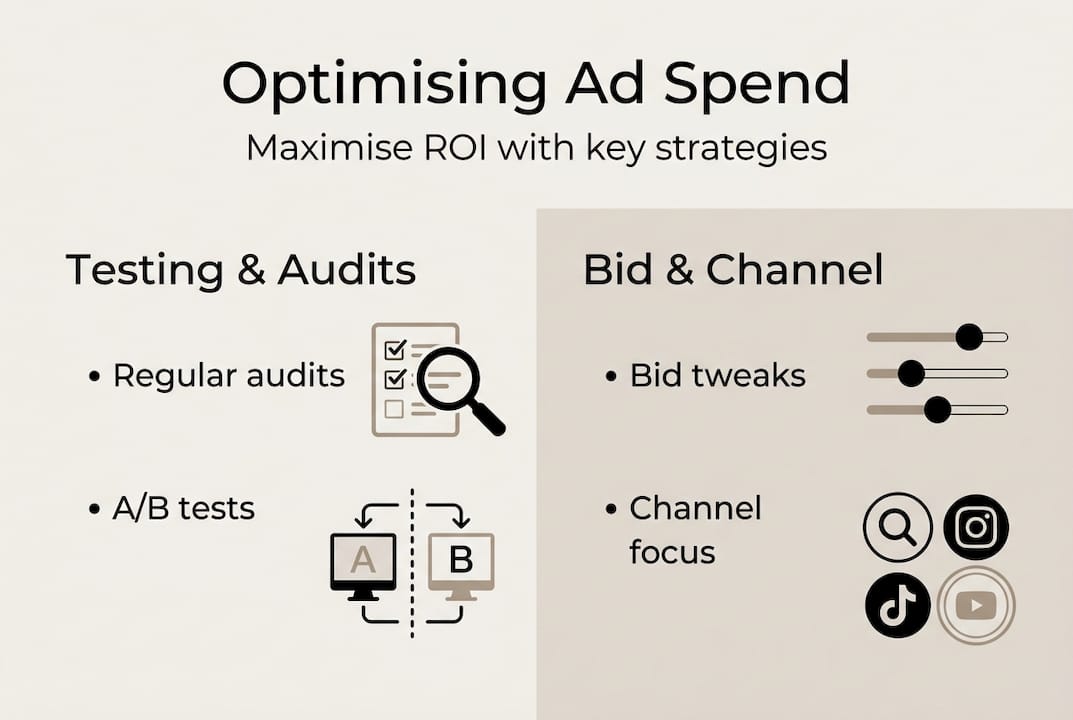
As budget optimisation involves ongoing testing, adjusting bids, and focusing on the most effective channels, consistency is what separates businesses that scale from those that plateau. Applying targeted advertising strategies aligned with your sector ensures your message reaches the right people at the right moment. Pairing this with solid conversion optimisation tips means the traffic you do pay for converts at its full potential.
Pro Tip: Schedule a structured campaign audit every four to six weeks. Even high-performing campaigns accumulate inefficiencies over time that regular reviews will surface.
Tools, metrics, and frameworks for measuring ad spend optimisation
All of the strategies above only generate value if you are measuring the right things. The right tools and metrics are what turn effort into evidence.
Essential metrics to track:
- CPA (cost per acquisition): How much you spend to generate one conversion, whether that is a sale, booking, or enquiry
- ROAS (return on ad spend): Revenue generated for every pound spent on ads
- CTR (click-through rate): The percentage of people who see your ad and click it, a signal of creative relevance
- Conversion rate: The percentage of clicks that result in the desired action on your website
As key metrics such as CPA, ROAS and CTR are essential for monitoring campaign efficiency, tracking these consistently allows you to spot problems early and act before budget is wasted.
Popular tools for ad spend optimisation:
| Tool | Key feature | Best for |
|---|---|---|
| Google Ads | Smart bidding, performance insights | Search and shopping campaigns |
| Meta Ads Manager | Audience targeting, creative reporting | Social and remarketing campaigns |
| Google Analytics 4 | Cross-channel attribution | Full funnel tracking |
| AI reporting platforms | Automated anomaly detection | Scaling accounts efficiently |
Quick-check framework for ongoing campaign review:
- Check CPA and ROAS weekly against your targets
- Review CTR to identify creative fatigue
- Assess audience overlap monthly to prevent cannibalisation
- Confirm conversion tracking is firing correctly after any website changes
- Compare current performance against the same period in the previous month
“Businesses that review their campaigns regularly and act on the data consistently outperform those that rely on initial setup alone. Tracking is not optional; it is the foundation of long-term ROI.”
Staying current with top digital marketing trends ensures your measurement approach evolves as platforms change. For those ready to integrate smarter technology, understanding AI tool selection can significantly reduce the manual workload involved in ongoing campaign monitoring.
Why ‘optimisation’ is more mindset than maths
Here is the honest perspective that most guides will not give you: optimisation is not a destination. It is a way of operating.
The most common misbelief we see is that once a campaign is performing well, the work is done. Marketers stop testing, stop questioning, and start treating current results as the ceiling rather than the baseline. That is where growth stalls.
The businesses that consistently outperform their competitors are not the ones with the biggest budgets or the most sophisticated tools. They are the ones with a genuine culture of curiosity. They test when things are going well. They dig into failures without embarrassment. They treat every campaign as a source of learning, not just a source of revenue.
Quick wins from optimisation are real and worth pursuing. But the compounding advantage comes from building a process where improvement is habitual. Marketers and business owners who embrace that approach do not just optimise their campaigns; they build an institutional advantage that is very difficult for competitors to replicate.
Supercharge your results with expert optimisation
Understanding ad spend optimisation intellectually is a strong start. Executing it consistently, at scale, across multiple channels and sectors is where most teams hit their limits.

At NU Life Digital, we work with e-commerce brands and assisted living operators to build paid advertising systems that actually perform. From structuring campaigns for scalable growth to implementing the tracking that makes real decisions possible, our approach is grounded in measurable outcomes. Explore our paid advertising strategies to see how we drive ROI across sectors, or discover our tailored eCommerce solutions built for brands ready to scale. For businesses wanting to integrate AI into their ad management, our guidance on optimising with AI tools will show you exactly where automation adds the most value.
Frequently asked questions
What is ad spend optimisation in simple terms?
Ad spend optimisation means getting the most return for every pound you spend on digital ads, using data to improve targeting, creative, and budgets continuously.
Which metrics best measure ad spend optimisation?
CPA, ROAS, CTR, and conversion rate are the most reliable indicators of optimisation success, as key metrics for optimisation directly reflect campaign efficiency and revenue impact.
How often should I optimise my ad spend?
You should review and adjust your ad spend at least monthly. For active or high-budget campaigns, weekly reviews are recommended, since regular review is vital for sustaining long-term optimisation results.
Can small businesses benefit from ad spend optimisation?
Absolutely. Even on modest budgets, optimising for the right audience and tracking conversions properly means your spend goes further. Ad spend optimisation is effective for businesses at every size and stage.