
TL;DR:
- A digital strategy is a structured plan that aligns technology and marketing to achieve specific business goals. Companies with digital strategies grow faster and achieve higher profitability than those operating reactively. Sector-specific tactics and continuous measurement are essential for maximizing digital growth.
Most business owners assume that having a website, posting on social media, and running the occasional ad campaign counts as a digital strategy. It does not. There is a significant difference between having a digital presence and operating with a structured, evidence-based digital strategy. Companies with digital strategies grow revenue 2.3x faster than those without one, achieving 40% faster scaling and 35% higher profitability. If you are running an assisted living facility or an e-commerce brand and you want to scale sustainably, this article will show you exactly how to build and apply a digital strategy that produces real, measurable results.
Table of Contents
- What is digital strategy and why does it matter?
- The digital strategy framework: core pillars for scaling and revenue growth
- Beyond the basics: advanced tactics for the assisted living and e-commerce sectors
- From strategy to results: measuring and iterating for maximum impact
- Why the best digital strategies break the rules
- Advance your digital strategy with expert help
- Frequently asked questions
Key Takeaways
| Point | Details |
|---|---|
| Digital strategy definition | A digital strategy unifies technology, data, and processes to drive repeatable business growth. |
| Key components | Core pillars include customer insight, tech stack, revenue models, and process automation. |
| Evidence-based results | Strategy-led companies scale faster and boast 35% higher profits than peers. |
| Sector applications | Tailor tactics for your industry, such as automation for e-commerce and outreach in assisted living. |
| Continuous improvement | Ongoing measurement and refinement ensure your strategy delivers maximum impact. |
What is digital strategy and why does it matter?
Let’s be direct. A digital strategy is not a content calendar or a list of platforms you post on. It is a structured plan that integrates digital technologies, data, and capabilities to achieve specific business objectives. Think of it as the architecture behind every marketing, technology, and operational decision you make online.
Without this architecture, most businesses operate reactively. They run ads when they feel like it, redesign their website when it looks dated, and adopt new tools based on what a competitor is doing. That approach wastes budget and produces inconsistent results.
“A digital strategy turns scattered online activity into a coordinated system where every channel, tool, and decision serves the same commercial goal.”
The essential components of a working digital strategy include:
- Customer insights: Deep understanding of who your audience is, what they need, and how they make decisions
- Technology stack: The platforms, tools, and systems that power your operations and customer experience
- Revenue model adaptation: Aligning your pricing, offers, and funnels to digital buyer behaviour
- Automation and AI: Reducing manual workload while improving speed and consistency across customer touchpoints
Consider a practical example. An assisted living facility with no strategy might spend money on Google ads that send traffic to a generic homepage. A facility with a proper digital strategy sends that same traffic to a purpose-built landing page, triggers an automated follow-up sequence, and tracks which enquiries convert to tours. The spend is identical. The results are not.
Understanding why strategy drives growth is the first step. The second is knowing what that strategy actually looks like in practice.
| Ad hoc digital activity | Structured digital strategy |
|---|---|
| Reactive campaigns | Planned, goal-driven campaigns |
| Disconnected tools | Integrated technology stack |
| Vanity metrics | Revenue-linked KPIs |
| Inconsistent results | Predictable, scalable growth |
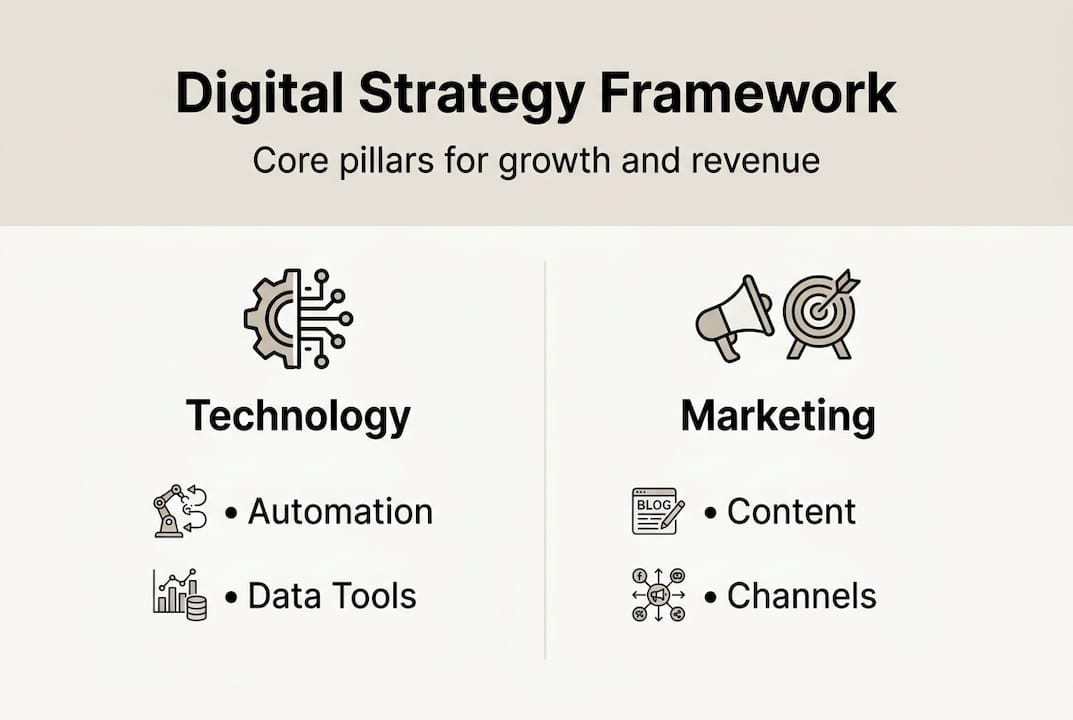
The digital strategy framework: core pillars for scaling and revenue growth
A framework gives your strategy structure. Without it, even the best ideas stay disconnected. The core pillars of an effective digital strategy each serve a distinct purpose, and together they form a growth system rather than a collection of tactics.
Companies with digital strategy scale 40% faster and achieve 35% higher profitability compared to those without. That gap exists because strategy-led businesses build systems, not just campaigns.

| Pillar | Function | Business outcome |
|---|---|---|
| Customer insight | Audience research and segmentation | Higher conversion rates |
| Technology stack | CRM, automation, analytics tools | Operational efficiency |
| Content and SEO | Authority building and organic traffic | Reduced paid ad dependency |
| Paid acquisition | Targeted traffic generation | Faster revenue growth |
| AI and automation | Lead handling and customer journeys | Scalability without extra headcount |
Here is how to identify and implement each pillar for your business:
- Audit your current digital activity. List every channel, tool, and campaign you are currently running and identify what is producing revenue versus what is simply consuming budget.
- Define your primary business objective. Occupancy targets for assisted living, monthly revenue goals for e-commerce. Your strategy must serve a specific number.
- Map your customer journey. From first awareness to conversion and retention, identify where prospects drop off and where the biggest opportunities exist.
- Select and integrate your technology stack. Choose tools that talk to each other. A CRM that connects to your ad platform and your website creates a feedback loop that improves performance over time.
- Build automation into the process. Every repetitive touchpoint, from follow-up emails to lead scoring, should be automated so your team focuses on high-value work.
Pro Tip: Assign a revenue metric to each pillar before you build it. If you cannot explain how a pillar contributes to income, it is not ready to be part of your strategy. This single habit separates businesses that scale from those that stay busy.
Building a clear digital strategy workflow and connecting it to scalable marketing frameworks is where most businesses find their biggest performance gains.
Beyond the basics: advanced tactics for the assisted living and e-commerce sectors
Foundational frameworks apply broadly, but the tactics that drive results are always sector-specific. Digital strategies must be sector-tailored to unlock rapid growth and operational efficiency. Generic approaches produce generic results.
For assisted living and senior care businesses:
- Implement AI-powered admissions workflows that automatically follow up with enquiries within minutes, not days. Speed of response is one of the strongest predictors of conversion in this sector.
- Use geo-targeted paid campaigns that speak directly to adult children researching care options, not just the seniors themselves. The decision-maker and the end user are often different people.
- Integrate a secure CRM that tracks every enquiry, tour booking, and admission stage so your team always knows where a family is in the decision process.
- Build trust through content. Case studies, staff profiles, and virtual tour videos reduce the anxiety families feel and shorten the sales cycle significantly.
- Explore care home marketing strategies that are built specifically around occupancy growth.
For e-commerce brands:
- Use AI-driven product recommendation engines to increase average order value. Businesses that personalise the shopping experience see measurable lifts in both conversion rate and basket size.
- Automate abandoned cart sequences with dynamic content that reflects the specific products a user viewed, not a generic reminder.
- Build post-purchase flows that drive repeat buying. Acquiring a new customer costs five times more than retaining an existing one.
- Test pricing architecture. Subscription models, bundles, and tiered offers often outperform single-product listings at scale.
Statistic to note: E-commerce businesses that implement AI-driven personalisation report conversion rate improvements of up to 30%.
Pro Tip: In both sectors, the biggest mistake is treating automation as a cost-cutting tool rather than a growth tool. The goal is not to replace human interaction. It is to make sure no lead goes cold and no customer feels ignored. Use automation to create speed and consistency, then let your team handle the conversations that matter most.
If you want to optimise e-commerce strategies for higher conversions, the starting point is always the customer journey, not the ad spend.
From strategy to results: measuring and iterating for maximum impact
Building a strategy is only half the work. The businesses that scale fastest are the ones that measure relentlessly and adjust quickly. Measurement and ongoing iteration is essential to realising full digital strategy value.
Here is how to build a measurement system that actually informs decisions:
- Define your KPIs before you launch. Cost per lead, enquiry-to-admission rate, revenue per visitor, customer lifetime value. Choose metrics that connect directly to business outcomes, not platform vanity metrics.
- Set a review cadence. Weekly for paid campaigns, monthly for SEO and content, quarterly for overall strategy performance. Consistency matters more than frequency.
- Use attribution modelling. Understand which channels and touchpoints are actually driving conversions. Last-click attribution alone will mislead you.
- Create a testing culture. Run structured A/B tests on landing pages, ad copy, and email sequences. Small improvements compound significantly over time.
- Act on the data. Sounds obvious, but many businesses collect data and never change their behaviour based on it. Schedule a monthly strategy review where decisions are made, not just discussed.
Common measurement mistakes that hold businesses back:
- Tracking impressions and clicks instead of revenue and leads
- Measuring too infrequently to catch problems before they become expensive
- Ignoring qualitative data such as customer feedback and sales team observations
- Failing to connect marketing data to operational outcomes
Staying current with the latest digital trends also matters. The tools and channels that worked in 2024 are not automatically the best choices in 2026. Your measurement system should flag when performance shifts so you can investigate and adapt.
Why the best digital strategies break the rules
Here is something most strategy guides will not tell you. The businesses that achieve the most significant growth are rarely the ones that follow a framework perfectly. They are the ones that use frameworks as a starting point and then adapt aggressively based on what their data and customers are actually telling them.
Rigid adherence to templates creates a false sense of security. You can tick every box in a digital strategy checklist and still produce mediocre results because the framework was built for a generic business, not yours.
The contrarian truth is that data, creativity, and genuine customer listening consistently outperform formulas. We have seen assisted living facilities triple their enquiry volume not by copying what competitors do, but by talking to families who chose them and building their entire strategy around those insights.
The same applies to e-commerce. The brands scaling past £100k per month are not following a playbook. They are testing relentlessly, listening to their buyers, and making decisions that feel uncomfortable but are backed by evidence. Understanding how digital agencies transform online presence often comes down to this willingness to challenge assumptions and act on real signals rather than industry templates.
Advance your digital strategy with expert help
If this article has clarified what a real digital strategy looks like, the next question is whether you have the systems in place to execute one. Most businesses we work with do not lack ambition. They lack the infrastructure.

At NU Life Digital, we build that infrastructure. From website design specialists who engineer sites to convert, to AI automation services that handle lead nurturing without adding headcount, every solution we offer is built around one goal: measurable revenue growth. If you are ready to move from scattered activity to a structured growth engine, our digital strategy consulting is the place to start. Let’s build something that scales.
Frequently asked questions
What exactly does a digital strategy include?
A digital strategy includes customer insights, technology choices, revenue model adaptations, and process automation, all structured to achieve clear business objectives rather than simply maintaining an online presence.
How does digital strategy improve profitability?
By aligning technology and marketing around specific business goals, strategy-led firms achieve 35% higher profitability and scale 40% faster than businesses operating without a structured approach.
Is digital strategy different for e-commerce and assisted living?
Yes, each sector requires tailored approaches. Sector-tailored strategies unlock rapid growth, such as AI automation for e-commerce conversion and personalised outreach workflows for assisted living admissions.
How do you know if your digital strategy works?
Tracking revenue-linked KPIs and iterating based on real data ensures your strategy delivers. Ongoing measurement and iteration is what separates strategies that compound over time from those that plateau.
Recommended
- Proven ways to boost online sales for ambitious e-commerce brands – Nu Life Digital
- Top strategies to optimise e-commerce brands for higher conversions – Nu Life Digital
- Scalable marketing: achieve sustainable growth in 2026 – Nu Life Digital
- SEO strategies every business should adopt – Nu Life Digital
- Scaling a Personal Injury Law Firm: Marketing Strategies