
TL;DR:
- Integrating AI into marketing significantly boosts conversion rates and ROI, becoming a business baseline.
- Success relies on proper data management, organizational culture shift, and strategic planning.
- Starting with focused pilots on high-impact use cases enables measurable early wins and sustainable scaling.
Most business owners assume AI is something to explore later, once the fundamentals are sorted. That assumption is costing them revenue right now. Businesses that combine AI with their marketing strategy are seeing 3x higher conversion rates compared to those relying on traditional methods alone. This article walks you through the concrete case for integration, the practical frameworks that make it work, the challenges you will face, and the best practices that separate businesses that scale from those that stall. Whether you run an e-commerce brand or an assisted living facility, this is the clearest guide you will find on turning AI from a buzzword into a genuine growth engine.
Table of Contents
- The business case for integrating marketing and AI
- How integrated marketing and AI frameworks actually work
- Key challenges and solutions when integrating AI with marketing
- Best practices: Applying integrated marketing and AI in real scenarios
- Our perspective: Why successful integration starts with mindset, not just tools
- Unlock growth by integrating marketing and AI with expert support
- Frequently asked questions
Key Takeaways
| Point | Details |
|---|---|
| Integration drives ROI | Combining marketing and AI delivers up to 3.2 times the return on investment compared to siloed approaches. |
| Frameworks enable success | A clear step-by-step integration plan minimises risk and speeds up measurable results for any business. |
| Overcome common pitfalls | Success hinges on strong data, collaborative teams, and proactive governance to avoid the most frequent failures. |
| Pilots deliver momentum | High-impact pilot projects in content, emails, or lead scoring show rapid wins and build internal support. |
| Mindset matters | Cultural readiness and upskilling teams are just as crucial as the right tools for ongoing success. |
The business case for integrating marketing and AI
The numbers are difficult to ignore. Brands that have woven AI into their marketing operations are not just saving time — they are generating significantly more revenue from the same budget. The evidence points to one clear conclusion: integration is not a competitive advantage any more. It is quickly becoming the baseline.
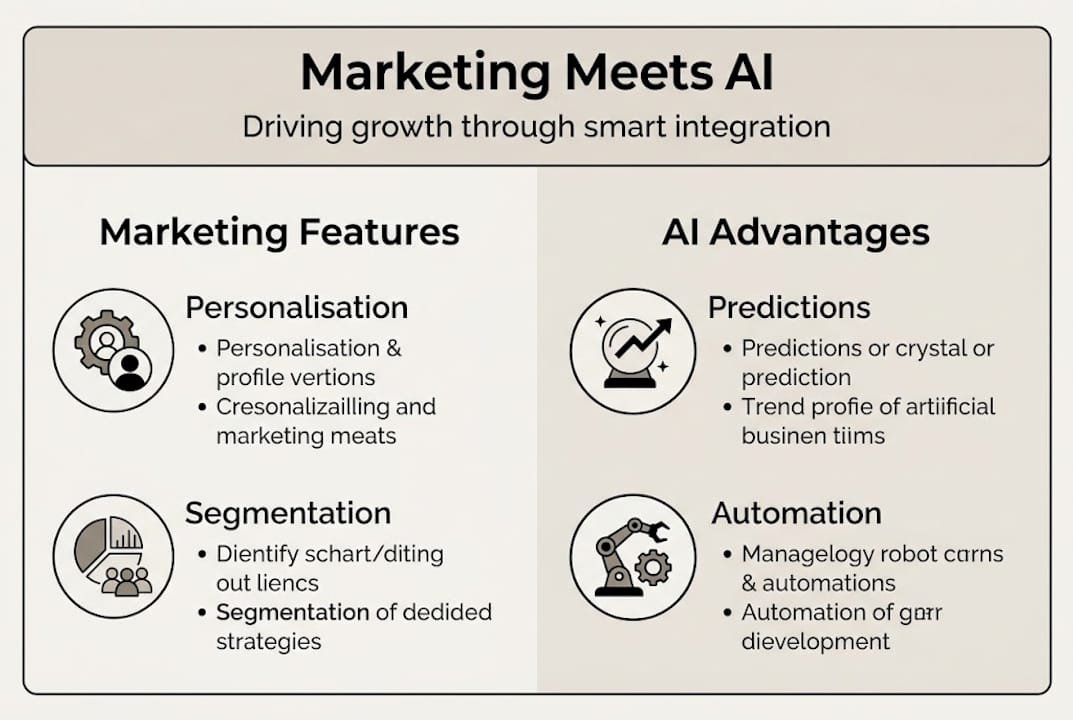
Consider what happens when AI handles personalisation at scale. Instead of sending the same email to your entire list, AI segments your audience based on behaviour, purchase history, and intent signals, then tailors the message accordingly. The result is higher open rates, more clicks, and more conversions. For e-commerce brands, this alone can transform a modest campaign into a consistent revenue driver.
For assisted living operators, the impact is equally significant. AI can score incoming enquiries based on likelihood to convert, flag high-priority leads for immediate follow-up, and automate nurture sequences that keep families engaged throughout a lengthy decision process. Occupancy rates improve not because you are spending more, but because you are spending smarter.
The 2026 marketing trends confirm that predictive analytics and AI-driven personalisation are now the dominant forces shaping campaign performance across sectors. Brands like L’Oréal have demonstrated this at scale, achieving 3x conversion rates and a 4.1x ROI on AI-assisted content generation. These are not outliers. They are the new benchmark.
Here is a snapshot of what integrated marketing and AI delivers across key performance areas:
| Performance area | Traditional marketing | AI-integrated marketing |
|---|---|---|
| Personalisation | Segment-based, manual | Individual-level, automated |
| Lead scoring | Manual or basic rules | Predictive, behaviour-driven |
| Campaign optimisation | Post-campaign review | Real-time, continuous |
| Content output | Time-intensive | Scaled with AI assistance |
| ROI | Variable | Up to 3.2x average |
Understanding the importance of marketing strategy is the foundation here. AI amplifies a good strategy. Without one, it simply amplifies confusion.
“AI does not replace strategy. It accelerates it. Businesses that integrate both are building compounding advantages that widen every quarter.”
Key benefits you can expect from integration:
- Higher conversion rates through real-time personalisation
- Reduced cost per acquisition via smarter audience targeting
- Faster campaign iteration using AI-generated insights
- Improved lead quality and follow-up speed in assisted living admissions
- Scalable content production without proportional headcount growth
How integrated marketing and AI frameworks actually work
Knowing that integration works is one thing. Understanding how to build it is another. The good news is that there is a proven structure you can follow, regardless of your sector or current tech stack.
A six-step integration framework has emerged as the industry standard: audit your current data and tools, set clear KPIs, build a unified data layer, select the right AI tools, run a focused pilot, and iterate based on results. Each step is deliberate. Skipping ahead leads to the kind of expensive failures we see regularly.
Here is how the two most common approaches compare:
| Approach | Description | Best suited for |
|---|---|---|
| Full-stack integration | All marketing channels connected via unified AI platform | Larger e-commerce brands |
| Phased pilot model | Start with one high-impact use case, then expand | Assisted living, SMEs |
For most businesses reading this, the phased pilot model is the right starting point. Pick one area where AI can deliver a quick, measurable win. For e-commerce, that might be AI-powered product recommendations or abandoned cart sequences. For assisted living, it could be automated lead scoring combined with AI chatbot enquiry handling.
Here is a practical implementation roadmap:
- Audit your existing data sources and identify gaps
- Define two or three KPIs that directly tie to revenue or occupancy
- Choose a single martech tool that addresses your highest-priority use case
- Run a 90-day pilot with a defined test group
- Measure results against your KPIs and document learnings
- Scale what works and retire what does not
Pro Tip: Budget allocation matters here. Most businesses underinvest in data infrastructure and overinvest in tools. A rough guide is 40% on data and integration, 40% on the AI tool itself, and 20% on training and change management.
For those ready to go further, using AI for predictive campaigns is one of the highest-leverage moves available in 2026, particularly for businesses with established customer data.
Key challenges and solutions when integrating AI with marketing
Here is the uncomfortable reality: 60% of AI marketing integrations fail, and poor preparation is the primary reason. Understanding why integrations stall is just as important as knowing how to build them.
The most common obstacles fall into three categories:
- Data silos: Marketing, sales, and operations teams often hold data in separate systems that do not communicate. AI cannot function well on fragmented data.
- Organisational resistance: Teams that fear redundancy or do not understand AI’s role tend to undermine adoption, consciously or not.
- Ethical and compliance risks: In sectors like assisted living, handling personal and sensitive data requires strict governance frameworks before any AI tool touches it.
“The organisations that succeed with AI integration are not those with the biggest budgets. They are the ones that solve their data problems first.”
Solving the data silo problem starts with AI data management practices that unify your sources into a single, accessible layer. This is not glamorous work, but it is foundational.
For organisational readiness, the answer is not a training day. It is a sustained culture shift. Building AI-ready teams means redefining roles so that people understand how AI supports their work rather than replaces it. Marketing managers become strategists and editors. Admissions coordinators focus on high-value conversations while AI handles routine follow-ups.

Pro Tip: Before selecting any AI tool, run a readiness audit across three dimensions: data quality, team capability, and process clarity. If any of the three score poorly, fix them before investing in technology.
Human oversight also remains non-negotiable. CMOs are right to be cautious about handing full autonomy to AI systems. Brand voice, ethical judgement, and relationship nuance are areas where human input still determines the outcome.
Best practices: Applying integrated marketing and AI in real scenarios
Theory is useful. Practical application is where growth actually happens. Here is how to move from planning to execution in your specific context.
For e-commerce brands, the highest-impact starting points are:
- Implement AI-driven product recommendations on category and product pages
- Deploy automated abandoned cart sequences with personalised messaging
- Use AI content generation tools to scale blog and ad copy output
- Set up predictive audience segments for paid advertising campaigns
- Monitor real-time performance dashboards and adjust bids automatically
For assisted living operators, the priority sequence looks different:
- Integrate an AI chatbot on your website to handle initial enquiries 24/7
- Set up lead scoring to prioritise families most likely to convert
- Automate follow-up email sequences tailored to where families are in the decision process
- Use AI to analyse which marketing channels produce the highest-quality enquiries
- Regularly review AI outputs with your admissions team to refine scoring models
Starting with high-impact pilots such as content generation in e-commerce and lead scoring in assisted living consistently delivers early wins while keeping risk low. The key is maintaining brand oversight throughout.
Pro Tip: Assign a human reviewer to audit AI-generated content and automated communications monthly. This keeps your brand voice consistent and catches errors before they reach customers or families.
Common mistakes to avoid:
- Automating too much too fast before validating outputs
- Ignoring the quality of data feeding your AI tools
- Failing to communicate AI’s role to your internal team
- Treating AI as a cost-cutting tool rather than a growth lever
Understanding how AI automation fits in to your broader marketing system is essential before committing to any specific tool. The wrong tool, well implemented, still produces poor results. When choosing AI tools, always start with the problem you are solving, not the technology itself.
Our perspective: Why successful integration starts with mindset, not just tools
Most guides on AI and marketing focus on tools, frameworks, and tactics. Very few address the real reason integrations succeed or fail: the mindset of the people leading them.
We have worked with businesses that had access to excellent AI tools and still saw poor results. The common thread was not the technology. It was leadership teams that treated AI as a project to complete rather than a capability to build. They implemented a tool, declared it done, and moved on. Six months later, nothing had changed.
The businesses that genuinely scale with AI are the ones that reorganise around it. They redefine what their marketing team does. They invest in data quality as a strategic priority. They accept that AI amplifies whatever strategy and data you feed it, which means poor inputs produce amplified failures, not just minor ones.
The shift required is from “we are implementing AI” to “we are becoming an AI-enabled organisation.” That distinction sounds subtle, but it changes every decision that follows. Explore the AI technology foundations that support this kind of structural thinking.
Unlock growth by integrating marketing and AI with expert support
If this article has shown you anything, it is that the gap between knowing and doing is where most businesses get stuck. The frameworks exist. The tools are available. What separates the businesses that scale from those that stay flat is having the right partner to build the system properly.

At NU Life Digital, we specialise in helping e-commerce brands and assisted living operators build exactly this. From AI integration and automation to full marketing strategy, we design systems that generate real, measurable growth. Our team of specialists in AI technologies works alongside your business to implement what actually moves the needle. If you are ready to scale, explore our e-commerce AI strategies or get in touch to discuss a tailored integration roadmap for your business.
Frequently asked questions
What is the most important benefit of integrating AI and marketing?
The biggest benefit is significantly higher ROI through personalisation, predictive analytics, and smarter campaigns. Businesses using integrated AI marketing report 3.2x higher ROI and triple the conversion rates of those using traditional methods alone.
What are common mistakes when integrating marketing and AI?
The most frequent errors are poor data quality, unclear KPIs, and insufficient internal preparation before deployment. Research shows 60% of failures stem directly from inadequate readiness rather than the technology itself.
How long does it take to see results from AI marketing integration?
Focused pilots typically deliver measurable wins within three to six months, but the full compounding benefits of integration mature over 12 months or more. A structured integration roadmap ensures early results while building towards long-term scale.
Is full automation recommended for marketing teams?
No. A balanced approach that blends AI automation with human oversight consistently outperforms full automation. The “agentic with a small a” model keeps humans in control of brand-critical and relationship-sensitive decisions.
What first steps should I take to combine marketing and AI?
Start with a thorough audit of your data and existing technology, then identify one high-impact area for a focused pilot project. The proven six-step framework prioritises audit and pilot phases before any attempt to scale.