
TL;DR:
- Conversion optimization focuses on increasing the percentage of website visitors taking desired actions. It involves enhancing page speed, trust signals, and user experience to boost revenue without extra marketing costs. Continuous testing and measuring key metrics ensure sustained growth and genuine customer trust.
Most businesses pour their budget into driving more traffic, convinced that more visitors automatically means more revenue. It rarely works that way. The average e-commerce site converts at just 2 to 3 percent, which means 97 percent of hard-won visitors leave without buying. For assisted living facilities, the gap between enquiry and occupancy can be equally painful. Conversion optimisation changes the equation entirely. Rather than spending more to attract visitors, you extract far greater value from the audience you already have. This guide explains what conversion optimisation actually is, what makes a website genuinely effective at converting, and which strategies deliver measurable revenue growth for both e-commerce brands and assisted living providers.
Table of Contents
- What is conversion optimisation?
- The key elements of a high-converting website
- Top strategies for improving conversion rates
- Measuring and tracking conversion optimisation success
- Why obsessing over conversion rates is not enough
- How Nu Life Digital can help you accelerate growth
- Frequently asked questions
Key Takeaways
| Point | Details |
|---|---|
| Focus on existing visitors | Optimising your conversion rate often produces faster revenue growth than simply increasing your website traffic. |
| Essential site elements | Fast-loading pages, clear calls-to-action, and trust signals have the biggest impact on conversions. |
| Continuous improvement wins | Consistently measure and experiment with changes to maintain and grow your conversion performance. |
| Human touch matters | Optimisation should enhance—not replace—authentic customer relationships, especially in high-trust sectors. |
What is conversion optimisation?
A conversion is any action a visitor takes that moves them closer to becoming a customer. For an e-commerce business, that might be a purchase, an add-to-basket event, or a newsletter sign-up. For an assisted living facility, it could be a care enquiry form submission, a brochure download, or a tour booking. Every business has a different definition of what a successful conversion looks like, and that definition shapes everything.
Conversion rate optimisation is the process of increasing the percentage of website visitors who take a desired action. It is not about redesigning your site for aesthetic reasons or chasing trends. It is a disciplined, evidence-based practice of identifying what stops visitors from converting and systematically removing those barriers.
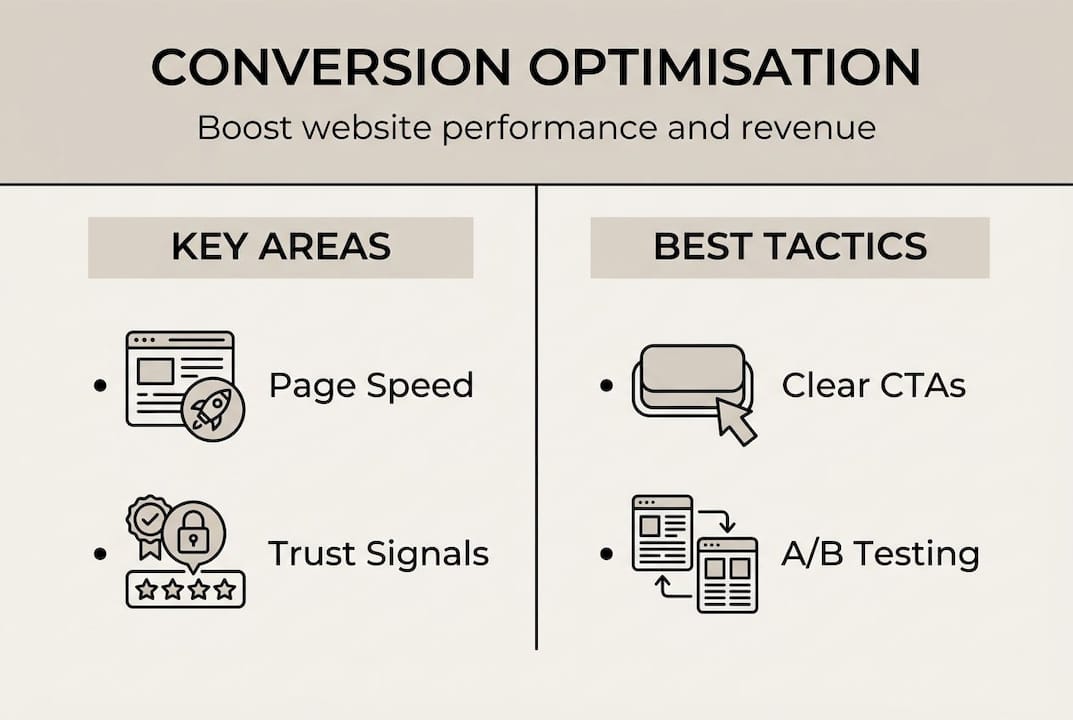
The business case is compelling. Rather than spending more on paid advertising to attract new visitors, conversion optimisation makes your existing traffic work harder. That means lower cost per acquisition, higher return on ad spend, and scalable revenue growth without proportionally scaling your marketing budget. You can read more about how website conversion drives growth and why it should be central to your strategy.
Here are the most common conversions relevant to each sector:
- E-commerce: completed purchases, add-to-basket clicks, email sign-ups, product page engagement, and upsell acceptances
- Assisted living: care enquiry form completions, virtual tour bookings, brochure requests, phone call initiations, and live chat interactions
Pro Tip: Before running any optimisation tests, define your primary conversion goal clearly. Trying to optimise for everything at once dilutes your focus and makes it nearly impossible to attribute results accurately.
The beauty of conversion optimisation is that even small gains compound quickly. Improving your conversion rate from 2 percent to 3 percent is a 50 percent increase in revenue from the same traffic. For a business turning over £500,000 per year online, that is an additional £250,000 without spending a penny more on acquisition.
The key elements of a high-converting website
Now that you understand the concept, let’s explore what makes a website truly effective at converting visitors. The answer is not a single magic feature. It is a combination of elements working together to reduce friction, build trust, and guide visitors towards action.
Page speed, clear calls-to-action, and trust signals are the most influential factors on conversion rates. A site that loads slowly, buries its contact form, or fails to reassure visitors will haemorrhage potential customers regardless of how much you spend on advertising.

Here is how poor-performing and high-converting sites compare across the key elements:
| Element | Poor-converting site | High-converting site |
|---|---|---|
| Page speed | Loads in 4 or more seconds | Loads in under 2 seconds |
| Calls-to-action | Vague or hidden | Clear, prominent, and benefit-led |
| Social proof | Absent or generic | Specific reviews and case studies |
| Navigation | Complex and cluttered | Simple and goal-oriented |
| Mobile experience | Desktop-first design | Fully optimised for mobile |
| Trust indicators | Missing or weak | Accreditations, guarantees, photos |
“The businesses that win online are not always those with the most traffic. They are the ones that have engineered every page to move visitors towards a clear, confident next step.”
For e-commerce brands, the highest-impact areas are product pages and the checkout flow. Unclear product descriptions, poor imagery, hidden delivery costs, and a complicated checkout are the most common conversion killers. Reviewing your web design best practices and applying them rigorously to product and checkout pages can yield significant gains quickly.
For assisted living facilities, trust indicators carry enormous weight. Families researching care for a loved one are making one of the most emotionally significant decisions of their lives. Staff photos, CQC ratings, resident testimonials, and transparent pricing all reduce anxiety and increase the likelihood of an enquiry. Your landing page optimisation approach should reflect this emotional context at every stage.
Mobile optimisation is non-negotiable across both sectors. More than half of all web traffic now arrives via mobile devices, and a site that is difficult to navigate on a phone will lose those visitors almost immediately.
Top strategies for improving conversion rates
With these fundamentals set, let’s dive into specific actions you can take to start seeing measurable results. Strategy without execution is just theory, so each of the following approaches is designed to be actionable from day one.
Businesses adopting data-driven CRO strategies see up to 50% higher revenue per visitor. That figure alone should make conversion optimisation a boardroom priority.
- Run A/B tests on your highest-traffic pages. Test one variable at a time: a headline, a button colour, a form layout, or an image. Small changes to high-traffic pages can produce measurable results within days.
- Use analytics to find your drop-off points. Where are visitors leaving your site? A sharp exit rate on a product page or enquiry form signals a specific problem that needs solving.
- Simplify your user journey. Every unnecessary click or form field is a potential exit. Reduce the number of steps between interest and action. For assisted living, a single prominent enquiry form often outperforms a multi-page contact process.
- Apply behavioural triggers. Urgency (limited availability), social proof (“47 families enquired this week”), and reciprocity (a free guide or checklist) all nudge visitors towards converting.
- Address cart abandonment directly. For e-commerce, automated email sequences targeting abandoned baskets can recover 10 to 15 percent of lost sales. This is one of the fastest wins available.
Pro Tip: Do not guess which pages need attention. Use heatmapping tools to see exactly where visitors click, scroll, and abandon. The data will often surprise you.
You can explore more conversion optimisation tips and conversion workflow techniques to build a structured approach that delivers consistent gains over time.
Measuring and tracking conversion optimisation success
Of course, effective optimisation is only possible if you actively monitor your progress. Without measurement, you are making changes in the dark and hoping for the best.
The core metrics every business should track are:
- Conversion rate: the percentage of visitors completing your target action
- Bounce rate: the percentage of visitors who leave after viewing only one page
- Average order value: particularly important for e-commerce growth
- Time on page: a signal of content relevance and engagement
- Cost per conversion: how much you spend to generate each lead or sale
Continuous measurement and rapid iteration are crucial for sustained CRO success. A single round of testing is not enough. The businesses that see the greatest long-term gains treat optimisation as an ongoing discipline rather than a one-off project.
Here is a quick reference for key metrics and their business impact:
| Metric | What it tells you | Business impact |
|---|---|---|
| Conversion rate | How effectively your site converts | Direct revenue indicator |
| Bounce rate | Whether visitors find what they expect | Signals relevance and UX issues |
| Average order value | How much each customer spends | Affects total revenue per visitor |
| Time on page | Engagement with your content | Indicates content quality and fit |
| Cost per conversion | Efficiency of your ad spend | Shapes budget allocation decisions |
Google Analytics 4 and Hotjar are the two most widely used tools for tracking these metrics. Google Analytics 4 provides session-level data, goal tracking, and funnel visualisation. Hotjar adds qualitative insight through heatmaps, session recordings, and on-site surveys. Together, they give you a complete picture of what is happening and why. Understanding how content drives conversion rates is also a valuable layer to add to your measurement strategy.
Set a baseline before making any changes. Without a benchmark, you cannot know whether your optimisation efforts are working.
Why obsessing over conversion rates is not enough
This brings us to a crucial caveat that many businesses miss. Conversion rate is a number, and like all numbers, it can be gamed. You can increase short-term conversions by creating false urgency, hiding cancellation options, or making it deliberately difficult to leave a page. These tactics might lift your rate temporarily, but they erode trust and damage long-term customer relationships.
In e-commerce, a customer who feels pressured into a purchase they regret becomes a return, a negative review, or a chargeback. In assisted living, a family who felt misled during the enquiry process will not only leave but will warn others. The stakes are high in both sectors, and authenticity is not optional.
The businesses that sustain strong conversion performance over time are those that balance optimisation with genuine customer experience. They test and iterate, yes, but they also invest in the quality of their interactions, the clarity of their communication, and the trust they build at every touchpoint. Understanding how web design drives conversion for assisted living illustrates this balance well. A high conversion rate built on trust is an asset. One built on manipulation is a liability waiting to surface.
How Nu Life Digital can help you accelerate growth
If you’re ready to accelerate your own conversion performance, here’s how you can get support.

At NU Life Digital, we specialise in building the systems that turn website visitors into paying customers and genuine enquiries. Whether you need expert web design engineered around conversion, a full e-commerce optimisation strategy to scale your revenue, or a sector-specific approach for your assisted living facility, we bring the expertise and execution to make it happen. Our work is always tied to measurable outcomes, not vanity metrics. Explore our revenue-boosting tips or get in touch to discuss what a tailored conversion strategy could deliver for your business.
Frequently asked questions
What’s the difference between conversion optimisation and increasing traffic?
Conversion optimisation delivers higher ROI than focusing only on traffic because it extracts more value from visitors already on your site, while increasing traffic simply brings more people to the same experience.
How quickly can conversion optimisation deliver results?
Some improvements can generate measurable gains within weeks, but sustained growth depends on continuous testing and iteration. Rapid A/B testing cycles are core to achieving swift early wins.
Which conversion metrics should I track?
Key metrics include conversion rate, bounce rate, average order value, and time on site. Regular measurement of quantifiable goals is what separates businesses that improve consistently from those that plateau.
Is conversion optimisation relevant for assisted living facilities?
Absolutely. It can increase care enquiries and bookings by improving user journeys and building trust online. Sector-specific CRO tactics lead to meaningfully higher engagement for care providers who invest in them properly.