
TL;DR:
- Marketing automation enhances customer experiences by automating routine marketing tasks across multiple channels to drive growth. It relies on triggers, conditions, actions, and timing to create personalized workflows that improve lead nurturing, response times, and data insights. Success depends on clear customer journey mapping, clean data, and ongoing optimization over several months, aided by AI integration and strategic planning.
Marketing automation is more than just sending automated emails. Most business owners hear the term and picture a scheduled newsletter going out on a Tuesday morning. The reality is far more powerful. Marketing automation automates repetitive marketing tasks to deliver personalised customer experiences at scale, reacting to real behaviour across email, social media, paid channels, and your website simultaneously. For assisted living facilities trying to fill beds and e-commerce brands pushing towards £100k months, understanding this distinction is the difference between a tool that saves a few hours and one that genuinely drives growth.
Table of Contents
- What is marketing automation and how does it work?
- The benefits of marketing automation for assisted living and e-commerce businesses
- Designing effective marketing automation workflows
- Common challenges and expert tips for successful marketing automation
- Measuring and optimising marketing automation performance
- Rethinking marketing automation for your business
- How NU Life Digital can help you harness marketing automation
- Frequently asked questions
Key Takeaways
| Point | Details |
|---|---|
| Automation defined | Marketing automation uses software to automatically perform marketing actions triggered by customer behaviour. |
| Workflow design | Effective automation relies on well-structured workflows with clear triggers, actions and timing. |
| Business benefits | Automation saves time, nurtures leads, improves personalisation, and increases marketing ROI. |
| Continuous optimisation | Successful marketing automation requires ongoing analysis, testing and refinement. |
| Data quality importance | Clean and unified customer data ensures accurate triggers and prevents scaling errors. |
What is marketing automation and how does it work?
At its core, marketing automation is software that carries out routine marketing tasks without someone manually pressing a button each time. Think of it as a set of rules your marketing follows automatically, around the clock, based on what your customers actually do.
The mechanics are built on four components:
- Triggers: The event that starts a workflow. A prospect fills in a contact form on your assisted living website. A shopper abandons a cart on your Shopify store. A visitor views a pricing page three times in one week.
- Conditions: Logic that filters or branches the journey. Is this person a new enquiry or an existing family member? Have they opened the last two emails or gone quiet?
- Actions: What happens next. Send an email. Add them to a segment. Alert a sales rep. Update a record. Remove them from a cold outreach list.
- Timing: When the action fires. Immediately, after a two-day delay, or only between 9am and 5pm on weekdays.
Marketing automation follows a trigger to automated actions to outcomes pattern, reacting to customer behaviours like form submissions or email interactions. The result is a system that responds to each individual based on what they have done, not what you assume they want.
Here is a simple example sequence for an e-commerce brand:
- Customer browses a product category but does not purchase.
- Trigger fires after 30 minutes of inactivity.
- Condition checks: has this person bought before? If yes, send a loyalty discount. If no, send a “still thinking it over?” email with social proof.
- If email is opened, wait 24 hours, then send a follow-up with related products.
- If email is ignored for 72 hours, add to a re-engagement sequence.
Following a practical marketing automation checklist guide when setting this up ensures each step is mapped before you build, which saves considerable time and reduces errors. Pairing this with AI integration and automation can push these workflows even further by adding intelligent decision-making at key branch points.
The benefits of marketing automation for assisted living and e-commerce businesses
The numbers make the case plainly. Marketing automation drives a 14.5% increase in sales productivity and a 12.2% reduction in marketing overhead, with nurtured leads converting at higher rates and larger purchase sizes. For a lean team managing an assisted living facility or a product-based brand scaling up, those figures are not abstract. They represent hours reclaimed and revenue gained.
The specific advantages worth understanding are:
- Consistent lead nurturing without constant manual input. An adult child researching care options for a parent rarely converts on their first visit. Automation keeps your facility relevant across their weeks-long decision process without your team chasing each lead individually.
- Personalised messaging at volume. Rather than sending the same email to your entire list, automation lets you send the right message to the right person based on their behaviour, lifecycle stage, and interests.
- Faster response times. Speed to lead matters enormously in both sectors. Automated responses can acknowledge enquiries within seconds, which builds trust before a human even picks up the phone.
- Cleaner data and better decisions. Every interaction feeds back into your system, giving you accurate insight into what is working and what is not, without relying on guesswork.
“The businesses we see get the most from automation are not the ones with the most sophisticated tools. They are the ones who have taken the time to understand their customer journey first.”
Effective lead nurturing strategies underpin all of this. Automation without a clear nurture strategy is just noise. Understanding your marketing ROI before and after implementation gives you the evidence to keep refining.
Pro Tip: Before building a single workflow, map your customer journey on paper. Identify the three moments where leads most commonly go cold. Build your first automations to address exactly those moments, nothing else.

Designing effective marketing automation workflows
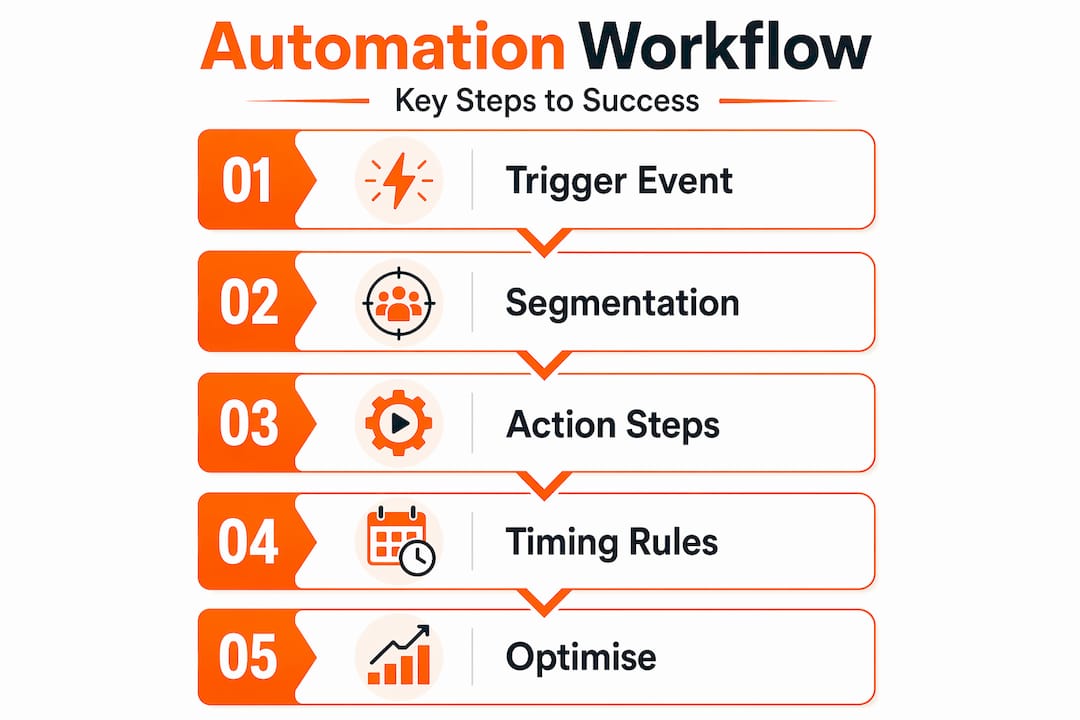
Knowing the benefits is one thing. Building workflows that actually deliver them is another. The four components mentioned earlier (triggers, conditions, actions, and timing) need to work together in a logical structure or your automation will misfire, send irrelevant content, or create customer experiences that feel clunky and robotic.
Workflows are triggered by specific customer actions, evaluate conditions such as buyer status, and execute responses like sending tailored emails or updating customer segments on a defined schedule. The key word here is specific. Vague triggers produce vague outcomes.
Consider the difference between a simple and a complex workflow:
| Feature | Simple workflow | Complex workflow |
|---|---|---|
| Trigger | Form submission | Cart abandonment + visit history |
| Conditions | None | Segment by purchase history |
| Actions | Single follow-up email | Multi-step, branched email sequence |
| Timing | Immediate | Staggered over 7 days |
| Goal | Acknowledge enquiry | Recover revenue and build loyalty |
A numbered process for building your first workflow:
- Define the single goal of the workflow before you build anything.
- Identify the trigger event and confirm your platform can capture it reliably.
- Map out the conditions that should branch the journey into different paths.
- Decide on actions for each branch and the timing between them.
- Test with a small segment before rolling out to your full audience.
- Document the workflow logic so anyone on your team can understand and edit it later.
Keep your segmentation logic, orchestration steps, and timing rules separate within your workflow builder. Mixing them together creates a tangled system that is almost impossible to debug when something goes wrong. Your digital marketing strategy workflow should treat automation design as a process, not a one-off task.
Pro Tip: Chain no more than five actions in a single workflow when starting out. Complexity creep is the fastest way to end up with a system nobody understands and nobody maintains.
Common challenges and expert tips for successful marketing automation
Most automation projects underperform not because the software is wrong but because the foundations are weak. Before you worry about which platform to use or whether to compare marketing automation software options, get these fundamentals right.
The most common problems are:
- Dirty data. If your contact records are incomplete or inaccurate, your triggers will misfire. Workflows send birthday emails to people with no birthday recorded. Segmentation puts B2B clients into B2C journeys. The errors scale at exactly the same rate as the good messages.
- Overcomplicated logic. A workflow that tries to do everything for everyone ends up serving no one well. Separate your use cases clearly.
- No exit criteria. Every workflow needs a clear end point or a way for contacts to exit when their behaviour changes. Failing to define this traps people in irrelevant sequences long after they have converted.
- Set-and-forget mentality. Automation is not a vending machine you load once. Customer behaviour changes, seasonal patterns shift, and what worked six months ago may now be generating unsubscribes.
Most value from automation comes from building reliable triggers and clean segmentation. Unreliable data or poor lifecycle logic scales errors as fast as good messages. That is worth sitting with for a moment. If your data is a mess, automation amplifies the mess.
“The businesses that struggle most with automation are those that bought the tool before they built the strategy.”
Your smart campaign management approach should include a monthly workflow audit as standard. Check open rates, click-throughs, and conversion data for every active sequence, and retire anything that has not been reviewed in more than 90 days.
Pro Tip: Run a data audit before activating any automation. Check for missing email addresses, duplicate records, and inconsistent tagging. One afternoon cleaning your CRM will save weeks of troubleshooting later.
Measuring and optimising marketing automation performance
Running automation without measuring it is like driving with no dashboard. You might be going in the right direction, but you have no idea how fast, how far, or whether the engine is about to fail. Marketing automation enables continuous optimisation by analysing campaign results and adjusting workflows and content based on data.
Key metrics to track across your workflows:
- Open rate and click-through rate by workflow step, not just overall.
- Conversion rate at the specific action you are trying to drive (booking, purchase, enquiry).
- Time to conversion from trigger to goal completion.
- Unsubscribe rate per sequence, which signals whether content is irrelevant or frequency is too high.
- Lead score progression to understand whether your nurture sequences are genuinely qualifying leads or just filling inboxes.
Here is an example of what optimisation can achieve:
| Metric | Before optimisation | After optimisation |
|---|---|---|
| Email open rate | 18% | 34% |
| Click-through rate | 2.1% | 6.8% |
| Lead-to-enquiry conversion | 4% | 11% |
| Average time to conversion | 22 days | 14 days |
These improvements came from three changes: a more specific trigger event, shorter email copy, and timing adjusted from morning sends to early evening. No new software. No bigger budget. Just data-driven refinement.
A/B testing is your primary tool here. Test one variable at a time: subject line, send time, call-to-action wording, or email length. Give each test enough volume to be statistically meaningful before drawing conclusions. Turning marketing data into action is a skill, and it compounds over time as your historical data grows.
Pro Tip: Set a calendar reminder every 30 days to review your top three workflows. Look at the drop-off points between steps. That is where your next optimisation effort should go.
Rethinking marketing automation for your business
Here is something most articles on this topic will not tell you: the platform you choose matters far less than the quality of your customer journey mapping. Debates about the best marketing automation platforms and marketing automation software comparisons often distract from the real work, which is understanding exactly what your customer experiences at every stage and building automation that improves that experience at the right moments.
Automation does not create personalisation. It delivers it. The difference is important. You still have to write emails that feel human, build sequences that reflect real decision-making timelines, and design offers that match where someone is in their journey. Automation determines the when and how. You determine the what.
The other misconception worth addressing is ROI timeline. Most businesses expect results within four to six weeks. The reality for assisted living facilities and e-commerce brands with longer customer lifecycles is that meaningful gains typically appear after three to six months of iterative testing. That is not a flaw in the system. It is the system working as designed.
There is also a common temptation to automate everything as quickly as possible. Resist it. Start with the single highest-value workflow: the one that addresses your biggest drop-off point or your most common lost lead scenario. Get that working reliably before expanding. A single well-built sequence that runs cleanly beats ten half-built ones that confuse both your team and your customers.
Integrating AI with marketing automation is the next frontier for both sectors. AI can improve trigger accuracy, personalise content dynamically, and flag anomalies in workflow performance before they become expensive problems. But the same principle applies: AI amplifies what is already there. If your foundations are solid, AI makes them exceptional. If they are not, AI scales the problems.
How NU Life Digital can help you harness marketing automation
Understanding the theory is one thing. Building a system that actually drives enquiries for your assisted living facility or revenue for your e-commerce brand is a different challenge entirely.
At NU Life Digital, we design and implement marketing automation systems built around your specific customer journey, not a generic template. Whether you need AI integration and automation services to handle lead nurturing end-to-end, e-commerce optimisation strategies that turn more traffic into revenue, or a professional web design foundation built to convert visitors from the first click, we build the full ecosystem. We do not drop in a tool and walk away. We build the strategy, the workflows, and the measurement framework, then refine them until they perform.
Frequently asked questions
What is marketing automation in simple terms?
Marketing automation uses software to automatically send personalised messages and perform marketing tasks based on customer actions, saving time and improving engagement without requiring manual effort for each interaction.
How do marketing automation workflows work?
Workflows start when a customer takes an action, which triggers automatic marketing responses following pre-set rules, delivering messages or updating records at precisely the right time based on behaviour.
Will marketing automation replace personalisation?
No. Automation determines when and how content is delivered, while personalisation is about what you say, helping you avoid generic messaging rather than creating it.
How soon can I expect results from marketing automation?
Most measurable gains appear after continuous testing and optimisation over several months; treating automation as an evolving system rather than a one-time set-up consistently leads to better outcomes.
Can marketing automation help small businesses with limited staff?
Yes. Automation handles repetitive tasks automatically, helping small teams nurture leads without constant manual effort, freeing people to focus on higher-value work like relationship building and strategy.