
TL;DR:
- Website audits are essential for identifying and addressing issues that cause performance drift, impacting rankings and conversions. They encompass technical SEO, performance, UX, content, and security, with regular checks driving continuous improvement and revenue growth. Presenting audit findings in commercial terms ensures better decision-making and action from business stakeholders.
Your website is not a finished product. The moment it goes live, it begins to drift. Algorithms shift, content ages, technical debt accumulates, and competitors sharpen their edge. The role of website audits is to catch that drift before it costs you rankings, conversions, and customers. Yet most business owners treat their website like a brochure printed once and forgotten. A proper audit is not a one-off technical exercise. It is a structured, repeatable process that tells you precisely where your site is losing money and what to do about it.
Table of Contents
- Key takeaways
- The role of website audits: what they actually cover
- Business impact: what audits actually fix
- How to perform a website audit that actually delivers results
- The evolving role of website audits in 2026
- Embedding audits into your ongoing digital strategy
- My honest take on why most audits miss the point
- Ready to put your website to work?
- FAQ
Key takeaways
| Point | Details |
|---|---|
| Audits reveal hidden losses | Most websites have 30 to 80 fixable issues, and roughly 20% of them are responsible for 80% of performance damage. |
| Five pillars cover the full picture | Technical SEO, performance, UX, content quality, and security must all be audited to get an accurate picture of site health. |
| Speed directly affects revenue | A one-second delay in page load can reduce conversions by up to 20%, making performance audits commercially critical. |
| AI readiness is now non-negotiable | Content in the top 30% of a page earns 44% of AI citations, so content placement is an audit metric you cannot ignore in 2026. |
| Audits must drive decisions | Findings framed in commercial impact language are far more likely to secure budget and get implemented than raw technical lists. |
The role of website audits: what they actually cover
Most people, when they hear “website audit,” picture someone checking for broken links. The reality is considerably broader. A thorough audit examines five distinct dimensions of your site, and weakness in any single one undermines the others.
Technical SEO. This covers crawlability, indexation, URL structure, canonical tags, structured data, and site architecture. If search engines cannot read your pages properly, no amount of content investment will save your rankings.
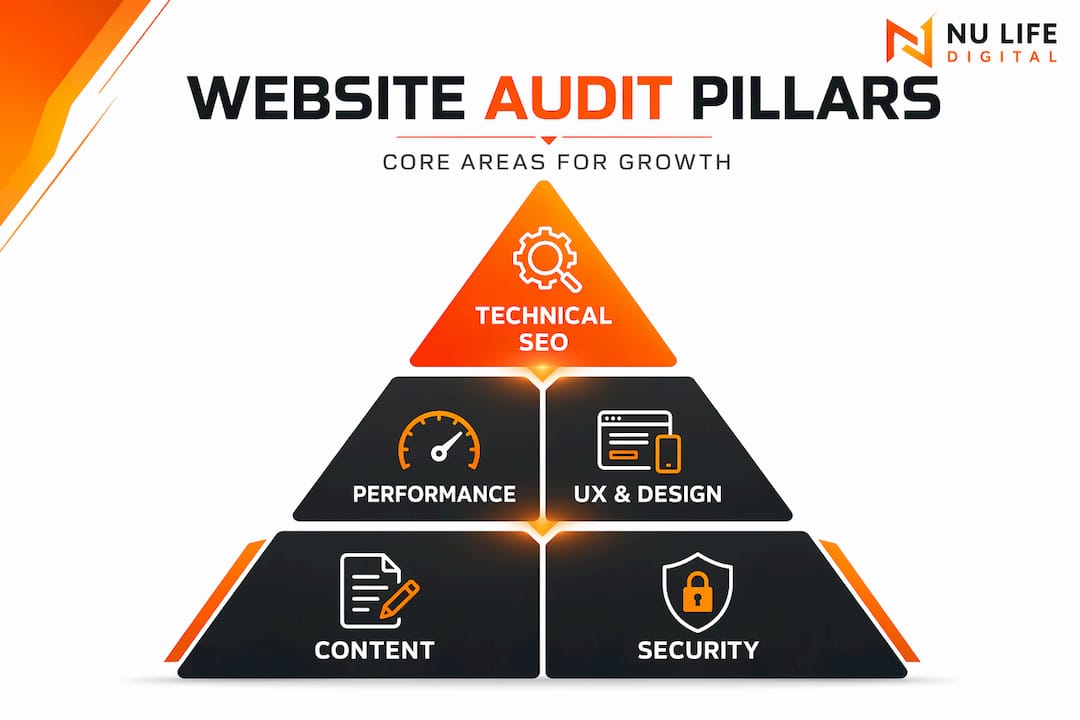
Performance. Page speed, Core Web Vitals, server response times, and image optimisation all fall here. 53% of mobile visitors abandon a site that takes longer than three seconds to load, which means a slow site is not an inconvenience, it is a revenue leak.
UX and design. Navigation clarity, mobile responsiveness, accessibility, and conversion pathways. A site can be technically perfect and still fail commercially if users cannot find what they need within seconds.
Content quality. Freshness, accuracy, keyword relevance, duplicate content, and information depth. Pages that do not offer genuine information gain over competing content rarely maintain strong rankings or earn citations from AI-powered search tools.
Security. SSL validity, software vulnerabilities, malware exposure, and data protection compliance. Ignoring this pillar does not just put users at risk. Regulatory fines for non-compliance can reach 4% of annual global turnover.
These five pillars interact constantly. A slow page affects UX. Thin content weakens technical SEO signals. Security gaps damage user trust. Audit all five together, or you are only ever solving part of the problem.
Pro Tip: Run a lightweight quarterly website health check covering all five pillars, then reserve your full in-depth audit for once or twice a year. If you make significant site changes, trigger an additional audit immediately.
Business impact: what audits actually fix
The reason audits matter commercially is simple. Your website is often the first detailed interaction a prospect has with your business. 80% of a professional firm’s best referrals leave after visiting a poorly performing website. That is not a marketing problem. That is a conversion infrastructure problem.
A website performance review focused on speed can have an immediate financial impact. A one-second page delay reduces conversions by up to 20%. For an e-commerce brand turning over £500,000 per year, a sustained two-second slowdown could theoretically cost six figures annually without a single change to your marketing spend.

SEO audits contribute to organic visibility by identifying crawl errors, cannibalised keywords, and missing structured data that actively suppress your rankings. But the real shift comes when those findings are translated into business language. Commercially framed SEO findings are significantly more effective at securing the budget and team commitment needed to act on them. Telling a board that a crawl error is costing you X leads per month lands far better than listing a 404 status code.
UX audit findings tend to produce the fastest wins. Improving navigation, removing friction from checkout flows, and clarifying calls to action are changes that can lift conversion rates within weeks. For context on how directly these improvements translate to revenue, look at conversion rate fundamentals to understand the financial mechanics behind user experience decisions.
Compliance audits are increasingly urgent. Beyond GDPR, businesses operating internationally must account for accessibility legislation and emerging AI regulation. The cost of ignoring this goes well beyond fines. It erodes user trust at the exact moment they are deciding whether to buy.
Pro Tip: Before your next audit, set a baseline for three metrics: organic sessions, conversion rate, and average page load time. Measure again 60 days after implementing fixes. That before-and-after comparison is how you prove audit ROI internally.
How to perform a website audit that actually delivers results
The difference between an audit that drives change and one that gathers dust in a shared folder comes down to process and prioritisation. Here is how to approach it properly.
-
Crawl the site. Use a technical crawl tool to map every URL, identify broken links, flag redirect chains, check meta tags, and surface crawlability issues. Free and open-source options can handle core audit checks including robots.txt validation, broken links, and Core Web Vitals without budget overhead.
-
Collect performance data. Pull real user metrics from analytics alongside lab data from performance testing tools. Look at bounce rates segmented by device and page type. Cross-reference with your heatmap data if you have it.
-
Assess content and UX. Manually review your top 20 landing pages. Ask whether each page answers the visitor’s question clearly, loads fast, and guides them toward a specific action. Tools help with scale, but human judgement is irreplaceable here.
-
Analyse security and compliance. Check SSL certificate status, software version vulnerabilities, cookie consent implementation, and privacy policy accuracy.
-
Prioritise by commercial impact. This is where most audits fail. Rather than listing every issue, score findings by their likely revenue impact versus the effort required to fix them. The top-right quadrant of an impact versus effort matrix, high impact and low effort, is your sprint backlog.
Root cause thinking matters enormously at this stage. If three different pages have thin content, listing them individually misses the point. The root cause might be that your content briefing process does not include keyword research or a minimum information depth standard. Fix the process and you prevent the problem recurring.
The evolving role of website audits in 2026
The audit scope has expanded considerably over the past 18 months. The reason is the rise of AI-powered search and answer engines. 30.6% of all web traffic is now generated by non-human bots, with AI crawlers representing a growing and distinct share of that figure.
This matters because AI crawlers do not behave like Googlebot. They have their own user agents, their own crawl patterns, and their own content extraction methods. If your robots.txt blocks them inadvertently, your site becomes invisible to the AI tools that an increasing number of buyers now use as their first research step.
Modern AI crawler audit checks cover several specific areas:
- Robots.txt rules for AI agents. Review whether known AI crawler user agents such as GPTBot and ClaudeBot are allowed or blocked.
- Structured data completeness. Schema markup helps machines verify and attribute your content correctly. Incomplete or inconsistent schema degrades your chances of being cited.
- Semantic HTML and accessibility tree optimisation. AI tools extract content through the accessibility tree, not just raw HTML. Pages built with clean, semantic markup are far more extractable.
- Content extractability. If your key claims are buried in JavaScript-rendered elements or sit behind interaction requirements, AI tools frequently miss them entirely.
- Content placement. This is the finding most businesses are unaware of: content in the top 30% of a page earns 44% of AI citations, while content in the bottom 10% earns less than 5%.
| AI audit check | Why it matters |
|---|---|
| Robots.txt for AI agents | Prevents unintended blocks on GPTBot, ClaudeBot, and similar crawlers |
| Structured data completeness | Increases machine-readable attribution and citation probability |
| Semantic HTML quality | Improves content extraction via accessibility tree parsing |
| Content placement on page | Top-of-page content earns a disproportionate share of AI citations |
Embedding audits into your ongoing digital strategy
A single audit is useful. A programme of regular audits is transformative. The businesses that see compounding gains from their websites treat the audit as an ongoing rhythm, not a one-time project.
A practical cadence looks like this:
- Quarterly website health checks. Lightweight reviews covering Core Web Vitals, crawl errors, security alerts, and content freshness. These catch issues before they compound.
- Biannual deeper reviews. Full UX and content audits, conversion pathway analysis, and competitor benchmarking.
- Annual full audits. Complete technical, SEO, content, UX, and security reviews tied to your wider business planning cycle.
- Trigger-based audits. Run an audit after any major change: a site redesign, a CMS migration, a significant Google algorithm update, or a sudden traffic drop.
Routine site maintenance including content reviews and security patching prevents the slow accumulation of technical debt that most sites suffer in silence. Building this cadence also creates shared accountability across marketing, IT, and leadership, which is often the missing ingredient in businesses that audit but never implement.
Pro Tip: Tie each audit cycle to a specific business goal, whether that is increasing qualified enquiries, reducing bounce rate on product pages, or improving local search visibility. Audits without a defined commercial objective tend to produce activity rather than results.
My honest take on why most audits miss the point
I have reviewed audit reports from dozens of businesses, and the pattern is nearly always the same. The document is thorough. It lists 60, 80, sometimes 120 issues. It has colour-coded severity ratings. And it sits largely untouched six months later.
The problem is not the audit itself. It is that the findings are presented as a technical inventory rather than a commercial roadmap. When a business owner sees 80 issues, they feel overwhelmed, not empowered. The 20% of issues causing 80% of the site’s problems get buried alongside 64 things that genuinely do not matter much.
The audits I have seen drive real change are the ones that open with: “Here are three things costing you conversions right now, and here is what fixing them is worth.” That framing gets decisions made.
The other thing I would highlight is AI readiness. I have spoken with businesses spending serious money on content and SEO who have never checked whether their robots.txt is inadvertently blocking AI crawlers. In 2026, that oversight is no longer academic. It directly affects whether your brand appears in AI-generated answers, which is where a growing number of high-intent buyers start their research. For a deeper look at how technical SEO foundations connect to this, it is worth understanding how the basics and the new layer sit together.
Treat your audit as a living investment, not a compliance exercise. The businesses pulling ahead right now are doing exactly that.
— Ryan
Ready to put your website to work?
If this article has prompted the question “what would an audit actually reveal about my site?”, that instinct is worth acting on. At Nulifedigital, we approach every website audit as a commercial exercise first and a technical one second. Our reviews cover all five pillars, from page speed and crawlability to AI readiness and conversion pathways, and every finding is ranked by its likely business impact so your team knows exactly where to focus.

Whether you are running an e-commerce brand, a service business, or managing a growing digital presence, the gap between where your site performs today and where it could perform is almost always wider than expected. Explore our web design services or review our conversion optimisation guidance to see how audit-driven improvements translate directly into revenue. When you are ready to go deeper, our team is here to help.
FAQ
What is a website audit?
A website audit is a structured review of a site’s technical health, performance, content quality, UX, and security. It identifies issues affecting search visibility, user experience, and conversions, then prioritises fixes by commercial impact.
How often should you perform a website audit?
A quarterly health check is a practical minimum, with a full audit at least once per year. Trigger additional audits after major changes such as redesigns, CMS migrations, or significant algorithm updates.
What are the main website audit benefits?
Audits surface hidden issues costing you traffic and conversions, improve page speed, fix crawl errors, strengthen security, and provide a prioritised roadmap for measurable performance gains.
Why do so many website audits fail to deliver results?
Most audits fail because they list symptoms without identifying root causes, and present findings as technical inventories rather than commercial priorities. Findings need to be ranked by revenue impact to drive real decisions.
Does a website audit cover AI readiness?
Modern audits should include checks for AI crawler access in robots.txt, structured data completeness, semantic HTML quality, and content placement, since content in the top 30% of a page earns the majority of AI citations.