
TL;DR:
- Optimizing care home websites involves creating engaging content, trust signals, and a user-friendly design to turn passive visitors into inquiries. Effective strategies include mobile optimization, clear calls-to-action, SEO, retargeting, and transparent, scenario-based pricing. These combined efforts significantly improve occupancy rates without the need for complete website rebuilds.
Your care home website is getting traffic. Families are browsing, reading, comparing. But the phone isn’t ringing as often as it should, and your enquiry form submissions tell a similar story. That gap between visitors and actual enquiries is where occupancy is won or lost. These website conversion tips for care homes address exactly that problem, giving you a practical framework to turn passive browsers into booked tours, phone calls, and filled beds, whether you’re managing a single site in Surrey or a portfolio of assisted living facilities across the US.
Table of Contents
- Understanding key website conversion criteria for care homes
- Optimising your website design and content for trust and clarity
- Leveraging SEO and targeted content for higher enquiries
- Using digital marketing and retargeting to re-engage visitors
- Comparison of key website conversion tactics for care homes
- Our perspective: stop treating your website like a brochure
- Ready to turn your website into a genuine enquiry engine?
- Frequently asked questions
Key Takeaways
| Point | Details |
|---|---|
| Understand visitor behaviour | Care home website visitors typically research for months and visit multiple times before enquiring. |
| Build trust visually | Use authentic staff photos and prominently display certifications to reduce scepticism. |
| Focus on local SEO | Create multiple service and location pages to match how prospective families search online. |
| Retarget undecided visitors | Implement retargeting ads and email nurture campaigns to re-engage visitors who don’t convert initially. |
| Clear pricing drives enquiries | Use scenario-based pricing models to transparently communicate costs and prompt contact form submissions. |
Understanding key website conversion criteria for care homes
The care home sales cycle is not like buying a pair of trainers. Families take nearly 140 days and multiple site visits before they pick up the phone or submit an enquiry. That single fact should reshape how you think about your website entirely. It is not a brochure. It is a long-term relationship tool.
The typical conversion funnel for a care home website moves through four stages: awareness, consideration, intent, and action. Most administrators focus almost entirely on the action stage, adding a contact form and calling it done. The real opportunity is in consideration and intent, where the right content, design, and trust signals keep families returning.
What actually drives visitors away before they enquire:
- Slow page load times, particularly on mobile
- No clear next step visible without scrolling
- Pricing that is either absent or presented as a single, daunting figure
- Stock photography that feels impersonal and anonymous
- No visible accreditation, ratings, or regulatory information
Mobile versus desktop behaviour is worth paying close attention to. Mobile dominates initial research, but desktop drives the actual conversion actions, such as form submissions and phone calls. That means your mobile experience needs to be excellent for discovery, while your desktop experience needs to be engineered for action.
How to reduce bounce rate and guide visitors to the next step:
- Place a clear, benefit-led call-to-action in the hero section of every key page
- Use internal linking to guide visitors from a blog post to a service page to an enquiry form
- Add a sticky header with your phone number visible at all times on desktop
- Install live chat or an AI chatbot to answer questions in real time without requiring a phone call
- Use exit-intent pop-ups to offer a downloadable guide in exchange for an email address
Good conversion optimisation strategies treat the website as a system, not a collection of pages. Every page should have a job, and every visitor should always know what to do next.
Optimising your website design and content for trust and clarity
Families choosing a care home are making one of the most emotionally charged decisions of their lives. They are not just comparing amenities. They are trusting you with someone they love. Your website design either builds that trust in the first few seconds or loses it entirely.
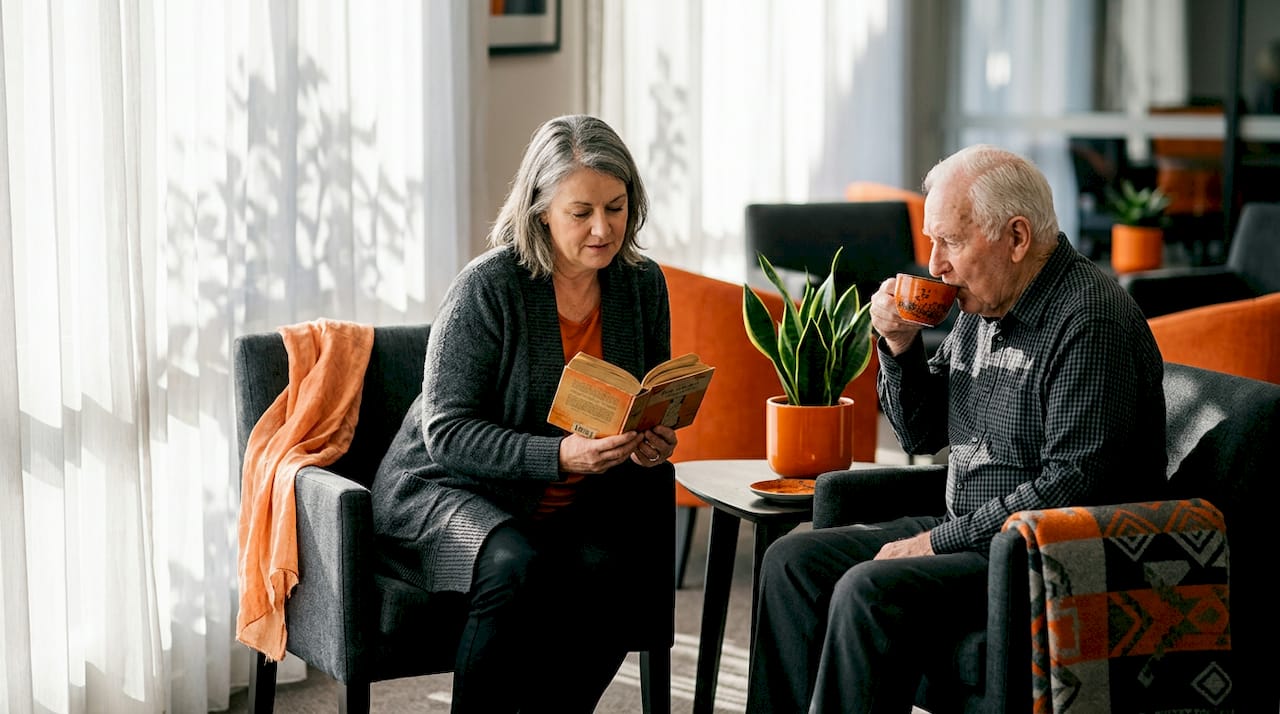
Top-performing care home websites share several consistent design choices: real photographs of actual staff members with short, personal bios; certifications and ratings displayed prominently without requiring visitors to search for them; and named care methodologies that give the home a distinct, credible identity rather than sounding like every other facility.
The role of web design in senior care goes far beyond aesthetics. Layout, colour choice, font size, and page hierarchy all affect how confident a family feels within moments of arriving on your site.
Trust-building design elements that directly impact conversions:
- Authentic team photos with first names, roles, and a one-line personal quote
- CQC ratings (UK) or state licensing information (US) displayed above the fold
- Named care programmes, such as “The Sunrise Wellbeing Model,” that signal a thoughtful, structured approach
- Scenario-based pricing sections that explain cost factors without publishing rigid tariffs
- Visible contact details on every single page, including a local phone number rather than a national 0800
Pro Tip: Scenario-based pricing is one of the most underused trust tools in care home marketing. Instead of hiding fees entirely or publishing a flat rate that scares families off, create a simple table that shows typical weekly costs based on care level and room type. It sets realistic expectations and dramatically reduces the friction around the first phone call.
| Design element | Impact on trust | Conversion benefit |
|---|---|---|
| Real staff photos with bios | High | Families connect emotionally before visiting |
| Accreditation displayed above the fold | High | Removes regulatory doubt immediately |
| Named care methodology | Medium | Differentiates from competitors |
| Scenario-based pricing | High | Reduces cost anxiety and encourages enquiry |
| Visible contact on every page | Very high | Eliminates friction at the moment of intent |
Leveraging SEO and targeted content for higher enquiries
Getting families to your website in the first place is half the battle. Dedicated service and location pages consistently outperform generic “what we offer” pages because they match exactly how families search. A family in Manchester types “residential care home for dementia patients in Manchester,” not “care services.” If you do not have a page that answers that query directly, you simply will not appear.
Care home SEO requires topical authority, local optimisation, voice search readiness, and regular content updates to maintain and improve rankings over time.
Key SEO actions to prioritise for your care home website:
- Build a pillar page for each core service type (dementia care, respite care, nursing care) supported by detailed cluster content
- Claim and fully optimise your Google Business Profile, including photos, services, opening hours, and regular posts
- Maintain consistent NAP (name, address, phone number) across every online directory and citation
- Answer voice search questions directly on your website, for example: “How do I know when my parent needs residential care?”
- Publish fresh content at least twice per month to signal to search engines that your site is active and authoritative
A practical content cluster structure for a care home:
- Pillar page: “Residential care in [your town or city]”
- Cluster page: “Dementia care in [your town or city]”
- Cluster page: “Respite care options in [your town or city]”
- Blog post: “Signs your parent may need residential care”
- Blog post: “How to talk to a loved one about moving into care”
| Content type | SEO value | Conversion value |
|---|---|---|
| Service location pages | Very high | High, matches high-intent searches |
| Pillar and cluster content | High | Medium, builds topical trust |
| Voice search FAQs | Medium | High, captures early research queries |
| Regular blog posts | Medium | Medium, builds authority over time |
| Google Business Profile posts | Low | High, supports local discovery and credibility |
These effective SEO strategies compound over time. The care homes that invest in structured content now are the ones with full occupancy six months from now.
Using digital marketing and retargeting to re-engage visitors
Here is a number worth sitting with: 96% of first-time visitors do not convert when they first arrive on your website. They are researching. They are comparing. They are not ready. Most care home websites simply let those visitors leave and never engage with them again. That is a significant missed opportunity.
Retargeting changes the equation. By placing a tracking pixel on your website, you can show tailored adverts to people who have already visited specific pages. A family that spent three minutes reading your dementia care page can then see a targeted advert on Facebook, YouTube, or Google as they continue their daily browsing.
Retargeting ad strategies that work for care homes:
- Segment audiences by the specific page they visited (dementia care, nursing care, respite care) and serve relevant ads
- Use Google Display Network for broad reach and YouTube pre-roll ads for emotional, story-led content
- Run Facebook retargeting with social proof, such as a family testimonial or a recent award
- Set frequency caps to avoid showing your ads so often that they feel intrusive
- Test a “Download our free guide” offer as an alternative conversion point for families not yet ready to call
Retargeting is not about chasing people. It is about staying visible during a long, emotionally complex decision. The family that visited your site three weeks ago and is still researching will convert at a far higher rate than a cold visitor, because they already know who you are.
Combining retargeting with an email nurture sequence is where the real gains happen. Offer something genuinely useful (a guide to funding care, a checklist for visiting care homes) in exchange for an email address. Then send a series of helpful, non-salesy emails over four to six weeks that position your home as the most knowledgeable and caring option available.
Pro Tip: The most effective retargeting campaigns for care homes use video. A 30-second clip showing your communal spaces, a member of staff explaining their approach, and a family member speaking about their experience will outperform a static image advert almost every time.
The digital marketing for care homes approach that consistently fills occupancy combines retargeting with email nurture, rather than relying on either in isolation.
Comparison of key website conversion tactics for care homes
Not every tactic carries the same weight. Some produce results quickly. Others build slowly but create compounding returns. Understanding the difference helps you allocate budget and attention where it will have the greatest impact on occupancy.
Effective care home marketing combines mobile optimisation, paid search, and email nurture as complementary channels rather than competing priorities. The step-by-step care home marketing approach that works consistently treats these as layers that reinforce each other.
| Tactic | Speed of results | Cost | Long-term value | Difficulty |
|---|---|---|---|---|
| Mobile optimisation | Immediate | Low to medium | High | Low |
| On-page SEO and content | 3 to 6 months | Medium | Very high | Medium |
| Paid search (Google Ads) | Days | High ongoing | Medium | Medium |
| Email nurture programme | 4 to 8 weeks | Low | High | Low to medium |
| Retargeting ads | Weeks | Low to medium | High | Low to medium |
The pattern here is clear. Paid search gets you in front of families fastest, but it stops the moment you stop paying. SEO and content take time but pay dividends for years. Retargeting and email nurture are the glue that connects everything together and prevents warm leads from going cold.
Our perspective: stop treating your website like a brochure
Most care home websites we review share a fundamental problem. They are built to describe, not to convert. They tell families what the home offers. They list the rooms. They show a gallery. They include a contact page buried in the navigation. And then they wonder why enquiries are low.
The uncomfortable truth is that a website which simply looks professional is not the same as a website that is built to convert. Families researching care homes are anxious, time-poor, and overwhelmed with options. Your website has about eight seconds to show them they are in the right place before they hit the back button and visit a competitor.
What actually moves the needle is specificity. Not “we provide exceptional person-centred care” but “our dementia care team completes 40 hours of specialist training annually, and every resident has a named keyworker.” Not a generic “get in touch” button but “Book a tour this week and meet our team.” The difference between these two approaches is the difference between a website that generates two enquiries a month and one that generates twelve.
We have seen care homes with modest traffic completely transform their enquiry volume simply by restructuring their homepage hierarchy, adding real staff bios, and moving the phone number to a sticky header. No extra advertising spend required.
Ready to turn your website into a genuine enquiry engine?
If this article has highlighted gaps in how your current website is performing, you are not alone. The good news is that most of the fixes are achievable without rebuilding from scratch. At NU Life Digital, we specialise specifically in helping care homes and assisted living facilities increase occupancy through high-converting websites, targeted digital marketing, and AI-powered admissions systems.

We have built this expertise by working exclusively in the senior care space across the UK and US, which means we understand the emotional complexity of your audience, the compliance requirements of your sector, and the specific tactics that fill beds. Whether you need a full website rebuild, a conversion audit, or a complete digital marketing programme, we are ready to help. Get in touch today to discuss how we can increase your enquiry volume and occupancy rate.
Frequently asked questions
What are the most effective website elements to increase care home enquiries?
Real staff photos with bios and certifications displayed prominently are among the most impactful elements, alongside dedicated service pages and clear calls-to-action with contact details visible on every page.
How important is mobile optimisation for care home websites?
Critically important. Mobile dominates initial research while desktop drives actual conversion actions, meaning a poor mobile experience will cost you visitors before they ever reach a point of genuine interest.
How can care homes effectively re-engage visitors who do not convert immediately?
Deploy retargeting ads on Google, YouTube, and Facebook, and combine them with an email nurture programme offering genuinely useful content. 96% of first-time visitors do not convert on their first visit, so sustained engagement is essential.
What role does SEO play in improving care home website conversions?
SEO drives qualified traffic by matching how families actually search. Dedicated pages for services and local SEO improve rankings for high-intent queries and increase the likelihood that visitors who arrive are already considering your type of care.
Why is transparent pricing important on a care home website?
Scenario-based pricing removes the biggest source of anxiety for families researching care, helping them understand realistic costs without the shock of a rigid tariff, which encourages them to submit an enquiry rather than simply leave.