
TL;DR:
- Actionable data directly guides specific marketing decisions tied to business outcomes.
- Focusing on a few key metrics aligned with revenue yields better growth results.
- Building a strong first-party data foundation enhances decision accuracy and personalization.
Most businesses are drowning in data and starving for insight. You have dashboards full of numbers, reports piling up every Monday morning, and analytics tools tracking everything from scroll depth to session duration. Yet despite all of it, the marketing decisions that actually move the needle still feel like educated guesswork. The uncomfortable truth is that collecting more data does not automatically produce better results. What separates high-growth businesses from stagnant ones is not the volume of data they hold, but their ability to identify which data points genuinely inform decisions and act on them with speed and precision.
Table of Contents
- What makes marketing data actionable?
- Why actionable data matters for growth
- The role of first-party data in actionable marketing
- How to turn data into action: steps and pitfalls
- A hard-earned perspective: why actionable data beats ‘big data’ every time
- How Nu Life Digital helps you turn data into results
- Frequently asked questions
Key Takeaways
| Point | Details |
|---|---|
| Focus on actionable data | Only data that leads to decisive marketing actions truly drives growth. |
| Prioritise first-party sources | First-party data gives the most reliable and customised insights for your business. |
| Measure outcomes, not just activity | Success comes from linking marketing data directly to revenue and retention rather than surface metrics. |
| Apply, test and learn | Turning insights into action and constantly validating them ensures sustained improvement. |
What makes marketing data actionable?
Raw data is everywhere. Actionable data is rare. Understanding the difference is the first step to building a marketing strategy that actually works.
Actionable marketing data is information that directly tells you what to do next. It points to a specific change, decision, or test that can improve a measurable outcome. General data, by contrast, might be interesting, but it does not tell you what to change or why. Knowing that your website had 40,000 visits last month is general data. Knowing that visitors from paid social convert at 0.4% while visitors from email convert at 3.8% is actionable, because it tells you exactly where to shift budget.
The importance of tracking marketing data lies precisely in this distinction. Tracking for the sake of tracking creates noise. Tracking with a clear business question in mind creates signal.
| General data | Actionable data |
|---|---|
| Total website visits | Conversion rate by traffic source |
| Overall email open rate | Open rate per campaign segment |
| Social media impressions | Revenue attributed per social channel |
| Bounce rate (site-wide) | Bounce rate by landing page and device |
| Total leads generated | Lead-to-close rate by campaign type |
The characteristics that make data truly actionable are straightforward:
- Timely: It reflects recent behaviour, not trends from six months ago
- Specific: It relates to a defined audience segment, channel, or product
- Tied to a business goal: It connects directly to revenue, retention, or acquisition
- Testable: It suggests a hypothesis you can validate with a controlled change
- Owned: It comes from your own systems, not third-party estimates
That last point matters more than most teams realise. Analytics in advertising increasingly depends on first-party signals as third-party cookies disappear and privacy regulations tighten. As one critical warning from research into real-time personalisation notes, third-party intent data can lead to confident but inaccurate decisions. Treat such signals as directional until you have validated them against your own first-party data and controlled tests.
“The real danger is not a lack of data. It is overconfidence in data that has never been stress-tested against actual business outcomes.”
Staying across digital marketing trends is useful context, but your own validated data will always outperform industry benchmarks when it comes to making specific decisions for your specific audience.
Why actionable data matters for growth
After seeing what qualifies as actionable, let us investigate why it is essential for driving measurable business results, not just reporting activity.
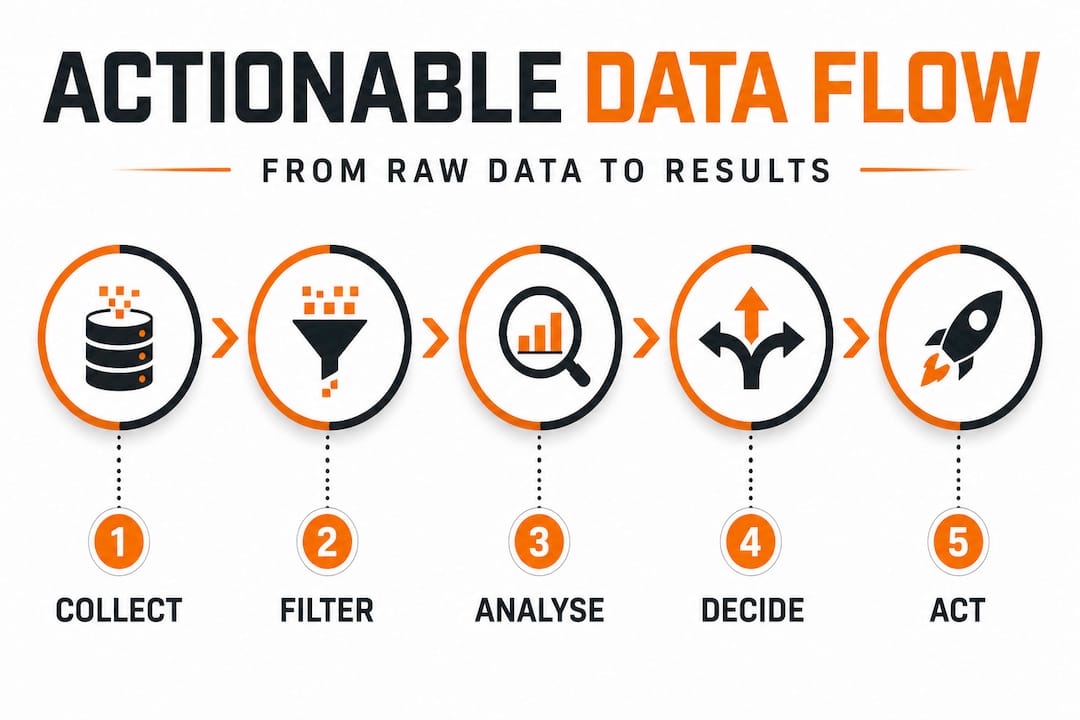
The path from data to growth is not automatic. It follows a clear sequence, and skipping any step breaks the chain:
- Collect data from reliable, first-party sources aligned to your customer journey
- Clean and segment the data so it reflects distinct audience behaviours, not averages
- Identify patterns that suggest a specific cause and effect relationship
- Form a hypothesis based on those patterns (for example: “If we shorten the checkout flow, conversions will increase”)
- Test the change with a controlled experiment or phased rollout
- Measure the outcome against a pre-defined KPI tied to revenue or retention
- Scale or reject the change based on results, then repeat
This process is what separates businesses that grow predictably from those that run campaigns and hope for the best. Marketing data analysis confirms that companies with structured data-to-action processes consistently outperform those relying on intuition alone.
Here is where many teams go wrong. They focus on engagement metrics, likes, shares, open rates, time on page, and treat them as proof that a campaign is working. But as research into personalisation strategy makes clear, technically personalised experiences can still fail if the measurement focuses on engagement rather than incremental revenue or customer lifetime value. A campaign that generates thousands of clicks but no pipeline movement is not a success. It is an expensive distraction.

Pro Tip: Before launching any campaign, define the single metric that will determine whether it succeeded. Not five metrics. One. Make it revenue-linked, and set a threshold before you start so you cannot move the goalposts later.
If you are working to boost online sales for an e-commerce brand, the distinction between engagement and revenue impact becomes even more critical. A product page with a 70% bounce rate and a 12% conversion rate is performing better than one with a 30% bounce rate and a 1% conversion rate. Vanity metrics will tell you the opposite story.
The same principle applies in assisted living marketing. Enquiry volume means nothing if the quality of leads is poor and your admissions team is spending hours on calls that go nowhere. Actionable data means tracking lead-to-tour rate, tour-to-admission rate, and cost per admitted resident. Those are the numbers that connect marketing spend to actual occupancy growth. Applying conversion tactics based on these metrics produces far better results than chasing click-through rates.
The role of first-party data in actionable marketing
Understanding why actionable insights matter, the next step is to ensure your data foundation is solid, starting with first-party assets.
First-party data is information you collect directly from your own customers and prospects through your own channels. It is the most reliable, most privacy-safe, and most customisable data source available to your business. Third-party data, by contrast, is purchased or aggregated from external sources, and its accuracy is always an estimate.
| Data type | Source | Reliability | Best use | Key risk |
|---|---|---|---|---|
| First-party | Your website, CRM, email | High | Personalisation, segmentation, retention | Requires robust collection setup |
| Second-party | Partner data sharing | Medium | Audience expansion | Dependent on partner quality |
| Third-party | Data brokers, ad platforms | Variable | Prospecting, broad targeting | Can lead to inaccurate decisions |
The types of first-party data your marketing team should be prioritising include:
- Website interaction data: Pages visited, time on page, click paths, and exit points
- Purchase and transaction history: What customers bought, when, how often, and at what value
- Email engagement by segment: Opens, clicks, and conversions broken down by list segment
- Form and enquiry data: What questions prospects ask, where they drop off, and what they convert on
- CRM data: Lead source, sales cycle length, and conversion rate by channel
- Customer feedback and survey responses: Direct signals about what is working and what is not
The value of first-party data is that it reflects your actual customers, not a statistical model of what customers like yours might do. This matters enormously when you are trying to personalise experiences or optimise campaigns. A third-party audience segment might tell you that users aged 45 to 60 in a given postcode are interested in senior care. Your own CRM data will tell you that the families who actually convert tend to come through organic search, ask about memory care specifically, and take an average of 18 days from first enquiry to booking a tour. That is the difference between directional and decisive.
Pro Tip: Build your first-party data collection around the customer journey, not around what is easiest to track. Map every touchpoint from first awareness to post-purchase, and ensure you are capturing intent signals at each stage in a privacy-compliant way.
Pairing strong first-party data with data insights tools and integrating AI and marketing systems allows you to automate the analysis and surface patterns that would take weeks to find manually. This is where businesses start to build genuine competitive advantage.
How to turn data into action: steps and pitfalls
With a strong data foundation, it is time to focus on how to make data implementation successful and sustainable.
The gap between having good data and acting on it effectively is where most marketing strategies fall apart. Here is a practical framework for closing that gap:
- Conduct a data audit: Review what you are currently tracking, identify gaps, and remove redundant or unreliable sources. Start clean.
- Define your business questions first: Do not start with data and look for meaning. Start with a specific question, such as “Why is our cost per acquisition rising?” and then find the data that answers it.
- Set clear KPIs tied to revenue: Every metric you track should connect to a business outcome. If you cannot draw a line from the metric to revenue, retention, or acquisition, question whether it belongs on your dashboard.
- Validate insights before acting: One data point is not a trend. Look for consistency across time periods, segments, and channels before making significant changes.
- Test changes in a controlled way: Use A/B tests, phased rollouts, or holdout groups to measure the true impact of any change before scaling it.
- Review and iterate on a fixed cadence: Set a weekly or fortnightly review rhythm. Data that is reviewed monthly is already stale by the time you act on it.
The mistakes that derail this process are predictable:
- Measuring engagement instead of outcomes (clicks, likes, and shares instead of revenue and retention)
- Making decisions based on a single week of data without accounting for seasonality or anomalies
- Ignoring the control group and attributing all improvement to the change you made
- Chasing too many metrics at once, which fragments attention and slows decision-making
- Skipping the validation step and scaling a change that only appeared to work
Research into personalisation strategy reinforces this point clearly. Personalised experiences fail when the underlying strategy is weak, content differences are too small, or measurement focuses on engagement rather than incremental revenue. The same logic applies to any data-driven initiative. Execution without a sound strategic foundation produces noise, not growth.
Pro Tip: Design your data strategy backwards. Start with the outcome you want, define the metric that proves you achieved it, then build the data collection and analysis plan to track that metric. This prevents you from collecting data for its own sake.
A well-structured strategy workflow that integrates data review cycles into campaign planning will always outperform a reactive approach. Refer to a marketing analytics guide to benchmark your current process and identify where the biggest gaps sit.
A hard-earned perspective: why actionable data beats ‘big data’ every time
Here is something the data industry does not say loudly enough. More data does not make you smarter. In many cases, it makes you slower.
We have worked with businesses that had access to genuinely impressive data infrastructure. Multiple analytics platforms, detailed attribution models, cross-channel reporting, the works. And yet their marketing teams were paralysed. Every decision triggered a debate about which dashboard to trust. Every campaign review turned into a three-hour meeting about data discrepancies. The data was abundant. The clarity was absent.
The teams that grow fastest are almost always the ones with fewer metrics, not more. They pick four or five numbers that genuinely connect to revenue and retention, they track them obsessively, and they make decisions quickly because the signal is clean. There is no committee debate about whether to trust the numbers, because the numbers come from their own systems, validated against real outcomes.
The risk of vanity metrics is not just wasted time. It is strategic misdirection. A business that celebrates a 40% increase in social media followers while its customer acquisition cost is rising and its repeat purchase rate is falling is not growing. It is declining with good PR.
“Technically personalised experiences can still fail if the underlying strategy is weak and the measurement focuses on engagement rather than incremental revenue.” Real-Time Personalisation: When ‘Personal’ Isn’t Profitable
This applies directly to both assisted living marketing and e-commerce. In assisted living, a facility might run a campaign that generates 200 enquiries in a month and call it a success. But if only 4 of those enquiries convert to tours and 1 becomes a resident, the campaign was expensive and ineffective. The actionable question is not “how do we get more enquiries?” It is “how do we attract enquiries from families who are genuinely ready to make a decision?”
For e-commerce brands looking to boost online sales, the same discipline applies. Focus on average order value, repeat purchase rate, and revenue per visitor. These tell you whether your business is actually growing or just getting busier.
Pro Tip: Set a “data diet” for your team. Choose no more than five metrics per quarter that directly connect to your growth goals. Review them weekly. Ignore everything else until the next quarter review.
How Nu Life Digital helps you turn data into results
Strategic, measurable data is not just a reporting tool. It is a growth multiplier when it is structured correctly and acted on consistently.

At NU Life Digital, we build the systems that turn data into decisions. Whether you are an e-commerce brand trying to optimise e-commerce conversions or an assisted living facility looking to fill beds with qualified enquiries, we design the full ecosystem around measurable outcomes. Our approach combines design for measurable results with AI integration and paid advertising strategies to ensure every part of your marketing is tracked, tested, and tied to real revenue. If you are ready to stop guessing and start growing, we would like to show you what a data-driven growth engine actually looks like in practice.
Frequently asked questions
What is the difference between actionable data and big data?
Actionable data informs clear, timely decisions tied to specific business outcomes, while big data refers to large volumes of information that may not yield any specific direction. Third-party data in particular can create a false sense of insight compared to well-validated first-party data.
How can actionable marketing data boost sales?
When applied correctly, actionable data helps you target the right customers, refine your messaging, and increase conversions at every stage of the funnel. Linking data to incremental revenue and customer lifetime value is essential for measuring whether your marketing is genuinely working.
Why is first-party data crucial for actionable marketing?
First-party data is the most accurate foundation for personalisation and optimisation because it reflects your actual customers rather than statistical estimates. Overreliance on unchecked third-party sources increases the risk of confident but incorrect decisions.
What is the biggest mistake people make with marketing data?
The most common pitfall is focusing on engagement metrics that do not connect to real business results. Technically personalised experiences often fail precisely when success is measured by clicks and impressions rather than revenue and retention.
How do I start making my marketing data more actionable?
Define your business goals first, then build your data collection plan backwards from the outcome you want to achieve. Connecting data actions to measurable business outcomes, and testing changes in a controlled way, is what separates data-informed growth from expensive guesswork.
Recommended
- What is performance marketing? Drive measurable growth – Nu Life Digital
- Data insights – Nu Life Digital
- Why marketing strategy matters for business growth – Nu Life Digital
- Effective conversion tactics: proven examples to boost sales – Nu Life Digital
- Unlock the role of data in marketing for 2026 growth
- Event data: the key to impactful marketing in 2026