
TL;DR:
- SEO is essential for assisted living facilities as families start their search online.
- A comprehensive SEO strategy includes audits, keyword research, content, technical fixes, reviews, and tracking.
- Effective local SEO builds trust, improves visibility, and directly correlates with occupancy growth.
Word of mouth built assisted living facilities a generation ago. Today, families in the US and UK open Google the moment they begin researching care options for a loved one, and if your facility does not appear in those early searches, you simply do not exist in their decision-making process. Print adverts, referral networks, and open days still have a role, but they cannot compensate for an invisible digital presence. This guide breaks down exactly how search engine optimisation (SEO) works for assisted living, why it directly influences occupancy rates, and what practical steps you can take right now to start capturing the enquiries your competitors are already receiving.
Table of Contents
- Why SEO matters for assisted living facilities
- Core components of an effective SEO strategy
- Best practices for content and local SEO in assisted living
- Technical SEO and performance essentials
- Tracking results and justifying SEO investment
- A hard truth: why most assisted living SEO fails (and what works instead)
- Get expert support to transform your assisted living SEO results
- Frequently asked questions
Key Takeaways
| Point | Details |
|---|---|
| SEO increases occupancy | Effective SEO directly translates to more qualified enquiries and higher occupancy rates for assisted living facilities. |
| Local optimisation is critical | Local search and reviews help your facility reach families at the critical moment of decision. |
| Technical health matters | Website speed, security, and mobile usability are key for converting online visitors into real-life residents. |
| Track what matters | Focusing on metrics like enquiries, tours, and occupancy proves the true value of SEO investment. |
| Expert support accelerates results | External guidance and technical know-how can save time and avoid costly SEO pitfalls in this competitive sector. |
Why SEO matters for assisted living facilities
The starting point is simple: your prospective residents and their families are searching online before they do anything else. They are typing phrases like “assisted living near me,” “dementia care in [city],” and “best care homes in [county]” into search engines, reading reviews, comparing facilities, and forming strong opinions, all before making a single phone call.
SEO drives organic traffic, enquiries, and occupancy for assisted living facilities in a way that no other digital channel quite matches for consistency and cost efficiency. Unlike paid adverts that stop the moment you pause your budget, organic SEO compounds over time. A page that ranks well this month will likely still be generating enquiries six months from now.
Consider what neglecting SEO actually costs you. If a competitor facility ranks in the top three positions on Google for your local search terms, research consistently shows they will capture the overwhelming majority of clicks. Studies suggest the first organic result alone attracts roughly 27% of all clicks, with that figure dropping sharply for positions four and below. Families rarely scroll past the first page.
Here is what effective SEO delivers for a care facility:
- Higher volume of qualified website visitors who are actively searching for your services
- More completed enquiry forms and direct telephone calls from families ready to book a tour
- Improved credibility through visible ratings, reviews, and authoritative content
- Better understanding of which services and locations drive the most interest
- A measurable pipeline connecting digital activity to actual bed occupancy
“Organic search is not a vanity metric for assisted living facilities. Every position you climb in local results represents real families who now see your name instead of a competitor’s.”
For those wanting to understand the broader picture, digital marketing for care homes sits within a wider ecosystem that includes paid advertising and social media. But SEO is the foundation. Without it, every other channel works harder than it needs to. A well-structured digital marketing strategy workflow always places organic visibility at its core.
Core components of an effective SEO strategy
Understanding that SEO matters is one thing. Knowing precisely what to do about it is another. A successful SEO strategy for an assisted living facility is not a single action; it is a structured process with several interdependent components.
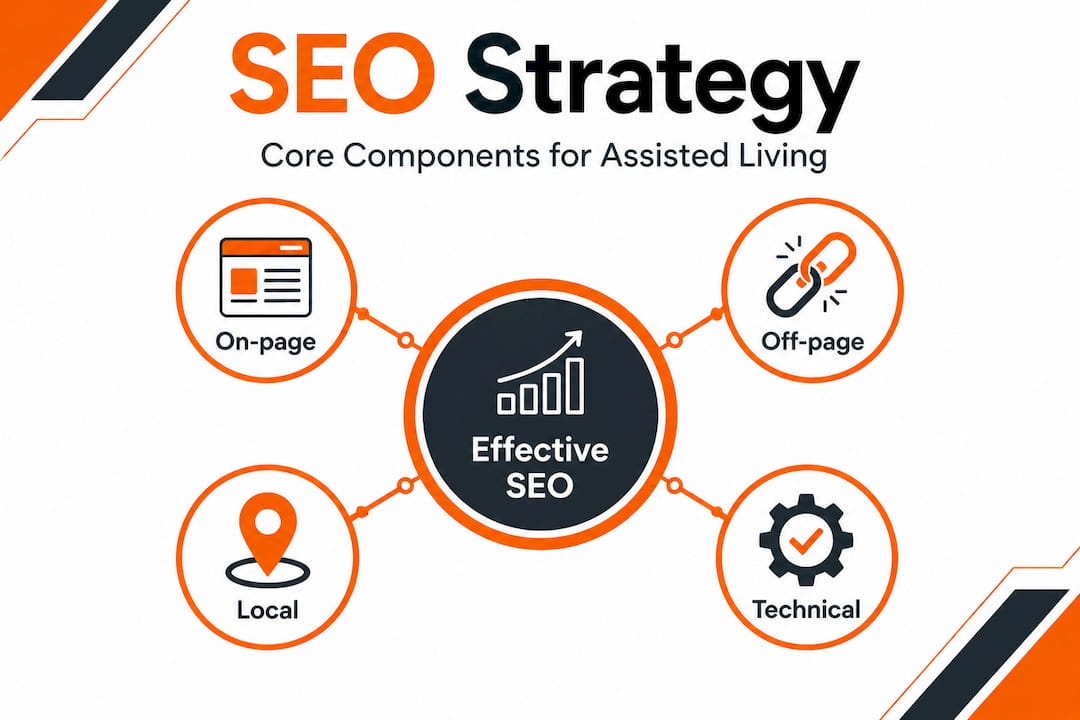
Implementing a seven-step SEO process yields the best results for assisted living providers, covering audits, keyword research, content creation, technical fixes, review collection, and ongoing tracking. Skip any one of these and the whole effort becomes less effective.
Here is how the process unfolds in practice:
- Website audit — Identify what is currently working, what is broken, and where opportunities exist. This includes checking page speed, broken links, duplicate content, and missing metadata.
- Keyword research — Find the exact phrases families type into Google when looking for your type of care. Include local terms, service-specific terms, and question-based queries.
- On-page optimisation — Update page titles, headings, image descriptions, and body text to include your target keywords naturally and meaningfully.
- Content creation — Publish helpful, trustworthy articles, guides, FAQs, and testimonials that answer real questions families have about choosing care.
- Technical improvements — Fix underlying website issues that prevent search engines from properly reading and ranking your pages.
- Review and reputation management — Actively gather and respond to reviews on Google and other platforms to build credibility and support local rankings.
- Tracking and reporting — Monitor the key metrics that tie SEO activity directly to business outcomes like enquiries and occupancy.
| SEO type | What it covers | Assisted living example |
|---|---|---|
| On-page SEO | Content, headings, keywords, internal links | Optimising your “memory care” service page for local search |
| Technical SEO | Site speed, mobile usability, crawlability | Fixing a slow-loading homepage that loses visitors on mobile |
| Off-page SEO | Backlinks, citations, reviews, reputation | Earning a mention from a local NHS or hospital website |
Each type reinforces the others. Strong content attracts backlinks. Good reviews boost local rankings. Fast pages reduce bounce rates, which signals quality to search engines.
Pro Tip: Start your SEO effort with a thorough audit before touching anything else. You need a clear picture of your existing strengths and weaknesses before investing in new content or technical changes. Many facilities waste months fixing the wrong things first.
For a thorough breakdown of how these components work specifically in the care sector, explore SEO strategies for care homes and how they feed into an assisted living growth framework built around sustainable occupancy.
Best practices for content and local SEO in assisted living
Content and local SEO are where assisted living facilities can genuinely differentiate themselves. Generic, thin website copy does not rank, does not build trust, and does not convert visitors into enquiries. Families making care decisions are under enormous emotional and practical pressure, and they respond to content that feels honest, informative, and human.
Compliance and consistent content are vital for SEO in the assisted living sector. In the UK, this means adhering to CQC standards and data privacy regulations. In the US, it means aligning with state-specific licensing requirements and avoiding misleading claims. Both markets demand transparency and accuracy in all published information.
Here is what effective content and local SEO looks like for a care facility:
- Educational resource pages — Guides on topics like “How to choose an assisted living facility” or “What to expect from a care assessment” answer real search queries and establish your authority.
- Location-specific landing pages — If you operate multiple sites or serve distinct areas, each location deserves its own optimised page with unique content.
- Staff profiles and community updates — These humanise your facility and signal to Google that your site is regularly updated with fresh, relevant content.
- Verified testimonials and case studies — Families trust the experiences of other families. Real stories, used with proper consent, carry significant weight both for trust and for SEO.
- Optimised Google Business Profile — This is your most important local SEO asset. Keep it updated with accurate hours, photographs, services, and a regular stream of review responses.
| Local SEO element | Priority level | Action required |
|---|---|---|
| Google Business Profile | Critical | Claim, verify, and update monthly |
| Location keywords in headings | High | Include city or county in H1 and H2 headings |
| Review quantity and quality | High | Request reviews from satisfied families after move-in |
| Local citations and directories | Medium | Ensure consistent name, address, phone across all listings |
| Location-specific content | Medium | Create dedicated pages for each area served |
Pro Tip: Ask families to leave a Google review within the first two weeks of a resident settling in. This is the moment when satisfaction is at its highest and the experience is fresh. A brief, friendly message with a direct link to your review page removes all friction.
Understanding how content marketing enhances SEO results is particularly important in assisted living, where trust is built long before any formal enquiry is made. Every article, FAQ, and testimonial page is a touchpoint in that trust-building journey.
Technical SEO and performance essentials
A beautifully written care guide means nothing if your website takes eight seconds to load on a mobile phone. Families researching care options are often doing so on smartphones, frequently in stressful circumstances, and a slow or glitchy website sends an immediate negative signal about your facility’s professionalism.

Technical fixes are essential within a structured SEO process for assisted living providers. Search engines like Google use page experience signals, including loading speed, mobile usability, and security, as direct ranking factors. This means a technically weak website will underperform in search results regardless of how good its content is.
Key technical SEO priorities for assisted living websites include:
- Page speed optimisation — Compress images, use modern file formats, and minimise unnecessary code to reduce loading times to under three seconds.
- Mobile-first design — More than half of all web searches now happen on mobile devices. Your site must be fully functional and readable on a small screen.
- HTTPS security — An SSL certificate is a basic requirement. Families will not trust an unsecured site with enquiry forms or personal details.
- Accessibility compliance — Ensure the website meets WCAG accessibility standards. This matters ethically and also signals quality to search engines.
- Structured data (schema markup) — Adding schema code to your website helps Google display rich results, such as star ratings, opening hours, and service information, directly in search results. This significantly improves click-through rates.
- Broken link audits — A page that leads to a 404 error frustrates visitors and wastes your SEO authority. Review and fix broken links regularly.
Pro Tip: Run your website through Google’s free PageSpeed Insights tool once per quarter. It provides a prioritised list of technical improvements with clear descriptions of what to fix and why. This single habit catches most technical issues before they become serious ranking problems.
For specialist support with website infrastructure, explore technical SEO solutions or access ongoing SEO helpdesk services that keep your site performing at its best.
Tracking results and justifying SEO investment
One of the most common frustrations for care facility managers is the inability to connect their SEO spend to actual business outcomes. Rankings go up. Traffic increases. But does any of it fill beds? The answer is yes, provided you are tracking the right metrics and building a clear reporting chain from digital activity to occupancy.
Tracking KPIs like organic traffic, inbound enquiries, tour bookings, and occupancy rates is the only credible way to prove SEO return on investment for assisted living facilities. Chasing a number one ranking for its own sake is a distraction.
Here is a practical tracking framework you can implement immediately:
- Set up Google Analytics 4 (GA4) — Configure it to track enquiry form submissions, telephone click events, and tour booking completions as goal conversions.
- Connect Google Search Console — This free tool shows which search queries bring visitors to your site, how often you appear in results, and where your click-through rates could improve.
- Record enquiry source at point of contact — Train reception and admissions staff to ask every enquirer how they found you. “Google search” should be captured consistently.
- Build a monthly reporting dashboard — Include organic sessions, new users, form submissions, phone enquiries, tours booked, and new admissions. Review this data against the previous month and the same period last year.
- Attribute content launches to traffic spikes — When a new service page or blog article goes live, note the date and monitor whether that specific page drives increased sessions and enquiries over the following weeks.
Statistic to remember: Facilities that track the full conversion journey from organic visit to signed admission agreement are able to attribute average revenue per SEO enquiry, making future investment decisions straightforward rather than speculative.
The Growth Engine for assisted living approach ties every digital activity to an occupancy outcome. This is the mindset shift that transforms SEO from a marketing experiment into a boardroom-level business tool.
A hard truth: why most assisted living SEO fails (and what works instead)
Here is what most SEO guides will not tell you: the majority of assisted living facilities that invest in SEO do not fail because of bad keywords or poor content. They fail because SEO is treated as a separate, isolated activity rather than as part of a connected growth system.
We see this pattern constantly. A facility invests in optimisation, achieves a decent local ranking, begins receiving enquiries, and then the admissions team takes 48 hours to respond. Families in crisis do not wait 48 hours. They move on. The SEO “worked” but the facility still did not fill its beds.
Tracking KPIs including occupancy, not just rankings, forces you to look at the entire journey a prospective family takes, from Google search to move-in day. When you measure it this way, you quickly realise that SEO is just the beginning. Speed of follow-up, quality of the telephone conversation, clarity of your pricing information, and the warmth of your tour experience all sit downstream of the initial search click.
The other common failure is copying generic SEO advice. Tips designed for e-commerce or local tradespeople rarely translate cleanly to assisted living. The decision-making timeline is longer, the emotional stakes are higher, and the regulatory environment is more complex. What works is sector-specific content that speaks directly to the anxieties and priorities of adult children navigating care decisions for a parent.
Sustainable SEO success for assisted living comes from treating it as an ecosystem, not a checklist. Review effective SEO strategies for care homes with an honest assessment of whether your enquiry management, staff communication, and offline reputation are ready to support the digital leads you generate.
Get expert support to transform your assisted living SEO results
Now that you understand how SEO can reshape your facility’s visibility and occupancy, the next question is whether you have the in-house expertise and capacity to implement it properly. Most marketing managers at care facilities are managing multiple channels simultaneously, often without a dedicated SEO resource.

At NU Life Digital, we work exclusively with assisted living and senior care providers across the US and UK, building the digital infrastructure that turns search visibility into signed admissions. Our web design for assisted living service creates compliant, conversion-optimised websites engineered to perform in local search and convert family visitors into enquiries. Alongside design, our digital consulting services provide the strategic direction, technical expertise, and ongoing reporting your team needs to grow occupancy predictably. If you are ready to stop leaving enquiries on the table, we are ready to help you capture them.
Frequently asked questions
How quickly can SEO increase occupancy for an assisted living facility?
Significant increases in visibility and enquiries may be seen within three to six months, with occupancy growth following after consistent campaign effort and strong enquiry management.
What local SEO tactics work best for assisted living?
Claim your Google Business Profile, gather quality reviews consistently, and use local location-specific keywords naturally across your service pages, headings, and URLs.
Should I focus on Google or other search engines for assisted living SEO?
Prioritise Google as it dominates search in both the US and UK, but ensure your website loads correctly and is visible on Bing and Apple Maps, as these platforms carry growing importance for older demographics.
How should we measure SEO success for assisted living?
Track qualified enquiries, booked tours, and new resident admissions as your primary success metrics, rather than focusing solely on search ranking positions.
What is the risk of not investing in SEO for my assisted living facility?
Competitors will capture the overwhelming majority of online family searches, steadily eroding your facility’s enquiry pipeline and making occupancy harder to sustain without expensive paid advertising to compensate.