
TL;DR:
- Most e-commerce sales are lost at checkout due to hidden costs and forced account creation.
- Tracking micro-metrics at each funnel stage helps identify and fix specific leaks effectively.
- Full customer journey optimization beyond checkout drives sustainable growth through retention and advocacy.
Every e-commerce business loses money through funnel leaks. The question is how much, and where. Cart abandonment sits at around 70% globally, meaning roughly seven out of ten shoppers who add items to their basket never complete a purchase. That is an enormous amount of revenue sitting on the table. This guide breaks down every stage of the e-commerce funnel, explains exactly where businesses lose potential customers, and gives you the actionable steps to plug those leaks, improve conversions, and build sustainable revenue growth from awareness all the way through to advocacy.
Table of Contents
- Understanding the e-commerce funnel and its key stages
- Mapping metrics to each funnel stage for actionable insights
- Fixing funnel leaks: Common mistakes and high-impact quick wins
- Optimising the journey: From first touch to post-purchase advocacy
- Why most funnel advice is too narrow (and how to rethink optimisation for 2026)
- Next steps: Accelerate your growth with expert support
- Frequently asked questions
Key Takeaways
| Point | Details |
|---|---|
| Map key funnel stages | Every funnel stage from awareness to advocacy needs focus for maximum growth. |
| Track micro-metrics | Measure each stage’s performance to accurately diagnose and fix leaks. |
| Reduce checkout friction | Small changes at checkout—like transparent pricing—can cut abandonment by over half. |
| Optimise the whole journey | Boost revenue and loyalty by connecting improvements across the customer journey, not just at checkout. |
Understanding the e-commerce funnel and its key stages
Before you can fix anything, you need a clear picture of how the funnel actually works. Most people think of it as a straight line from ad click to purchase. That is only part of the story.
The e-commerce funnel is better understood as a cycle. Customers enter at the awareness stage, move through consideration and purchase, and then ideally loop back through retention and advocacy. When you treat the funnel as a cycle rather than a one-way journey, you start to see how post-purchase experience drives future revenue, not just the checkout page.
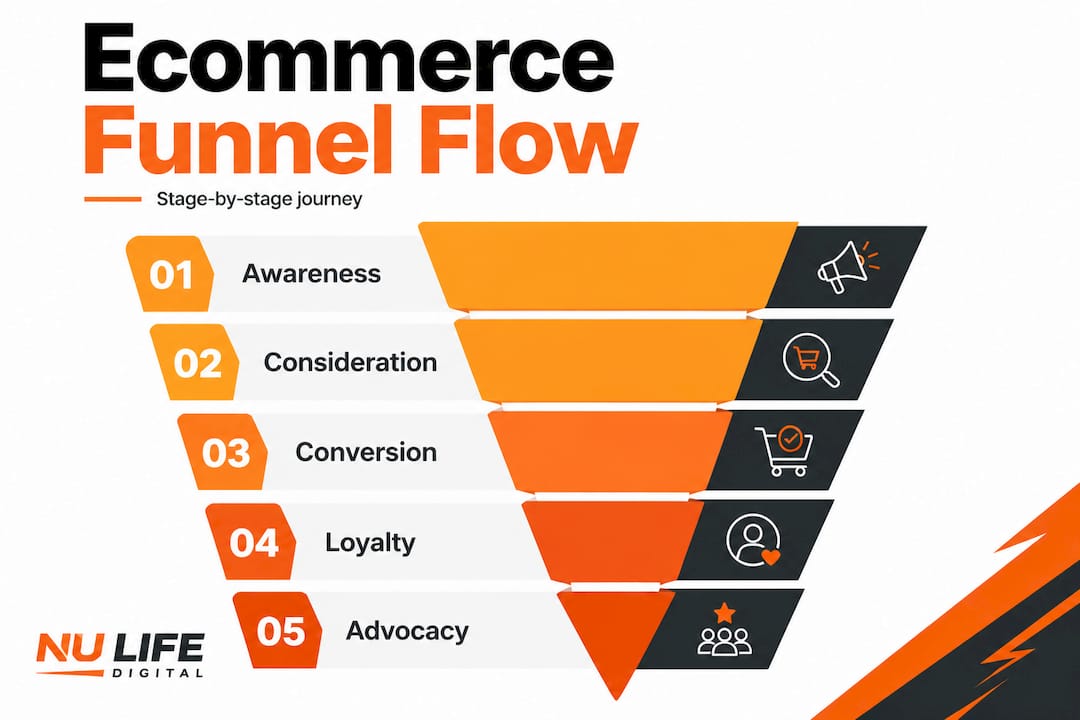
Here is how each stage breaks down and what typically happens inside them:
| Funnel stage | Customer action | Common leak point |
|---|---|---|
| Awareness | Discovers your brand via ads, search, or social | Poor targeting, weak creative |
| Consideration | Views products, reads reviews, compares options | Unclear value proposition, slow site |
| Purchase | Adds to basket, begins checkout, completes order | Hidden costs, forced account creation |
| Retention | Returns to buy again, engages with email | No post-purchase communication |
| Advocacy | Recommends to others, leaves reviews | No loyalty incentive or reward |
Most businesses pour energy into the top of the funnel, spending heavily on traffic while ignoring the leaks further down. The brutal reality is that optimising e-commerce funnel stages lower down delivers a far higher return than simply buying more traffic.
The checkout stage is consistently the biggest pain point. As the revenue-generating ecommerce CX guide makes clear, high-leak points cluster around the checkout experience, where friction, confusion, and surprise costs drive shoppers away at the final moment. Fixing this stage alone can meaningfully move your revenue.
Key areas where businesses most commonly struggle:
- Awareness to consideration: Low-quality product pages that fail to build trust or demonstrate value
- Consideration to purchase: Complicated navigation, no reviews, or a confusing pricing structure
- Purchase to retention: Zero follow-up communication after an order is placed
- Retention to advocacy: No system to reward loyal customers or prompt referrals
“The funnel does not end at purchase. The brands that grow sustainably are the ones that treat retention and advocacy as seriously as acquisition.”
Understanding these stages sets the foundation for everything that follows. Once you see the full picture, it becomes obvious why fixing the checkout in isolation is never enough.
Mapping metrics to each funnel stage for actionable insights
Knowing the funnel stages is one thing. Knowing exactly where your own funnel is bleeding is another. That is where micro-metrics come in.
A recognised methodology for funnel optimisation is to map specific micro-metrics to each stage, such as product interest rate, cart-to-view rate, checkout start rate, and individual step completion rates for shipping, payment, and promo code entry. This gives you a diagnostic view of your funnel rather than a vague sense that something is wrong.
Here is a practical comparison of the metrics that matter at each stage:
| Funnel stage | Primary metric | Secondary metric |
|---|---|---|
| Awareness | Traffic volume, cost per click | Bounce rate, session duration |
| Consideration | Product page views, time on page | Add-to-cart rate |
| Purchase | Cart-to-checkout rate, checkout start rate | Checkout completion rate |
| Retention | Repeat purchase rate, email open rate | Customer lifetime value |
| Advocacy | Review submission rate, referral rate | Net Promoter Score |
Setting up this tracking system is simpler than many businesses assume. Follow these steps to get started:
- Connect your analytics platform to your e-commerce store, whether that is Google Analytics 4, Shopify Analytics, or a dedicated tool such as Hotjar or Heap.
- Define your funnel steps in your analytics tool, mapping each stage from landing page through to order confirmation.
- Set up event tracking for key micro-interactions: product image zooms, size guide views, add-to-cart clicks, and checkout step completions.
- Create a weekly dashboard that surfaces drop-off rates at each stage, so you can spot changes quickly rather than discovering problems months later.
- Benchmark your rates against industry averages so you know whether your 60% cart-to-checkout rate is strong or weak for your category.
The goal of step-by-step conversion optimisation is not to obsess over every number. It is to identify your single biggest leak and fix it before moving on. That discipline is what separates growing brands from ones that spin their wheels.
Understanding website conversion growth at a metric level also protects you from misleading headline numbers. A rising overall conversion rate can mask a collapsing repeat purchase rate, for example. Micro-metrics reveal the truth.
Pro Tip: Pick three metrics and track them weekly for a month before adding more. Analysis paralysis is a real risk. Focus on your biggest leak, fix it, then move to the next.
Fixing funnel leaks: Common mistakes and high-impact quick wins
With your metrics in place, you can now identify and attack the most costly leaks in your funnel. Some problems are technical, some are psychological, and some are simply a matter of giving customers what they need at the right moment.

The data on cart abandonment is stark. Around 70% of carts are abandoned globally, and the top reasons are well-documented: approximately 48% of shoppers abandon because of unexpected extra costs such as shipping or taxes, while around 26% leave because they are forced to create an account before checking out. These are fixable problems.
The most common and costly leak sources are:
- Hidden costs revealed late: Shipping fees, VAT, or handling charges that only appear on the final checkout page destroy trust and push customers to competitors.
- Compulsory account creation: Adding a registration wall before purchase is one of the most effective ways to lose a sale. Guest checkout is not optional; it is essential.
- Poor mobile user experience: With the majority of e-commerce traffic now coming from mobile devices, a checkout flow that is clunky on a small screen will haemorrhage conversions.
- Slow page load times: Every additional second of load time measurably reduces conversion rate. This is not a theoretical concern; it is a revenue issue.
- Lack of trust signals: No reviews, no security badges, no clear returns policy. Shoppers need reassurance, especially from brands they have not bought from before.
Practical fixes that deliver real results:
- Display total costs including shipping from the product page onwards, not just at checkout.
- Offer guest checkout as the default option, with account creation as an optional step after purchase.
- Run your checkout flow on three or four different mobile devices to find friction points your desktop testing never reveals.
- Add a progress indicator to multi-step checkouts so customers know how close they are to completing their order.
- Place trust badges, secure payment logos, and your returns policy prominently on the checkout page, not buried in the footer.
- Use abandoned cart email sequences with a clear call to action, sent within one hour, 24 hours, and 72 hours of abandonment.
These website conversion optimisation tips do not require a complete rebuild. Many can be implemented within days. The key is to prioritise by impact, fix the highest-volume leak first, and measure the result before moving on.
Pro Tip: Install an exit survey tool at the checkout page and ask one simple question: “What stopped you from completing your order today?” Even 20 responses will reveal patterns you cannot see in analytics data alone. Direct customer feedback is the fastest route to understanding real friction.
Optimising the journey: From first touch to post-purchase advocacy
Plugging leaks gets you to baseline performance. True growth comes from lifting every stage of the journey deliberately. This is where the compounding effect of funnel optimisation becomes genuinely powerful.
As the complete guide to ecommerce CX makes clear, optimising discovery through post-purchase advocacy, not just the checkout, is what creates durable, scalable revenue. Single-stage fixes deliver single-stage gains. Whole-journey optimisation creates a growth machine.
Here is how to approach each stage with intention:
- Awareness: Invest in content and creative that targets the specific problems your ideal customer has. Paid ads should drive qualified traffic, not just volume. A high bounce rate from paid campaigns is a signal that your targeting or messaging is misaligned.
- Consideration: Optimise your product pages with high-quality imagery, detailed descriptions, genuine customer reviews, and clear answers to the questions buyers typically ask. Video demonstrations consistently outperform static images for complex or premium products.
- Purchase: Streamline checkout to the fewest possible steps. Test one-page checkout formats if your platform supports them. Remove every element that is not directly helping the customer complete their order.
- Retention: Build an automated post-purchase email sequence that confirms the order, provides shipping updates, asks for a review, and then delivers a personalised recommendation or exclusive offer within 14 to 30 days. Many brands treat the order confirmation email as the end of the conversation. The best brands treat it as the beginning.
- Advocacy: Create a structured loyalty programme or referral scheme. Customers who refer others have a dramatically higher lifetime value than those acquired through paid channels. Even a simple “refer a friend for 15% off” mechanism, communicated consistently, builds a self-reinforcing acquisition loop.
The conversion optimisation strategies that drive the biggest long-term gains are always the ones that improve multiple stages simultaneously. For example, personalising the onboarding email sequence based on what a customer bought improves both retention and the likelihood of advocacy.
“Businesses that focus only on acquisition are renting their revenue. Businesses that invest in the full customer journey own it.”
Think about what a 5% improvement in repeat purchase rate means to your business. For many brands, existing customers converting more frequently is worth more than doubling ad spend. That is the power of treating the funnel as a cycle rather than a straight line.
Why most funnel advice is too narrow (and how to rethink optimisation for 2026)
Here is something worth saying plainly. Most funnel advice focuses on a single stage. Fix the checkout. Reduce cart abandonment. Improve your product page copy. These are valid tactics but they represent a fundamental misunderstanding of how growth actually works.
Checkout optimisation, on its own, is a ceiling. You improve conversion from 2% to 2.4% and then wonder why growth has plateaued. The brands that scale consistently are the ones that treat the funnel as an integrated system, where every stage feeds the next and data flows through the whole operation.
The real multiplier is combining three things: continuous data monitoring at each funnel stage, deliberate journey improvements that compound over time, and the discipline to test one variable at a time so you actually know what is working. Most businesses do none of these things consistently.
We see this clearly in progressive e-commerce brands. The ones scaling toward six and seven figures monthly are not the ones with the cleverest single ad or the most aggressive discount strategy. They are the ones with clean data, a properly structured funnel, a post-purchase communication system that runs automatically, and a team that reviews performance weekly rather than quarterly.
The proven conversion tactics that deliver lasting results are boring by nature. They are iterative, methodical, and data-driven. But they compound. A 10% improvement across five funnel stages does not add 50% to your revenue; the maths of compounding means it adds considerably more. That is the model worth building.
Stop asking “how do I fix my checkout?” Start asking “what does my full funnel data tell me, and where is the biggest return on my next hour of optimisation work?” That shift in thinking is what separates brands that plateau from those that scale.
Next steps: Accelerate your growth with expert support
If you have read this far, you already understand your funnel better than most of your competitors. Now the question is execution.
At NU Life Digital, we work with e-commerce brands that are ready to move from knowing what to do to actually doing it at scale. Whether you need to explore our website conversion optimisation tips for quick wins, or you want a full growth strategy built around your entire customer journey, we have the systems and expertise to get you there. Our strategies for higher conversions are built for brands targeting £50k to £100k and beyond per month, combining conversion-focused design with data-led optimisation and AI-powered automation. If you are ready to build a funnel that actually works from first touch to loyal advocacy, let us talk.
Frequently asked questions
What is the most common cause of e-commerce funnel leaks?
The top cause is checkout friction, particularly hidden costs revealed late in the process and forced account creation walls, which together drive around 70% cart abandonment globally.
How do I measure my funnel’s performance?
Track micro-metrics at each stage, including add-to-cart rate, cart-to-checkout rate, and checkout completion rate, using the micro-metrics methodology to pinpoint exactly where prospects drop off.
Which funnel stage offers the fastest ROI gains?
The checkout stage typically delivers the fastest return, since small changes such as removing hidden costs or enabling guest checkout directly reduce the 70% abandonment rate and recover sales that were already close to converting.
Why should I optimise beyond the checkout?
Optimising the full journey, from awareness through to post-purchase advocacy, builds repeat business and referral loops that sustain revenue growth far beyond what any single checkout improvement can achieve.
Recommended
- Top strategies to optimise e-commerce brands for higher conversions – Nu Life Digital
- Boost revenue with top website conversion optimisation tips – Nu Life Digital
- Step-by-step conversion rate optimisation guide: grow revenue – Nu Life Digital
- Proven ways to boost online sales for ambitious e-commerce brands – Nu Life Digital
- How digital funnels drive sales: a guide for entrepreneurs