TL;DR:
- Effective care home marketing requires a precise, occupancy-driven strategy tied directly to bed counts and conversions. Ensuring compliance, building trust, and engaging multiple stakeholders are essential to increase occupancy sustainably. Regular measurement and rapid response across channels turn marketing efforts into a reliable growth engine.
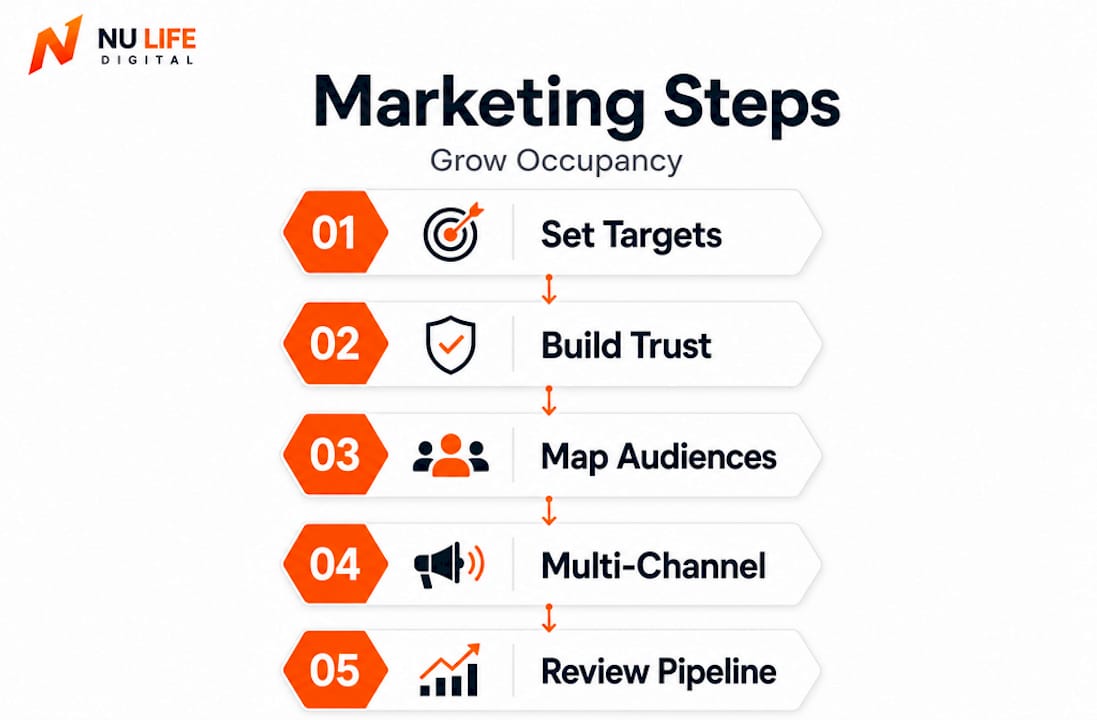
Filling vacant beds in a care home is not a job for generic digital campaigns or vanity metrics. Low occupancy is a revenue crisis, and the only way to fix it is to treat marketing as a precision operation tied directly to bed counts, conversion rates, and the complex web of people who influence every move-in decision. This guide cuts through the noise and gives you a structured, step-by-step approach that works in both the US and UK, respects regulatory obligations, and connects every single marketing activity back to the one number that actually matters: occupied beds.
Table of Contents
- Set the right occupancy and enquiry targets
- Comply with local regulations and build family trust
- Map and engage every audience that influences the decision
- Execute a multi-channel strategy for move-ins
- Measure, optimise, and avoid the common pitfalls
- Why compliance-first, occupancy-led marketing is the new care home standard
- Take your next steps: grow with expert-supported marketing
- Frequently asked questions
Key Takeaways
| Point | Details |
|---|---|
| Occupancy-led approach | Marketing succeeds when every tactic targets actual move-ins, not just impressions. |
| Regulatory compliance | UK marketers must prioritise honesty, CQC accuracy, and consent to build lasting trust. |
| Multi-stakeholder messaging | Your marketing must speak directly to both families and prospective residents at every stage. |
| Multi-channel execution | Combine digital, local referral, and offline tactics for steady, measurable occupancy gains. |
| Continuous optimisation | Regularly review conversions and compliance to avoid wasted spend and maximise results. |
Set the right occupancy and enquiry targets
Marketing without targets is guesswork. Before you choose a single channel or write a single ad, you need to work backwards from your occupancy goal. This is the foundational shift that separates facilities that consistently fill beds from those that endlessly chase traffic and wonder why enquiries never quite convert.
Start with the basics. Say your facility has 80 beds. Currently 54 are occupied. That means you have 26 vacant beds to fill. If your historical enquiry to move-in conversion rate sits at around 15%, then you need roughly 173 qualified enquiries to fill those vacancies. That is not a small number, and it immediately tells you that hoping people find your website organically is not a strategy.
An occupancy-led marketing approach works backwards from your target occupied beds and a realistic enquiry to move-in conversion rate, rather than optimising for vanity metrics like page views or social media impressions. This principle should govern every decision you make.
The next step is distributing that enquiry target over your realistic time window. If your average enquiry to move-in journey takes eight weeks, you need a steady pipeline running at all times, not a burst campaign followed by silence. Break the 173 enquiries into a weekly goal, assign that to your channels, and track it religiously.
Here is what a basic occupancy pipeline scorecard looks like:
| Metric | Target | This week | Year to date |
|---|---|---|---|
| Vacant beds | 26 | 26 | |
| Enquiries needed | 173 | 34 | 68 |
| Tours booked | 52 | 10 | 21 |
| Move-ins | 26 | 5 | 10 |
| Conversion rate (enquiry to move-in) | 15% | 14.7% | 14.7% |
Build something similar and review it every single week. Good digital marketing for care homes starts with this clarity, not with choosing between Facebook or Google.
Pro Tip: Keep a one-page pipeline scorecard pinned to the wall of every team meeting. When everyone sees the vacancy gap, marketing decisions become faster and sharper.
Once you have your targets locked, you have a genuine assisted living growth engine rather than a collection of disconnected activities. Every campaign, every piece of content, every referral conversation is now measured against the same goal.
Comply with local regulations and build family trust
Setting targets is only half the foundation. The other half is making sure every marketing activity you run is legally sound and genuinely trustworthy. Families choosing a care home for a loved one are under enormous emotional pressure. Any sign of misleading claims or slick marketing that glosses over reality will destroy trust instantly and permanently.
In the UK, compliance guardrails for vulnerable populations are non-negotiable: all advertising must be truthful and substantiated, your CQC rating must be displayed accurately, and every communication must comply with GDPR and PECR. Testimonials and photos involving residents require explicit written consent, obtained with a formal permission template that your compliance officer has approved.

The ASA CAP Code governs UK advertising broadly, but the care sector adds layers. A claim like “outstanding personalised care” must be supportable. If your CQC rating is “Requires Improvement,” you cannot imply otherwise in your marketing. The consequences of getting this wrong go beyond legal risk: families talk, and misleading claims about quality outcomes involving vulnerable-person imagery or testimonials will surface publicly and damage your reputation at the exact moment families are researching you online.
Here is a practical compliance checklist for every campaign:
- Honest claims only: Every quality statement must be evidenced and substantiated
- CQC rating displayed: Use your actual rating, link to your CQC profile, and never imply a higher rating than awarded
- GDPR and PECR compliant communications: Consent must be captured before any email or SMS marketing
- Testimonial and photo permissions: Obtain written consent, store it securely, and review permissions annually
- Sensitivity in imagery: Never use photos of residents who have not explicitly consented in writing
- Review third-party platforms: Ensure listings on directories like Carehome.co.uk reflect accurate, up-to-date information
“The most trusted care home marketers in any locality are those whose materials could pass scrutiny by a regulator, a journalist, and a grieving family simultaneously. Build every campaign to that standard.”
Your digital marketing strategy workflow should include a compliance gate before any content goes live. And when you get compliance right, it becomes a competitive advantage: families can see the difference between a home that is proud of its transparency and one that hides behind stock photography and vague promises. Pair compliance with content conversion strategies that inform, reassure, and guide families through their decision rather than simply selling at them.
Pro Tip: Create a single compliance template for testimonial and photo permissions, have your solicitor review it once per year, and train every member of staff who interacts with residents or families to use it consistently.
Map and engage every audience that influences the decision
Here is something most care home marketers underestimate: the person searching for a care home online is almost never the person who will live there. Assisted living decisions involve multiple stakeholders, often adult children plus the prospective resident, so your messaging and conversion content must serve both audiences simultaneously and speak to their different concerns.
Adult children are typically the primary researcher. They worry about safety, staffing ratios, activities, and whether their parent will be happy. They are usually managing guilt, grief, and time pressure simultaneously. The prospective resident, by contrast, worries about losing independence, leaving their home, and whether they will fit in socially.
A single generic brochure does not address either set of concerns adequately. You need dual-path content.
| Audience | Primary concern | Content that converts |
|---|---|---|
| Adult children (primary researcher) | Safety, quality, value, staffing | Virtual tours, CQC data, staff profiles, transparent pricing, testimonials from families |
| Prospective residents | Independence, belonging, dignity | Day-in-the-life videos, resident activity programmes, social events calendar, peer testimonials |
| Clinical referrers (GPs, discharge teams) | Clinical standards, medication management | Clinical capability summaries, professional case studies, direct contact details |
| Legal and financial advisers | Regulated status, fee transparency | Fee structures, funding guidance resources, regulatory standing |
Build your enquiry forms to capture which pathway a visitor is coming from. A simple question such as “Are you enquiring for yourself or a family member?” instantly allows you to tailor your follow-up communications. Your marketing strategy workflow should include separate email nurture sequences for each audience, and your care home enquiry form should be built to accommodate both paths without friction.
Test your FAQ pages and testimonials against both audiences too. A testimonial from a resident about enjoying the garden and making friends is gold for prospective residents. A testimonial from an adult child about the quality of night-time care and how quickly staff responded to a health concern is gold for families. You need both, prominently displayed.
Execute a multi-channel strategy for move-ins
With compliant, audience-specific content ready, the task is getting it in front of the right people at the right moment. Here is a practical weekly rhythm for care home marketing execution:
- Monday: Review pipeline scorecard. Identify which channels produced enquiries last week. Adjust budget or effort accordingly.
- Tuesday: Publish or update one piece of SEO-optimised content targeting local search terms (e.g., “care homes in [town name]”).
- Wednesday: Follow up with all outstanding enquiries. Speed matters enormously: responding within one hour of an initial enquiry dramatically improves conversion rates.
- Thursday: Reach out to one referral partner. This might be a GP surgery, a local solicitor who handles power of attorney, or a community group. Approach with value, not a pitch.
- Friday: Request a review from a recent move-in family. Track which directories the review appears on and respond publicly to all reviews, positive or negative.
“Speed is the most underestimated conversion lever in care home marketing. A family in crisis will enquire at two or three homes simultaneously. The one that calls back within the hour is the one that books the tour.”
For channel tracking, use this as your benchmark framework:
| Channel | Key metric | Target benchmark |
|---|---|---|
| Organic search (SEO) | Enquiries per month | 30% of total enquiries |
| Paid search (Google Ads) | Cost per qualified enquiry | Under £80 (UK) / $100 (US) |
| Care home directories | Tour bookings per listing | 2 to 3 per month per directory |
| Referral partners | Move-ins attributed | 20% of total move-ins |
| Social media (Facebook) | Enquiry form submissions | 10 to 15 per month |
| Email nurture | Tour conversion from nurture | 8 to 12% |
Referral marketing deserves its own focus. Mapping your local referrer ecosystem and approaching with genuine value before making any kind of pitch consistently produces higher-quality introductions than any paid channel. Start by listing every professional in a five-mile radius who regularly encounters families facing a care decision: GPs, hospital discharge teams, estate agents dealing with probate, solicitors handling deputyship and power of attorney, and funeral directors who support bereaved spouses still living at home.
Build care home SEO strategies that capture local intent searches, and pair them with assisted living SEO optimisation that ensures your facility appears in the right search results at the right time. Paid search can then amplify what organic search starts.
Pro Tip: Assign a named “channel champion” to each major lead source. One person owns referral relationships, another owns SEO and content, another manages paid ads. This prevents all channels defaulting to whoever has five minutes spare.
Measure, optimise, and avoid the common pitfalls
The most common failure in care home marketing is measuring tours to move-ins only once a quarter, rather than weekly. By the time you spot a problem in a quarterly review, you have already lost eight weeks of occupancy revenue.
Here is what you should be tracking every single week:
- Total enquiries by channel: Know where each one came from
- Tour booking rate: What percentage of enquiries result in a booked tour
- Tour to move-in conversion: How many tours actually convert
- Average time to move-in: Are you losing families during a long wait?
- CQC profile views and clicks: Are families checking your rating before enquiring?
- Review volume and sentiment: New reviews weekly across all directories
Run a fifteen-minute weekly standup with your marketing and admissions teams. Share the pipeline scorecard, flag any channels underperforming against benchmarks, and identify which enquiries have gone cold so follow-up can be escalated.
The three pitfalls that waste the most budget in this sector are: obsessing over website traffic while ignoring conversion rates; responding to enquiries hours or days late; and using generic, facility-focused messaging instead of audience-specific content that speaks to real fears and hopes. Niche marketing analytics can help you spot exactly where in the funnel you are losing families and why.
Pro Tip: Track conversion rates for every channel separately and share the results at every team standup. When the admissions team sees that referral leads convert at twice the rate of paid traffic, they immediately invest more time in referral relationships.
Why compliance-first, occupancy-led marketing is the new care home standard
There is a perspective worth sharing bluntly here: the era of care home marketing that prizes impressions, follower counts, and website sessions is over. Not because these metrics are irrelevant, but because they were never the right measure of success in this sector.
Care home marketing is a high-stakes, relationship-driven process operating under regulatory scrutiny and emotional intensity that very few other industries face. A family choosing a care home for a parent is not buying a product. They are entrusting you with the final chapter of someone’s life. The marketing that works in that context is marketing built on evidence, transparency, and genuine responsiveness.
Post-pandemic, families became significantly more discerning. CQC ratings are checked routinely. Reviews are read carefully. Staff turnover is scrutinised. Any facility that leans on polished photography and vague “award-winning care” language while failing to address real concerns will lose ground to a competitor whose assisted living growth engine is built around honest, audience-specific, data-driven marketing.
The facilities that will consistently outperform on occupancy over the next five years are not necessarily the ones with the biggest budgets. They are the ones that treat compliance as a competitive advantage, respond to enquiries faster than anyone else, build genuine referral relationships in their communities, and measure every campaign against occupied beds. That is the professional standard now. Everything else is just noise.
Take your next steps: grow with expert-supported marketing
If this framework has shown you gaps in your current approach, the good news is that none of this needs to be built alone.

At NU Life Digital, we specialise in helping assisted living facilities fill beds consistently using a combination of high-converting web design, targeted paid advertising, and AI-powered admissions systems. Whether you need a website that actually converts family enquiries or a full occupancy-led marketing strategy, we have built the systems to deliver it. Start with our guide to web design for assisted living to see what a conversion-engineered facility website looks like, or work through our website checklist for higher conversions to audit your existing site against the standards that actually move families from browsing to booking a tour.
Frequently asked questions
What is an occupancy-led marketing plan for care homes?
An occupancy-led marketing plan organises all efforts around the number of vacant beds, ensuring your targets, channels, and lead conversion rates are configured to fill actual needs, not just boost website visits.
What compliance issues are unique to UK care home marketing?
UK care home marketing must meet ASA standards, use CQC ratings accurately, and comply with GDPR and PECR rules. Compliance guardrails for vulnerable populations are particularly strict around testimonials, resident photography, and how quality claims are substantiated.
How can we improve enquiries and move-in conversions?
Focus on multi-channel visibility with rapid response to every lead, tailored messaging for both families and prospective residents, and a structured referral partner programme that produces consistent high-quality introductions.
What makes partner referral marketing work for care homes?
Mapping your local referrer ecosystem and approaching with genuine value first, such as co-hosting a dementia awareness event with a GP surgery, consistently produces higher-quality introductions than any paid channel and builds long-term sustainable referral flows.
What is the biggest mistake in care home marketing?
Focussing on impressions or web sessions rather than meaningful leads, tours, and move-in rates misses the occupancy goal entirely. As the occupancy-led approach makes clear, all activity must be traceable back to filled beds, not vanity metrics.
Recommended
- Effective SEO strategies for care homes to boost enquiries – Nu Life Digital
- Build an effective digital marketing strategy workflow – Nu Life Digital
- Elevate assisted living occupancy with effective SEO – Nu Life Digital
- Assisted Living Growth Engine™ – Nu Life Digital
- Proven strategies to increase brand visibility for SMBs – Palmador Blog