
TL;DR:
- Most businesses accumulate vast amounts of data but lack the analytics to generate meaningful insights that drive growth.
- Effective analytics applies logic and context to data, enabling smarter decisions, optimized strategies, and increased revenue.
- Adopting a mindset of continuous questioning, experimentation, and AI integration is essential for sustainable growth and competitive advantage.
Most businesses are sitting on mountains of data and going nowhere fast. They track pageviews, monitor ad spend, watch conversion numbers fluctuate, and still struggle to explain why growth stalls or where their best customers actually come from. The problem is not a lack of information. It is a lack of analytics. There is a critical difference between collecting data and generating the kind of insight that changes decisions, sharpens strategy, and compounds into real revenue growth. This article breaks down how analytics creates genuine value, where conventional measurement goes wrong, and what businesses in assisted living, e-commerce, and experience-based sectors need to do differently.
Table of Contents
- Why analytics, not just data, drives growth
- The six process-level paths: How analytics creates value
- Beyond attribution: Incrementality and the real measurement of growth
- Experimentation: The competitive advantage most teams avoid
- Machine learning: The future direction of analytics and growth
- Why most businesses get analytics wrong — and how to get it right
- Ready to unlock growth with advanced analytics?
- Frequently asked questions
Key Takeaways
| Point | Details |
|---|---|
| Analytics drives action | Transforming data into insights through analytics unlocks sustainable business growth. |
| Beware misleading attribution | Traditional attribution can overstate marketing ROI; incrementality offers a truer picture. |
| Experiment for true growth | Real-world tests like holdouts provide evidence that analytics alone can’t deliver. |
| Machine learning shifts value | ML is changing how analytics powers strategy, decision-making, and feedback cycles. |
Why analytics, not just data, drives growth
Data by itself is inert. A spreadsheet full of customer behaviour, ad performance numbers, and sales figures does not tell you what to do next. Analytics is the process that applies logic, context, and structure to that data so it actually means something. Without it, you are guessing with extra steps.
The distinction matters enormously for how you allocate budget, design campaigns, and prioritise growth initiatives. Businesses that learn to turn marketing data into action consistently outperform those that simply accumulate reports nobody reads.
A 2025 literature review synthesising 176 academic articles identified six distinct process-level paths through which business analytics creates value, from decision-making and knowledge creation to operational efficiency and strategic feedback. Critically, the research found that machine learning is actively shifting how those value paths work, placing greater weight on continuous learning and improved decision cycles rather than static reporting.
“Analytics value is not a single output. It is built through distinct mechanisms, and machine learning is fundamentally altering which mechanisms matter most and how quickly they deliver results.”
Here is a quick summary of how analytics differs from raw data collection at a practical level:
| Raw data | Analytics output |
|---|---|
| Number of website visitors | Conversion rate by traffic source |
| Total ad spend | Cost per qualified lead by channel |
| Enquiry volume | Lead quality score and close rate |
| Email open rates | Revenue per subscriber segment |
| Booking numbers | Revenue per customer and repeat rate |
Pro Tip: Always start with a business question, not a dataset. Ask “why are high-intent visitors not converting?” before you open a dashboard. The question shapes which data matters and which is noise.
Strong marketing strategy and growth always begins with clear analytical questions tied to revenue outcomes. That discipline separates businesses that grow predictably from those that chase metrics without purpose.
The six process-level paths: How analytics creates value
Once you accept that analytics is the engine rather than the output, the next step is understanding exactly how it generates value. The 2025 research models six distinct pathways, each of which translates analytical capability into tangible business outcomes.
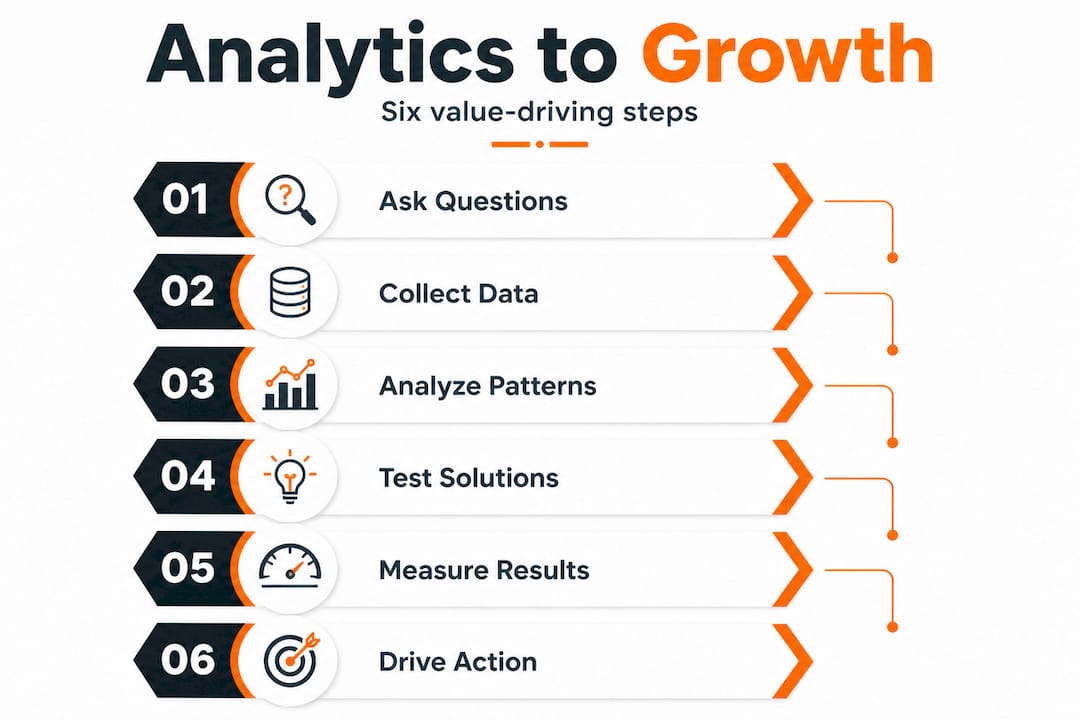
These are not abstract concepts. Every one of these paths represents a practical opportunity you can activate right now.
| Value path | What it does | Growth outcome |
|---|---|---|
| Decision-making | Turns insight into faster, better choices | Higher ROI on budget allocation |
| Knowledge creation | Builds institutional understanding over time | Competitive moat through proprietary insight |
| Operational efficiency | Identifies waste and streamlines processes | Lower cost per acquisition |
| Customer understanding | Maps behaviour, needs, and preferences | Improved targeting and retention |
| Risk reduction | Flags underperformance and anomalies early | Fewer costly mistakes |
| Feedback and learning | Closes loops between action and outcome | Compounding improvement over time |
Accessing these pathways is not automatic. It requires intentional design. Here is how to identify and activate value paths within your organisation:
- Map your decisions. List the five most important decisions your team makes each month. Are they backed by data, gut feel, or both? Identify which decisions could be sharper with better analytics input.
- Audit your data sources. Look at what you are actually collecting versus what you need. Most businesses have gaps in customer behaviour data, particularly around post-purchase activity and repeat engagement.
- Identify your biggest inefficiency. Pick one operational area where you suspect money is being wasted. Use analytics to quantify it before addressing it.
- Define a learning loop. Set up a simple cycle: test a change, measure the outcome, record the learning, apply it next cycle. Even a monthly review rhythm makes a significant difference.
- Assign ownership. Each value path needs a person responsible for actioning it. Analytics without ownership becomes a reporting exercise rather than a growth tool.
The data insights that create competitive advantage are rarely complicated. They are simply the result of asking better questions and having a system to act on the answers consistently.
Beyond attribution: Incrementality and the real measurement of growth
Here is where many businesses, including well-funded ones, get into serious trouble. Platform-reported attribution looks convincing. Google Ads says it drove 200 conversions. Facebook says it drove 150. Your CRM shows 180 sales. The numbers overlap, contradict, and everyone argues about which channel deserves credit.

The deeper problem is that attribution models measure correlation, not causation. They tell you which touchpoints appeared before a conversion, not which ones actually caused it.
This matters enormously when you are trying to scale. If you increase spend on a channel that looks responsible for growth but is not actually driving it, you waste significant budget while your real growth levers go unfunded.
Incrementality measurement addresses this by asking a different question entirely: what would have happened without this campaign? This counterfactual thinking is the foundation of causal measurement, and it routinely surfaces uncomfortable truths.
“Branded search and retargeting campaigns frequently show near-zero incremental lift when properly tested. They convert people who were already going to buy. Attribution credit is not the same as causal impact.”
Watch for these telltale signs that your attribution picture is overstated:
- Retargeting campaigns show high ROAS but your overall revenue does not change when you pause them
- Branded keyword spend appears to drive conversions that would have happened organically anyway
- Multiple channels claim credit for the same conversion, inflating total attributed revenue far beyond actual sales
- Your platform-reported conversion numbers are consistently higher than your CRM or payment processor data
- Campaign performance looks strong but business-level revenue growth is flat
Understanding ROI in marketing means accepting that some of what looks like performance is actually just measurement flattery. The businesses that scale efficiently are the ones willing to run the harder tests and act on what they find, even when the results are inconvenient.
This connects directly to performance marketing and growth strategy: real performance is proven through causal evidence, not credited touchpoints.
Experimentation: The competitive advantage most teams avoid
Incrementality does not emerge from analytics models alone. It requires genuine experimentation. And this is where organisational behaviour tends to get in the way of analytical rigour.
Most teams are evaluated on attributed KPIs. If your bonus depends on the attributed conversion numbers in your ad platform, you have a very strong incentive to avoid any test that might show those numbers are inflated. This is not dishonesty. It is a natural response to how teams are measured and rewarded. But it means that many organisations systematically avoid the experiments that would make them smarter and more efficient.
Practitioner evidence consistently shows that experiments outperform models, which outperform attribution. Holdout tests, geo-based experiments, and matched market testing reveal the truth about what is actually working in a way that no attribution model can replicate.
Here is how to launch a meaningful growth experiment in your business:
- Choose a testable hypothesis. For example: “Pausing retargeting spend for two weeks will not materially reduce total revenue.”
- Define your holdout group. Identify the audience, geography, or segment that will not receive the treatment. This is your control.
- Set a clear measurement window. Most geo tests and holdout experiments need at least two to four weeks of clean data to produce reliable results.
- Measure at the business level. Do not rely solely on platform data. Track total revenue, leads, or bookings in your CRM or backend system during the test period.
- Record and act on findings. Whether the hypothesis is confirmed or disproved, the learning is valuable. Document it and feed it into your next budget decision.
Pro Tip: Frame experiments to internal stakeholders as risk reduction, not channel audits. Saying “we want to make sure our budget is working as hard as possible” lands far better than implying that someone’s results might be overstated.
AI-powered predictive analytics can dramatically accelerate the experimentation cycle by identifying patterns in test data faster than manual analysis, helping you reach confident conclusions in shorter timeframes.
Machine learning: The future direction of analytics and growth
Machine learning is not simply a faster version of traditional analytics. It is a qualitative shift in how value gets created from data. Where conventional analytics describes what happened and why, machine learning begins to predict what will happen next and prescribe what to do about it.
For businesses in assisted living, e-commerce, and experience-based sectors, the practical applications are already accessible and delivering real results. The analytical literature is clear that ML is reshaping the feedback and decision-making value paths in particular, creating faster and more precise learning loops than any manual process can achieve.
Here are three concrete use cases relevant to our sectors:
- Assisted living and senior care. ML models can analyse enquiry data, response time patterns, and lead source quality to predict which incoming leads are most likely to convert to admissions. This allows admissions teams to prioritise intelligently and respond at the right moment, directly improving occupancy rates without increasing ad spend.
- E-commerce brands. Predictive replenishment and personalised product recommendation engines use machine learning to identify buying patterns and serve the right offer at the right time. For brands targeting £50k to £100k per month in revenue, this kind of personalisation compounds significantly across large customer bases.
- Luxury retreats and experience venues. ML-powered demand forecasting identifies peak booking windows and optimal pricing points, enabling revenue managers to maximise yield per booking period while maintaining the premium positioning that high-value clients expect.
Key insight: According to the 2025 research, the shift driven by ML is not merely about automating analysis. It fundamentally changes which value creation paths are most accessible and how quickly organisations can act on insight, moving from periodic reporting cycles to near-real-time feedback loops.
The most forward-thinking businesses are already integrating marketing and AI as a core operational strategy rather than an experimental add-on. Accessing machine learning services purpose-built for your sector is the practical next step if you are serious about staying ahead of competitors who are still relying on static dashboards.
Why most businesses get analytics wrong — and how to get it right
Here is the honest truth from working with businesses across multiple sectors: the analytics failure is almost never a technology problem. It is a mindset problem.
Business owners invest in dashboards, subscribe to analytics platforms, and hire someone to build reports. Then they look at those reports in quarterly meetings, nod, and go back to making decisions based on instinct. The data becomes wallpaper. Expensive, well-designed wallpaper.
The businesses that genuinely grow through analytics share one characteristic: they treat it as an ongoing decision tool, not a reporting ritual. They ask questions of their data constantly. They are genuinely curious about why numbers move, not just whether they are up or down. They build cultures where testing an assumption is seen as competent, not threatening.
There is also a persistent obsession with vanity metrics in our sectors. Assisted living operators track website traffic without measuring enquiry quality. E-commerce brands celebrate ROAS figures that do not survive incrementality testing. Experience venues count social followers while their booking conversion rate goes unexamined for months.
The shift required is not sophisticated. Stop asking “how did we perform?” and start asking “what should we do differently?” Treat every data point as a question rather than an answer.
For businesses in assisted living, e-commerce, and experience-based services, the genuine competitive edge in analytics comes from three things. First, building a clean, reliable data foundation so you are not making decisions on corrupted or incomplete information. Second, running regular experiments rather than relying purely on modelled attribution. Third, creating a culture where analytical curiosity is valued at every level of the organisation, not just in the marketing team.
Staying ahead of 2026 strategic marketing trends means understanding that the gap between analytics leaders and laggards is widening quickly. The businesses that treat analytics as infrastructure rather than an optional extra are the ones that will scale efficiently and sustainably.
Ready to unlock growth with advanced analytics?
At NU Life Digital, we build growth systems that turn analytical insight into measurable revenue. Whether you are scaling an e-commerce brand, filling beds in an assisted living facility, or maximising bookings for a premium experience venue, we combine strategy, data, and AI to deliver results that show up in your bank account.

Our approach covers everything from AI integration and automation that closes feedback loops at speed, to purpose-built e-commerce optimisation strategies that convert more of the traffic you are already paying for. If you want to understand exactly what your data is telling you and build a growth system around it, our analytics consulting team is ready to work with you. This is not about reports. It is about results.
Frequently asked questions
What is the difference between data and analytics in business growth?
Data is raw information; analytics is the structured process that transforms it into actionable growth strategies by identifying patterns, causal relationships, and decision-relevant insights.
Why can attribution in analytics be misleading for marketers?
Attribution models measure correlation rather than causation, which means they often overstate ROI. Incrementality testing reveals true business impact by measuring what would have happened without the campaign, frequently showing lower but more honest returns.
How can experimentation strengthen analytics for growth?
Controlled experiments such as holdouts and geo tests reveal true campaign effectiveness by eliminating the bias built into attributed KPIs, giving businesses the causal evidence they need to allocate budget confidently.
What role does machine learning play in modern business analytics?
Machine learning shifts how value is created through analytics by enabling continuous feedback loops, predictive modelling, and faster decision-making that static reporting tools simply cannot replicate.
Recommended
- Turn marketing data into action: what matters most – Nu Life Digital
- Why integrating marketing and AI drives business growth – Nu Life Digital
- Data insights – Nu Life Digital
- Why paid advertising drives measurable business growth – Nu Life Digital
- How To Drive Sales: A Multichannel E-commerce Marketing Guide!