
TL;DR:
- A strategic website redesign is essential for assisted living facilities to improve conversions and occupancy rates. Routine maintenance cannot fix core structural issues that cause prospects to leave without engaging, often costing facilities thousands or more. Proper planning, stakeholder alignment, and continuous optimization are crucial to achieving long-term growth and ROI from the digital presence.
Assisted living operators often spend months tweaking colours, swapping images, or refreshing a strapline, yet occupancy numbers barely move. The assumption is that any visible change counts as progress. It rarely does. A genuine gap exists between routine website maintenance and a full strategic redesign, and that gap has a direct cost measured in empty beds and missed enquiries. This guide walks you through the business case for redesign, the warning signs that your current site is holding you back, and the strategic steps that turn a rebuilt website into a consistent occupancy engine.
Table of Contents
- Why minor updates aren’t enough: Redesign vs maintenance
- Business case: How website redesign drives occupancy and ROI
- Is your facility due for a redesign? Top signs to watch
- Redesign strategy: Aligning quick wins and long-term growth
- The truth about website redesigns for assisted living
- Transform your facility’s digital presence with expert support
- Frequently asked questions
Key Takeaways
| Point | Details |
|---|---|
| Redesign beats maintenance | Only a thorough redesign can solve critical conversion or mobile issues and drive occupancy up. |
| Beware ROI delays | Delays in content production and unclear requirements can push returns to nine months or longer. |
| Prioritise mobile conversions | Mobile users convert less but dominate visits—redesign for their needs to boost results. |
| Blend quick wins with growth | Use PPC for rapid occupancy while SEO and content strategies mature post-redesign. |
Why minor updates aren’t enough: Redesign vs maintenance
Many facilities treat their website the same way they treat a boiler. Fix it when it breaks. Add a page when a new service launches. Update the footer copyright. These are maintenance tasks, and they serve a purpose. They keep the lights on. But they do nothing to address the structural problems that cause prospects to land on your site and leave without ever picking up the phone.
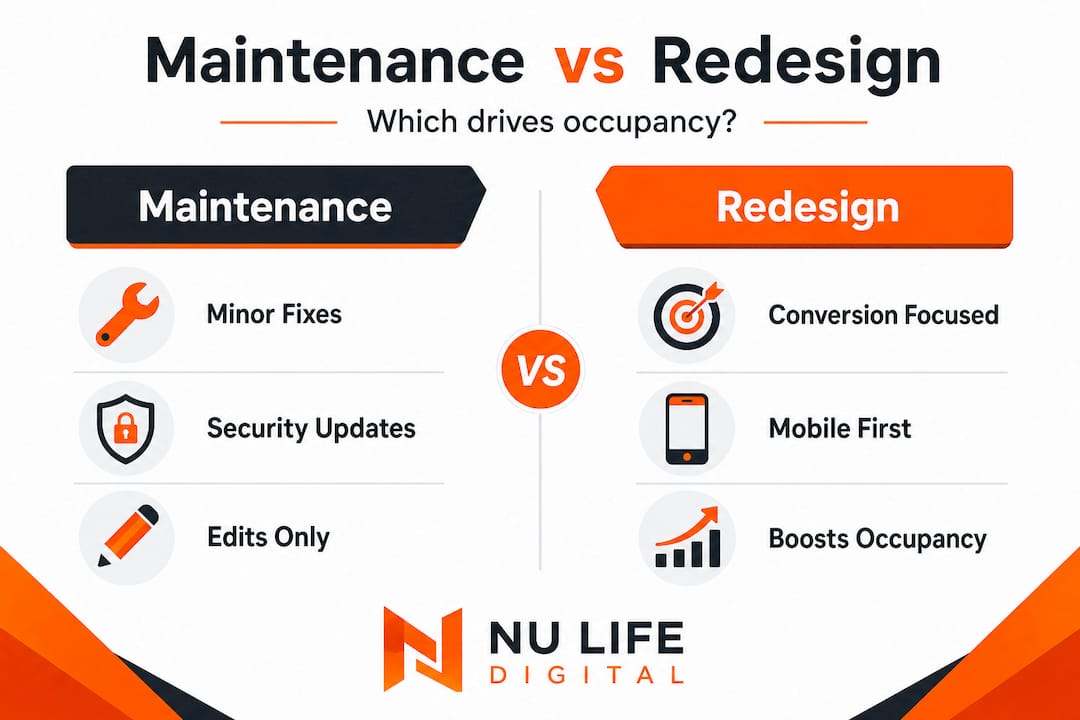
Website maintenance covers security patches, plugin updates, broken link fixes, and small content edits. A full redesign, by contrast, is a strategic overhaul of your information architecture, user journey, mobile experience, lead capture system, and brand positioning. These are entirely different activities with entirely different outcomes.
Redesign versus maintenance is a distinction that matters enormously when your conversion rate is stagnant or declining. If your site cannot guide a stressed adult child, searching on a smartphone at 11pm, from landing page to enquiry form in under three minutes, no amount of maintenance will fix that. The journey is broken at a structural level.
| Maintenance | Full redesign |
|---|---|
| Updates existing content | Rebuilds user journey from scratch |
| Fixes broken elements | Addresses root conversion problems |
| Low cost, quick to execute | Higher investment, strategic scope |
| Improves site reliability | Improves occupancy and lead quality |
| No brand repositioning | Can reposition your facility entirely |
| Suitable for functioning sites | Essential for declining performance |
“Quick PPC campaigns can fill a short-term occupancy gap, but when conversion infrastructure is fundamentally broken, only a strategic redesign resolves it. Maintenance is the wrong tool for a structural problem.” This is a reality many facilities only accept after months of wasted ad spend.
Understanding the redesign workflow for conversions makes it far easier to see where maintenance ends and meaningful change begins. When data shows declining conversions, poor mobile usability, or missed revenue targets, a patch will not rescue you.
Business case: How website redesign drives occupancy and ROI
Let us get specific about numbers, because the financial case for redesign is stronger than most operators realise, and the cost of inaction is higher than most expect.
A well-planned redesign increases lead generation by fixing the core user experience failures that cause prospects to bounce. It improves enquiry form completion rates, strengthens trust signals, and ensures your facility appears credible and welcoming on every screen size. Each of these improvements has a direct line to occupancy rates.
The counter-argument worth addressing honestly is cost. Poor redesigns that rebuild the wrong features can cost $100,000 (approximately £80,000) or more, with little to show in occupancy terms. This happens when facilities invest in visual polish without first auditing what prospects actually need. A beautiful homepage with a buried or confusing enquiry path is still a conversion failure.
| Risk factor | Impact on ROI |
|---|---|
| Content bottlenecks | Delays ROI realisation by 8-9 months |
| Wrong feature prioritisation | Wastes £80,000+ budget |
| Poor mobile experience | Conversion rate gap: 2.3% mobile vs 2.8% desktop |
| No stakeholder alignment | Scope creep, missed deadlines |
| No post-launch optimisation | Short-lived gains |
The mobile conversion rate gap is worth pausing on. Mobile converts at roughly 2.3% compared to 2.8% on desktop. That gap represents a meaningful volume of lost enquiries when most of your traffic arrives on a smartphone. A redesign that genuinely solves mobile usability closes that gap and adds real occupancy headroom.
Statistic to note: ROI from a redesign is typically realised 8-9 months post-launch. Facilities that move fastest on content preparation and stakeholder sign-off consistently hit results sooner.
Pro Tip: Before scoping your redesign, bring key stakeholders, including your admissions team and marketing lead, into the discovery phase. Their input shapes the right features and prevents expensive scope changes mid-project.
Investing in strong conversion optimisation strategies before and during a redesign ensures you rebuild what genuinely matters rather than what looks impressive on a design brief. Understanding website conversion for business growth is the foundation that separates facilities filling beds from those watching vacancies grow. Specifically for your sector, web design for assisted living involves trust architecture that generic design agencies simply do not account for.

Is your facility due for a redesign? Top signs to watch
Sometimes the hardest part is admitting the website is the problem. Occupancy plateaus are easy to blame on market conditions, pricing, or a competitor opening nearby. But when the site itself is repelling qualified prospects, the real culprit is structural and fixable.
Here are the clearest indicators that your facility is overdue for a strategic redesign:
- Stagnant or declining occupancy rates despite consistent marketing spend, suggesting enquiries are not converting.
- Slow page load times, particularly on mobile. A delay of even two seconds increases bounce rates significantly.
- Non-responsive layout that forces mobile visitors to pinch, zoom, and scroll horizontally to read basic information.
- High bounce rates on key pages such as the homepage, care options page, or pricing page, meaning visitors arrive and leave without engaging.
- Outdated visual design that does not reflect the quality and warmth of your facility, creating a trust gap before a prospect ever speaks with you.
- Content bottlenecks where updating a page requires a developer, causing information to go stale. This signals that your content management system is also due for attention.
- Low enquiry form completion rates, which point to a broken or poorly placed lead capture process.
- No clear calls to action, leaving visitors unsure what the next step is after reading about your services.
The mobile conversion rate gap of 2.3% versus 2.8% on desktop means a site that neglects mobile is quietly losing a meaningful share of potential residents. Most families begin their search on a phone, often in an urgent or emotional moment. If your site does not serve them clearly in that moment, they move to a competitor who does.
Pro Tip: Run your current site through Google PageSpeed Insights and check both mobile and desktop scores. Then walk the full enquiry journey on your own smartphone as if you were a worried family member. The friction points will be immediately obvious.
Using a detailed website checklist for revenue growth helps you assess each page systematically rather than relying on gut feel. Pairing that with strong content strategies for conversion ensures that a rebuilt structure is filled with the right messages, not just reorganised pages with the same weak copy.
Redesign strategy: Aligning quick wins and long-term growth
One of the most practical tensions in any redesign project is timing. You need occupancy results now. A full redesign and its accompanying SEO benefits take time to mature. The answer is not to delay the redesign, nor to abandon long-term strategy in favour of short-term fixes. The answer is to run both tracks simultaneously.
Here is a structured approach that many successful facilities follow:
-
Launch targeted PPC campaigns immediately. While the redesign is underway, Google and Facebook ads can drive qualified enquiries to your existing site or a purpose-built landing page. This maintains occupancy momentum without waiting for the full relaunch.
-
Prioritise high-impact redesign pages first. Your homepage, care overview page, and enquiry or contact page deliver the majority of conversion outcomes. Redesigning these first allows a phased launch that starts producing results before the full site is complete.
-
Build SEO architecture into the redesign from day one. URL structures, meta titles, schema markup, and page speed all need to be planned during design, not retrofitted afterwards. Retrofitting costs time and budget.
-
Develop content in parallel with design. Content bottlenecks are the primary cause of delayed ROI. Assigning a dedicated content resource during the redesign project, rather than leaving it until launch week, cuts months off your timeline.
-
Set 90-day post-launch review milestones. SEO gains compound over time, but you need measurable checkpoints. Define what success looks like at 90, 180, and 270 days, and review performance against those markers.
-
Integrate AI-driven lead handling early. Automated responses to enquiry form submissions, chatbot support outside office hours, and intelligent follow-up sequences mean no lead goes cold while your team focuses on admissions.
Understanding ROI in digital marketing clearly before your redesign launches gives you the measurement framework to justify continued investment and scale what works. Quick PPC wins sustain occupancy while SEO and content build a durable long-term position.
Pro Tip: Treat your redesign as a phased programme rather than a single event. A phased launch allows you to learn from real user behaviour on live pages and adjust the remaining sections before full release.
Contrasting approaches exist: some operators favour quick PPC for immediate occupancy and others rely entirely on long-term SEO. The evidence suggests neither extreme works as well as a coordinated dual strategy, particularly during a redesign window.
The truth about website redesigns for assisted living
Here is what most guides will not tell you directly. A redesign does not automatically fill beds. “Redesign and they will come” is a fantasy that has cost facilities tens of thousands of pounds and months of wasted time. Real results come from pairing a technically sound, conversion-focused rebuild with three things that most operators underinvest in: clear strategic goals set before a single wireframe is drawn, genuine mobile-first user experience thinking, and early stakeholder alignment that prevents the project from drifting.
The most damaging pattern we observe is this: a facility invests in a visually impressive redesign, launches it with enthusiasm, and then waits. Six months later, occupancy has not moved. The diagnosis is nearly always the same. The content was not ready at launch, the lead capture journey was not tested on mobile, and nobody defined what a successful enquiry path actually looked like before the build began.
Content bottlenecks delay ROI by an average of 8-9 months. That is not a design agency problem. That is a client-side resource problem that requires honest planning and dedicated time from someone on your team.
The other uncomfortable truth is that a redesign is not a destination. Facilities that treat launch day as the finish line consistently underperform those that treat it as the start of an optimisation programme. Your site should be reviewed, tested, and refined continuously based on real enquiry data, user behaviour recordings, and conversion analytics.
Strong conversion workflow insights reinforce this point clearly. The facilities achieving the best occupancy results from their websites are those running structured monthly reviews of their conversion data and acting on what they find. One good redesign, done properly, then consistently optimised, outperforms an endless cycle of cosmetic refreshes every time.
Transform your facility’s digital presence with expert support
If several of the warning signs in this article reflect your current website, the next step is a structured conversation about what a strategic redesign could achieve for your facility specifically.

At NU Life Digital, we build high-converting websites for assisted living facilities across the US and UK, designed from the ground up to generate consistent enquiries and support admissions growth. Our approach combines expert web design with AI-powered lead handling and conversion-focused strategy, so your website works around the clock. We apply proven web design best practices that are specific to senior care, not adapted from generic templates. If you are ready to stop patching and start growing, we would welcome a conversation about your facility’s goals and what a purpose-built digital presence could deliver.
Frequently asked questions
How long does it take to see ROI from a website redesign?
ROI typically arrives 8-9 months after launch, with delays most common when content preparation or internal approvals slow the process down.
Is a full redesign always necessary, or can maintenance suffice?
Maintenance handles minor fixes well, but failing conversions and poor mobile results require a full strategic redesign to resolve at a structural level.
What are the most costly errors in website redesign projects?
Rebuilding wrong features and slow content approvals are the two primary causes of wasted budget and extended timelines, often costing $100,000 or more in lost opportunity.
Should assisted living facilities prioritise mobile or desktop design?
Mobile demands the closest attention because conversion rates on mobile lag desktop by a measurable margin, yet the majority of families searching for care do so on a smartphone.
Recommended
- How a website redesign workflow drives more conversions – Nu Life Digital
- How web design drives conversion for assisted living – Nu Life Digital
- Conversion optimisation explained: strategies for revenue growth – Nu Life Digital
- Boost revenue with top website conversion optimisation tips – Nu Life Digital