
TL;DR:
- Many businesses invest heavily in digital marketing but struggle to measure true ROI, which hampers growth.
- Understanding key metrics like CLV, CPA, and revenue attribution, combined with analytics tools, can significantly improve returns.
Businesses pour thousands into Google ads, social campaigns, and content creation every month, yet many cannot say with confidence what they are actually getting back. It is one of the most common frustrations we hear from marketing managers and e-commerce owners alike. The assumption that digital marketing ROI is somehow vague or impossible to pin down is holding real businesses back from making smarter decisions. This guide will change that. By the end, you will know exactly how to define, measure, and improve your digital marketing ROI in ways that translate directly into business growth.
Table of Contents
- Understanding ROI in digital marketing
- Key metrics for measuring digital marketing ROI
- Analytics tools and data for enhancing ROI
- ROI benchmarks and maximising returns from digital marketing
- What most guides miss about ROI in digital marketing
- Increase your digital marketing ROI with expert help
- Frequently asked questions
Key Takeaways
| Point | Details |
|---|---|
| ROI guides strategy | Clear ROI measurement informs smart marketing decisions and budget allocation. |
| Metrics matter | Using multiple metrics gives a more accurate picture than relying on a single number. |
| Analytics drive improvement | Leverage analytics tools to discover opportunities for better returns on digital marketing. |
| Benchmark and optimise | Compare your ROI to industry norms and continually refine campaigns for the best results. |
| Think long-term | True digital ROI includes both immediate wins and sustained business growth over time. |
Understanding ROI in digital marketing
ROI stands for Return on Investment. In a digital marketing context, understanding ROI is fundamental for digital marketing effectiveness and means calculating how much profit your campaigns generate relative to what you spend on them. The basic formula is straightforward: subtract your marketing spend from the revenue it produced, divide that figure by your spend, and multiply by 100. The result is your ROI percentage.
What makes digital marketing ROI distinct from general business ROI is the granularity available to you. Unlike a TV billboard or a print catalogue, digital channels let you track every pound spent against every action taken. A click, a form submission, a purchase, an email open. This level of detail is an enormous advantage, and it is one that many businesses still fail to exploit properly.
ROI matters because it directly informs how you allocate budget. If one channel consistently returns £6 for every £1 spent and another returns £1.50, that difference should shape your entire strategy. Many businesses continue spreading budget evenly across channels out of habit rather than data. That approach costs money and slows growth.
Here are the most common misunderstandings around digital marketing ROI:
- It is the same as website traffic. Traffic is a vanity metric. ROI measures profit, not visits.
- It only applies to paid advertising. SEO, email, and content marketing all have measurable ROI.
- Short-term results tell the full story. A campaign might look weak in month one but generate compounding returns over six months.
- It is too complex to calculate without specialist tools. A basic spreadsheet and consistent tracking can get you most of the way there.
Working with experienced digital agency services can accelerate the process considerably, but the foundational thinking is accessible to any business owner willing to engage with the numbers. Understanding how agencies transform online presence is a useful starting point if you are evaluating where your current setup is falling short.
“ROI is not just a finance metric. It is the language that connects your marketing team’s work to business outcomes that the boardroom and investors actually care about.”
Key metrics for measuring digital marketing ROI
Once you understand what ROI means, the next question is: what do you actually measure? Digital marketing ROI is measured through various performance indicators, and relying on just one will give you a distorted picture.
The most important metrics to track are:
- CPA (Cost Per Acquisition): How much it costs to gain one paying customer. Lower is better, but only if the quality of customers remains high.
- CPC (Cost Per Click): The cost of a single click in paid advertising. Useful for benchmarking ad efficiency, but meaningless without conversion data alongside it.
- CPL (Cost Per Lead): The cost to generate a single enquiry or lead. Critical for service-based businesses where the sales cycle is longer.
- Revenue attribution: Identifying which channels and touchpoints contributed to a sale. This is where things get genuinely complex, but also genuinely revealing.
- Customer Lifetime Value (CLV): The total revenue a customer generates across their relationship with your business. A single purchase tells you little; CLV tells you everything.
The distinction between short-term and long-term metrics is one of the most important things to grasp. Short-term metrics like conversions and click-through rates tell you what is working right now. Long-term metrics like customer retention rates, brand search volume, and CLV tell you whether your marketing is building something durable.
Here is a simple comparison to illustrate this:
| Metric | What it measures | Time horizon | Risk if ignored |
|---|---|---|---|
| CPA | Cost to acquire one customer | Short-term | Overspending on poor-quality leads |
| CLV | Total revenue per customer | Long-term | Undervaluing loyal customers |
| Revenue attribution | Which channels drive sales | Both | Misallocating budget |
| Conversion rate | Visitors who take action | Short-term | Missing UX or offer problems |
| Brand search volume | Organic brand awareness | Long-term | Failing to invest in brand equity |
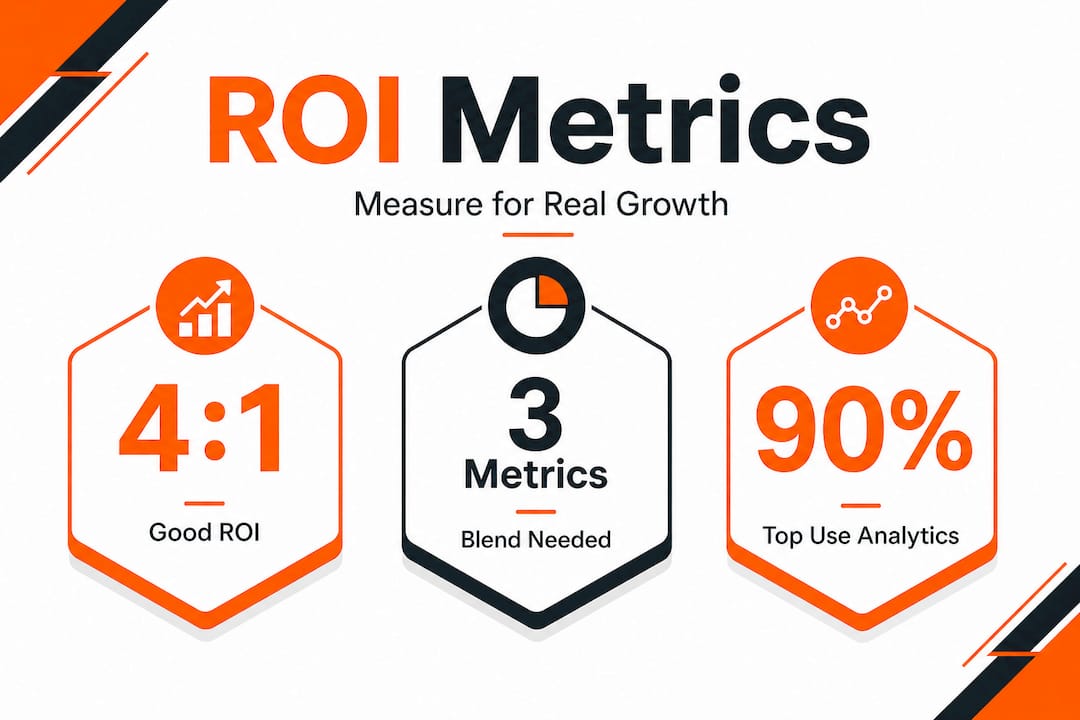
It is worth noting that multiple performance metrics are needed to assess real ROI, not a single number. The businesses that grow fastest are those that measure marketing ROI across several dimensions simultaneously rather than fixating on one figure.
Pro Tip: If you are only looking at click-through rates and ignoring revenue attribution, you are flying partially blind. Build attribution into your tracking from day one.
A common pitfall is obsessing over vanity metrics such as followers, impressions, or raw traffic. These numbers feel good but they do not pay salaries. Align your reporting around metrics that map directly to revenue. This is especially relevant if you are working in a competitive niche and every pound of budget needs to justify itself. Understanding performance marketing principles gives you a useful framework for making this shift. Staying current with digital marketing trends also helps you anticipate which metrics are gaining importance as platforms and algorithms evolve. Those working in regulated or niche sectors, such as senior care, can benefit from tailored guidance on digital marketing for care homes to identify the most relevant performance indicators. Use a ROI calculator to model different scenarios before committing budget.
Analytics tools and data for enhancing ROI
Knowing which metrics matter is only half the job. You also need the right tools to collect, interpret, and act on the data. Analytics can increase digital marketing ROI by up to 29%, which is a significant gain for businesses that have historically relied on gut instinct or fragmented reporting.
Here are the most widely used analytics tools and what each does well:
- Google Analytics 4 (GA4): The industry standard for tracking website behaviour, traffic sources, and conversion events. GA4 uses an event-based model, which means you can track almost any user action with the right setup.
- CRM dashboards (e.g., HubSpot, Salesforce): These connect marketing activity to actual sales outcomes. If your CRM is set up correctly, you can trace a lead from the first ad click through to closed revenue.
- Google Search Console: Reveals which search queries bring users to your site, click-through rates from organic search, and technical issues that may be suppressing your visibility.
- Meta Ads Manager and Google Ads: Both platforms offer in-built attribution and ROI reporting, though they each have an incentive to overstate their own contribution to conversions.
- Custom API integrations: For more sophisticated setups, pulling data from multiple platforms into a central dashboard (using tools like Looker Studio or a custom-built solution) gives a unified view of performance across all channels.
The real power of analytics is not in the dashboards themselves but in what they reveal. A well-configured GA4 account, for example, can show you that 60% of your paid traffic lands on a page with a 3% conversion rate while organic traffic to a different page converts at 11%. That single insight could redirect your entire paid strategy.

Consider a practical scenario: an e-commerce brand running Google Shopping ads notices through GA4 that mobile users have a 1.2% conversion rate while desktop users convert at 4.8%. Without analytics, they would have no idea why revenue was stagnating despite strong traffic. With this data, they can prioritise mobile UX improvements and see an immediate lift in ROI. This is what turning data into action actually looks like in practice.
AI is also changing how data is interpreted. Automated insights, predictive audiences, and intelligent bidding strategies are now built into many ad platforms. Understanding marketing and AI integration is increasingly important for businesses that want to extract maximum value from their data without requiring a full data science team.
Pro Tip: Set up conversion tracking for every meaningful action on your website before launching any paid campaign. This includes purchases, form submissions, phone call clicks, and live chat initiations. Without this foundation, you are optimising blind.
ROI benchmarks and maximising returns from digital marketing
Understanding benchmarks gives you a realistic target to aim for and helps you quickly identify when a campaign is underperforming. Benchmarks help set ROI expectations for digital campaigns and vary considerably by channel and industry.
Here is a general overview of what to expect across the main digital channels:
- Email marketing: Consistently one of the highest-performing channels. Average ROI benchmarks often sit in the region of 36:1 to 42:1, meaning for every £1 spent, returns of £36 to £42 are common. The low cost of delivery makes this possible.
- SEO (Search Engine Optimisation): Returns compound over time. Initial investment is high and results are slow, but a well-optimised site can generate significant organic revenue with relatively little ongoing spend after the first 12 to 18 months.
- Paid search (Google Ads): Average ROI tends to sit around 2:1 globally, though competitive niches can make this considerably harder to achieve. High-intent keywords and strong landing pages are the key variables.
- Paid social (Facebook, Instagram, LinkedIn): Highly variable. B2C brands with visually compelling products often see strong returns. B2B and service businesses need longer nurture sequences to see meaningful ROI from social paid campaigns.
- Content marketing: Slow to build but durable. Well-ranking content drives qualified traffic for years with no ongoing spend. ROI is harder to attribute but often excellent over a 24-month horizon.
The key insight from strategic digital marketing ROI analysis is that ROI should be compared across channels rather than evaluated in isolation. A campaign that returns 3:1 on paid social might look weak until you realise it is building the remarketing audience that makes your email campaigns perform at 40:1.
Actionable ways to improve your returns include:
- A/B testing landing pages: Small changes to headlines, button copy, and page layout can lift conversion rates by 20% to 40% on well-trafficked pages.
- Refining audience targeting: Excluding poor-fit audiences is often as valuable as finding new ones. Negative keywords and audience exclusions save significant budget.
- Improving your offer clarity: Many campaigns underperform not because of targeting or budget issues but because the value proposition is unclear. If a visitor cannot understand why they should act within five seconds, they will not.
- Funnel optimisation: Identify where in the customer journey people are dropping off and address those friction points systematically. Every stage of the funnel leaks; your job is to find where it leaks most.
Pro Tip: Do not benchmark your performance against industry averages alone. Track your own month-on-month improvement. Beating your own previous best is more actionable than chasing a number that may not reflect your market, your offer, or your audience quality.
Explore paid advertising strategies for more detailed frameworks on maximising returns from paid channels specifically.
What most guides miss about ROI in digital marketing
Most ROI guides tell you to measure everything, track everything, and optimise relentlessly. That advice is not wrong, but it misses something important. An obsessive focus on short-term ROI can actively damage your long-term business value.
Here is an uncomfortable truth: some of the best marketing investments look terrible in a 30-day ROI report. Brand building, content authority, community development, and trust signals all take time to compound. A business that slashes these activities every time a monthly report looks lean is systematically eroding the asset that makes all other marketing work better.
We have seen e-commerce brands triple their paid ad spend because the short-term ROI looked strong, only to see returns diminish six months later because they had neglected organic search, email list health, and brand differentiation. Their paid ROI was strong because they had built brand equity over years. They mistook the effect for the cause.
The most effective marketers we work with treat ROI across two simultaneous lenses: immediate revenue generation and long-term brand asset building. They make data-led decisions from actionable marketing data while protecting investments that show their value in years, not weeks.
This does not mean accepting poor results indefinitely in the name of “brand building.” It means constructing a reporting framework that captures both dimensions, so your strategy is neither purely short-term nor blindly long-term. The businesses that scale sustainably are those that refuse to sacrifice one for the other.
Increase your digital marketing ROI with expert help
Understanding ROI is the first step. Building the systems that consistently deliver it is where most businesses need genuine support.

At Nu Life Digital, everything we build is engineered around measurable returns. From conversion-focused web design to AI-powered lead handling and paid advertising ROI strategies, we focus on what moves the revenue needle. If you are an e-commerce brand looking to scale and need a partner focused on boosting online sales with clarity on returns, we would love to talk. We do not deal in guesswork or generic campaigns. We build growth engines, and ROI is how we measure whether they are working.
Frequently asked questions
How do you calculate ROI in digital marketing?
ROI in digital marketing is calculated as (Net Profit from Campaign minus Total Investment) divided by Total Investment, then multiplied by 100 for a percentage. The simplest ROI formula is straightforward to apply once you have consistent revenue attribution in place.
What is a good ROI for digital marketing campaigns?
A good ROI generally ranges from 4:1 to 8:1 or higher, though this varies by channel and industry. Marketing campaigns often target a 5:1 ROI as a reasonable benchmark to aim for initially.
Why is tracking ROI in digital marketing important?
Tracking ROI ensures your marketing spend generates real business value and prevents budget from flowing into channels that underperform. Consistent ROI tracking also improves strategic decision-making over time as you accumulate reliable performance data.
Which digital channels offer the highest ROI?
Email, SEO, and well-structured paid advertising consistently deliver strong returns, though the best channel depends on your business model and audience. ROI benchmarks vary significantly by channel, so comparing across your own mix is essential.
How often should I measure digital marketing ROI?
Measure ROI monthly to catch underperforming campaigns quickly, but also review quarterly and annual trends to capture the compounding value of brand and organic channels that take longer to mature.
Recommended
- Step-by-step conversion rate optimisation guide: grow revenue – Nu Life Digital
- Why marketing strategy matters for business growth – Nu Life Digital
- What is performance marketing? Drive measurable growth – Nu Life Digital
- Conversion optimisation explained: strategies for revenue growth – Nu Life Digital
- Digital marketing importance: grow your Sussex business
- Optimise Your Dubai Marketing Process for Greater ROI | Journal | Almost Impossible