
TL;DR:
- Conversion rate optimization boosts revenue by improving website actions without increasing traffic spend.
- A systematic CRO process, including proper tools and leadership buy-in, leads to sustainable growth.
- Key to success is viewing testing as a learning cycle, not just applying quick tactics.
You’re spending money on traffic, running ads, posting on social media, and still watching your sales or enquiries flatline. The problem usually isn’t your marketing spend. It’s what happens after someone lands on your website. Conversion optimisation strategies directly impact revenue and business growth, yet most businesses treat their website as a brochure rather than a revenue machine. This guide walks you through the exact process to fix that: from understanding the core concepts, to setting up your tools, running tests, and avoiding the mistakes that quietly kill results.
Table of Contents
- Understanding conversion rate optimisation and its impact
- What you need before you start: tools, data and preparation
- Step-by-step conversion rate optimisation process
- Avoiding common CRO mistakes and troubleshooting results
- What most guides miss about CRO: the mindset shift
- Accelerate results with expert conversion rate optimisation support
- Frequently asked questions
Key Takeaways
| Point | Details |
|---|---|
| CRO boosts revenue fast | Improving website conversion rates delivers rapid, measurable gains without buying extra traffic. |
| Right tools are essential | Analytics, heatmaps and structured data let you target bottlenecks for the greatest impact. |
| Follow a proven process | A clear, stepwise workflow avoids guesswork and delivers consistent optimisation wins. |
| Learn from every test | Systematic reviews and a learning mindset turn each experiment—win or lose—into future growth. |
| Expert help accelerates results | Working with specialists helps avoid critical mistakes and achieves stronger, faster CRO outcomes. |
Understanding conversion rate optimisation and its impact
Conversion rate optimisation, or CRO, is the practice of improving your website so a higher percentage of visitors take the action you want. That action might be a purchase, a form submission, a phone call, or a booking. The conversion rate itself is straightforward: divide the number of conversions by your total visitors, multiply by 100, and you have your percentage.
Why does this matter so much? Because CRO techniques can multiply sales without increasing your traffic spend. Instead of doubling your ad budget to double your revenue, you engineer more value from the visitors already arriving. That is a fundamentally different and far more efficient growth lever.
Here is a quick look at average conversion rates across sectors:
| Sector | Average conversion rate |
|---|---|
| E-commerce (general) | 1.5% to 3% |
| B2B services | 2% to 5% |
| Assisted living enquiries | 3% to 6% |
| SaaS free trials | 5% to 10% |
Even a one percentage point improvement from 2% to 3% represents a 50% increase in conversions from the same traffic. That is the power of incremental gains compounding over time.
Understanding why conversions power business growth means recognising that every element of your site either builds or destroys trust. Page speed, headline clarity, button placement, social proof, and form length all play a role. The role of content in CRO is particularly underestimated: the wrong words at the wrong moment will lose a sale no matter how polished your design looks.
Key business objectives you should align with user actions:
- E-commerce brands: Product page adds-to-basket, checkout completions, upsell acceptance
- Assisted living facilities: Enquiry form submissions, brochure downloads, tour bookings
- Service businesses: Contact form completions, phone call clicks, quote requests
The CRO definition by Optimizely frames it clearly: CRO is about understanding what drives, stops, and persuades your users, then acting on that knowledge systematically. Start with that mindset and everything else follows.
What you need before you start: tools, data and preparation
Once you know why CRO matters, set your foundation for reliable, actionable insights. Jumping straight into testing without proper setup is one of the most common and costly mistakes teams make. You end up running tests on assumptions rather than evidence, and the results tell you nothing useful.
Proper setup with analytics and heatmapping is essential to spot conversion barriers before you touch a single element on your site. Here is a comparison of the core tool categories:

| Tool type | Purpose | Example tools |
|---|---|---|
| Web analytics | Traffic, behaviour, drop-off points | Google Analytics 4, Adobe Analytics |
| Heatmapping | Click, scroll and attention patterns | Hotjar, Microsoft Clarity |
| Session recording | Real user journey playback | FullStory, Mouseflow |
| A/B testing | Split testing variations | VWO, Optimizely, Google Optimize |
| Form analytics | Field-level abandonment tracking | Formisimo, Zuko |
Before running a single test, make sure you have the following baseline data:
- Current conversion rate for each key page or goal
- Traffic volume sufficient for statistical reliability (generally 500 or more conversions per month per goal)
- Form submission rates and drop-off points
- Bounce rates segmented by device and traffic source
- Existing sales data showing which products or services convert best
Team structure matters too. CRO is not a solo job. You need a marketing lead to manage the strategy, a designer to build test variations, a developer to implement changes, and ideally a decision-maker who champions the programme. Without leadership buy-in, tests get deprioritised and momentum dies.
For setting up CRO tools correctly, follow the platform-specific guides and audit your tracking setup before trusting any data. Broken or misconfigured goals are far more common than most teams realise.
Pro Tip: Run a “data audit” before your first test. Check that all conversion goals are firing correctly in Google Analytics 4, confirm your heatmap tool is capturing data on your most-visited pages, and segment your traffic by device. Mobile and desktop users often behave very differently, and treating them as one group skews every decision you make.
Step-by-step conversion rate optimisation process
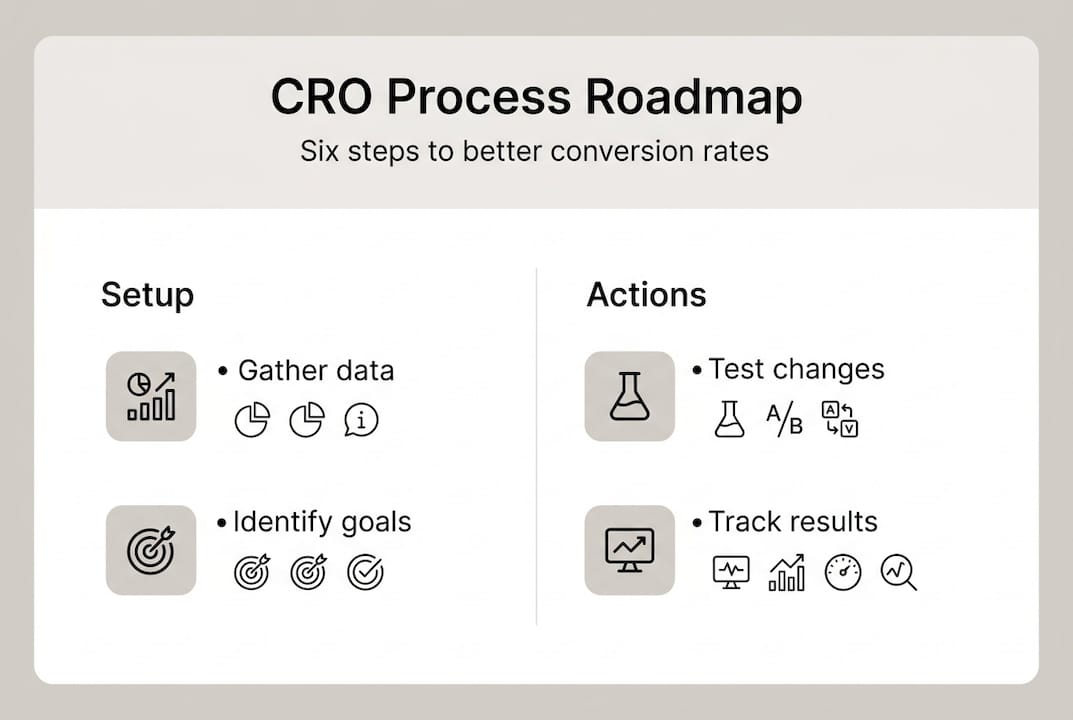
With your baseline set, you are ready for the core CRO workflow. This is the sequence that separates businesses who see measurable gains from those who run a few tests, get inconclusive results, and give up.
- Benchmark your current performance. Record your existing conversion rate, average order value (for e-commerce), and key funnel metrics. This is your control group.
- Gather qualitative and quantitative insights. Use heatmaps, session recordings, and user surveys to understand why visitors are not converting. Pair this with analytics data showing where they drop off.
- Form clear hypotheses. A hypothesis follows this structure: “If we change X, then Y will happen, because Z.” For example: “If we reduce the checkout form to three fields, cart completion will increase, because friction is the primary barrier.”
- Prioritise your tests. Use a prioritisation framework such as PIE (Potential, Importance, Ease) to focus on high-impact, achievable changes first. Landing page optimisation is almost always one of the highest-priority starting points.
- Build and launch the test. Create your variation, set your test live via your A/B testing platform, and let it run until you reach statistical significance. Never call a test early.
- Analyse results. Look beyond the headline metric. Did the winner perform consistently across devices? Did it affect other metrics like average order value or bounce rate?
- Implement and repeat. Roll out winners, document learnings from losers, and feed insights into your next hypothesis. Structured conversion workflows lead to measurable growth precisely because they are repeatable, not reactive.
Pro Tip: Start testing at the bottom of your funnel first. Your checkout page or enquiry form is closer to revenue than your homepage. A 10% improvement there delivers immediate, tangible results and builds team confidence in the process.
Remember: A failed test is not a wasted test. Every result teaches you something about your audience. The only wasted test is one you did not document properly. Well-optimised landing pages deliver significant conversion uplift, but only when learning is captured and applied systematically. Keep a shared test log your whole team can access.
For a broader view of how top practitioners approach this, the proven CRO process outlined by Crazy Egg reinforces these steps with real-world examples.
Avoiding common CRO mistakes and troubleshooting results
After mastering the process, avoid setbacks by learning from common pitfalls. Even experienced teams make errors that invalidate tests or waste weeks of effort.
The most damaging mistakes include:
- Changing too many elements at once. If you redesign a landing page entirely and conversions improve, you will not know which change caused it. Test one variable at a time.
- Neglecting mobile users. In 2026, mobile accounts for the majority of e-commerce traffic in most sectors. A test that wins on desktop but loses on mobile is not a winner.
- Stopping tests too early. Many teams call a test at 60% confidence because the trend looks promising. Statistically, this leads to false positives and wasted implementation effort.
- Not segmenting results. Aggregate data hides important truths. A change that harms new visitors but helps returning ones is not a straightforward win.
- Ignoring post-test reviews. Regular post-test reviews ensure continual improvement and keep the team learning from both wins and losses.
For boosting online sales, troubleshooting starts with asking the right questions: Was the test running long enough? Were there any external factors (seasonal traffic spikes, promotions) that skewed results? Was the sample size large enough?
Caution: If a test produces a surprising negative result, do not dismiss it. Negative results often reveal deeper problems: unclear value propositions, trust issues, or audience misalignment. Dig into session recordings for the losing variation before moving on. The CRO mistakes by HubSpot article is a useful reference for cross-checking your process against common failure points.
Building a habit of post-test documentation transforms your team from reactive testers into genuine learning machines. That institutional knowledge compounds over time and becomes one of your most valuable growth assets.
What most guides miss about CRO: the mindset shift
Here is the uncomfortable truth: most CRO guides focus on tactics because tactics are easier to sell. Change this button colour. Shorten your form. Add a testimonial. These things can work, but they are not what separates businesses that grow 20% in six months from those that plateau after one good test.
The real differentiator is leadership buy-in and a culture of experimentation. We have worked with teams who had access to the same tools, the same traffic, and the same budget. The ones who scaled consistently were the ones where the founder or marketing director treated every test result, win or loss, as valuable information rather than a verdict on someone’s judgement.
When you frame CRO as learning rather than winning, your team takes smarter risks, shares results openly, and builds on each cycle. That compounds. One client in the e-commerce space doubled their conversion rate over eight months not because they found a magic tactic, but because they ran 34 documented tests and extracted a lesson from every single one. Sustainable revenue growth does not come from one-off tricks. It comes from systems that keep improving.
Accelerate results with expert conversion rate optimisation support
Implementing a full CRO programme takes time, the right tools, and experience reading ambiguous data under pressure. Getting it wrong early wastes months.

At NU Life Digital, we specialise in building growth engines for e-commerce brands and assisted living facilities that are serious about scaling revenue. From auditing your current website optimisation setup to designing high-converting pages and running structured test programmes, we handle the full process. Our expert web design is engineered for conversion, and our e-commerce solutions are built to take brands from stagnant to scaling. If you are ready to turn more of your existing traffic into revenue, get in touch and let’s talk about what that looks like for your business.
Frequently asked questions
What is a good conversion rate for e-commerce in 2026?
A solid e-commerce conversion rate in 2026 sits between 2% and 4%, though top-performing stores regularly exceed 5%. Average e-commerce rates vary significantly by sector, traffic source, and device type.
What are the most important tools for conversion rate optimisation?
The essentials are Google Analytics 4 for behaviour data, a heatmapping tool such as Hotjar, A/B testing software, and session recording. Required CRO tools should be configured and audited before any testing begins.
How long does it take to see CRO results?
You may see early indicators within a few weeks, but a properly validated optimisation cycle typically takes two to three months. CRO timing and results depend heavily on your traffic volume and the number of conversions per goal.
How do I know a CRO test worked?
Look for statistically significant improvements in your target metric, ideally at 95% confidence or above, and confirm the result holds across different segments and devices over time.
What are common CRO mistakes to avoid?
Avoid testing multiple elements simultaneously, ignoring mobile performance, and stopping tests before reaching statistical significance. Common CRO mistakes also include failing to segment results and skipping post-test documentation.
Recommended
- Conversion optimisation explained: strategies for revenue growth – Nu Life Digital
- Website conversion workflow that drives measurable growth – Nu Life Digital
- Boost revenue with top website conversion optimisation tips – Nu Life Digital
- Top strategies to optimise e-commerce brands for higher conversions – Nu Life Digital
- Step by Step Digital Transformation Guide for ROI