TL;DR:
- Storytelling creates emotional connections, making marketing more persuasive and memorable.
- Effective stories should be meaningful, relevant, authentic, and differentiated to drive conversion.
- AI can support but not replace human touch; authenticity and ethics remain crucial in storytelling.
Most marketing fails before it even starts. Not because the product is weak or the budget is thin, but because it speaks to no one in particular. Features are listed, benefits are claimed, and audiences scroll straight past. Storytelling builds emotional connections by shifting the lens from brand claims to audience realities, making readers feel seen rather than sold to. This article breaks down why story outperforms pure fact, how to structure narratives for your specific sector, and where technology helps or hinders the process.
Table of Contents
- Why storytelling works in marketing
- The four pillars of effective brand storytelling
- Storytelling in action: strategies for assisted living, e-commerce, and luxury services
- Human vs AI storytelling: authenticity, ethics, and pitfalls
- What most brands get wrong about storytelling
- Supercharge your marketing with expert storytelling solutions
- Frequently asked questions
Key Takeaways
| Point | Details |
|---|---|
| Storytelling boosts engagement | Narrative-driven marketing builds emotional connections and increases audience response far beyond traditional feature lists. |
| Follow four key pillars | Meaning, relevance, authenticity, and differentiation give your brand story lasting power and impact. |
| Tailor stories to sector | Effective stories in assisted living, e-commerce, and luxury services align with industry values and audience expectations. |
| Balance human and AI input | Use AI for structure but rely on human truth and ethical review to maintain genuine connections with audiences. |
Why storytelling works in marketing
Most marketers assume the best argument wins. It does not. The brain does not respond to logic the way we might expect. When audiences encounter a well-crafted narrative, they enter a state called narrative transportation, where critical resistance drops and emotional engagement rises. This is not theory; it is measurable.
A meta-analysis of 227 studies involving 54,715 participants found that narrative processing correlates at 0.39 with persuasion, compared to just 0.24 for analytical messaging. That gap is significant. It means that a well-told story is measurably more persuasive than a well-argued case, across almost every context tested. Crucially, the research also showed that blending stories with facts produces the highest purchase intent, particularly for hedonic products (luxury goods, experiences, and lifestyle brands) and in written formats.
“The most effective marketing does not tell audiences what to think. It gives them a story in which they are already the main character.”
For assisted living providers, this means a resident’s journey from isolation to community is far more compelling than a list of care certifications. For e-commerce brands, a founder’s struggle to source ethical materials beats a product specification sheet. For luxury retreats, the transformation a guest experiences matters more than the thread count of the linen.
Storytelling also builds brand loyalty by helping audiences see themselves in the brand’s narrative, which creates a sense of belonging rather than mere preference. This is especially powerful in high-consideration purchases, where trust is the deciding factor.
Storytelling yields the greatest impact in these situations:
- High-emotion categories: care services, luxury, wellness, and lifestyle
- Long sales cycles where trust must be built over multiple touchpoints
- Competitive markets where product differentiation is minimal
- Sectors where community and shared values drive decisions
- Content marketing for SEO, where audience engagement signals matter
Pro Tip: Build stories around a relatable character facing a familiar challenge. When your audience sees their own life reflected in the narrative, identification is immediate and persuasion follows naturally.
The four pillars of effective brand storytelling
Knowing that story works is one thing. Knowing how to build one that actually converts is another. Research from Harvard Business School identifies four essential elements that separate forgettable narratives from brand-defining ones: meaning, relevance, authenticity, and differentiation.
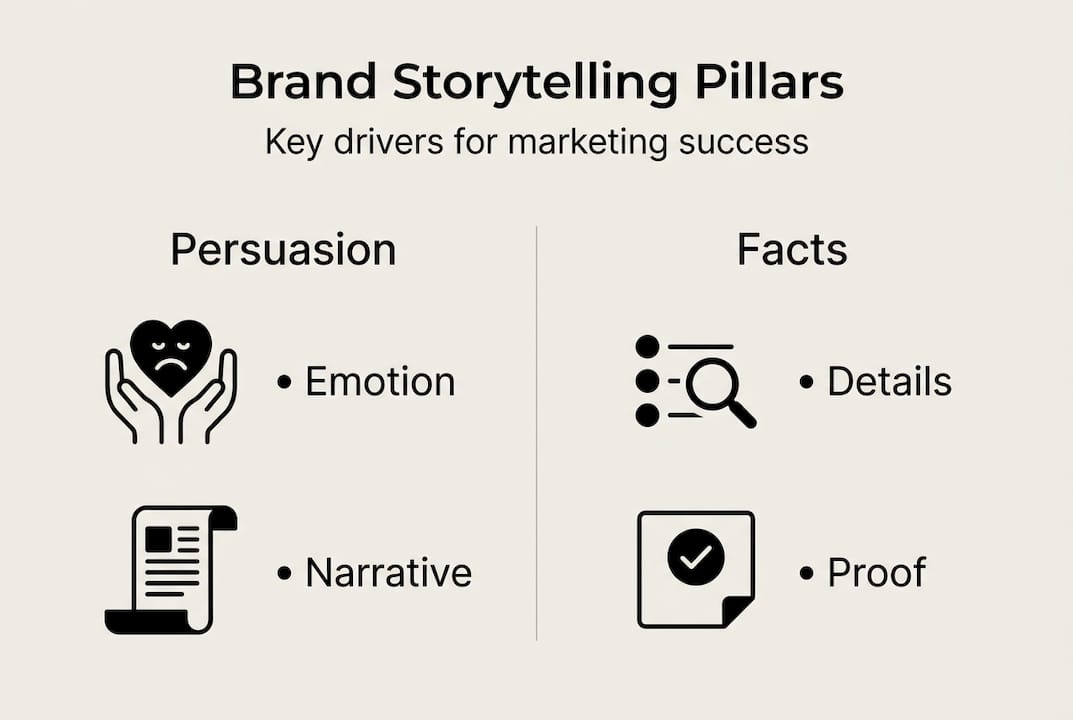
| Pillar | What it means | Why it matters |
|---|---|---|
| Meaning | The story carries a value or truth that resonates beyond the sale | Audiences remember what made them feel something |
| Relevance | The narrative connects directly to the audience’s lived experience | Generic stories are invisible; personal ones land |
| Authenticity | The story reflects real people, real challenges, real outcomes | Audiences detect performance immediately |
| Differentiation | The narrative positions your brand as distinct, not just different | Standing out in a crowded market requires a unique lens |
Implementing these four pillars requires a deliberate process:
- Define your core meaning. What does your brand stand for beyond profit? An assisted living facility might stand for dignity; a luxury retreat might stand for genuine restoration.
- Map the audience reality. What are your clients actually experiencing before they find you? Fear, frustration, aspiration? Start the story there.
- Anchor in truth. Use real testimonials, real case studies, and real outcomes. Constructed stories collapse under scrutiny.
- Identify your differentiating lens. What angle can only you tell? Your founding story, your method, your community? Own it.
- Select your archetype. Brand archetypes give stories a consistent emotional signature.
Pro Tip: Choose archetypes that match your sector’s emotional core. The Caregiver works powerfully in assisted living, where trust and compassion are paramount. The Explorer or Sage suits luxury retreats and premium experience brands that promise transformation and discovery. Forcing the wrong archetype onto your brand creates dissonance your audience will feel, even if they cannot articulate why.
Storytelling in action: strategies for assisted living, e-commerce, and luxury services
Frameworks only matter when they translate into real campaigns. Here is how the three sectors in our core audience apply storytelling with genuine effect.
| Sector | Best archetype | Narrative type | Key emotional hook |
|---|---|---|---|
| Assisted living | The Caregiver | Resident transformation journeys | Safety, dignity, belonging |
| E-commerce | The Creator / Rebel | Founder or sourcing stories | Values, community, sustainability |
| Luxury services | The Explorer / Sage | Guest experience transformation | Aspiration, exclusivity, restoration |
Best practices for weaving story throughout the customer journey:
- Awareness stage: Use short-form video or social content that introduces a relatable character facing the problem your service solves
- Consideration stage: Case studies and testimonial narratives that follow a before, during, and after arc
- Decision stage: Founder letters, behind-the-scenes content, and mission statements that reinforce authenticity
- Retention stage: Community stories, impact reports, and customer spotlights that sustain belonging
E-commerce fashion brands such as Oscar de la Renta demonstrate this exceptionally well, blending heritage storytelling with modern celebrity narratives in short films designed specifically for digital engagement. The result is perceived value that no product description alone could achieve.

For assisted living providers, a digital agency transformation can reframe an entire website around resident stories rather than facility features, shifting enquiry rates dramatically. For e-commerce brands looking to boost online sales, narrative-led product pages consistently outperform specification-led ones.
The critical point across all three sectors is this: tailor the story to the values your audience already holds. Do not try to introduce new values. Mirror theirs back to them, and show how your brand aligns with what they already believe.
Human vs AI storytelling: authenticity, ethics, and pitfalls
AI tools can now draft campaign narratives, social stories, and brand copy at remarkable speed. That speed is genuinely useful. But speed is not the same as truth, and truth is what makes storytelling work.
“AI generates structure, but lacks human emotional truth; prioritise authentic human craft over volume.”
What AI does well: identifying narrative patterns, structuring story arcs, generating volume for A/B testing, and scaling content across channels. What it consistently misses: the specific emotional texture of lived experience, the uncomfortable contradictions that make a story believable, and the cultural nuance that separates resonant from tone-deaf.
For sectors like assisted living, where audiences are making deeply emotional decisions about loved ones, a sanitised AI narrative can feel hollow or, worse, accidentally dismissive of real fears. Integrating marketing and AI effectively means using technology to support human storytellers, not replace them.
Ethical considerations and practical safeguards:
- Always have a human reviewer read AI-generated stories before publication, specifically looking for unintended triggers or missing emotional complexity
- Avoid using AI to fabricate testimonials or simulate customer experiences; authenticity is non-negotiable
- Be transparent with audiences where AI has assisted in content creation, particularly in trust-sensitive sectors
- Test narratives with a small pilot group before full deployment to catch tone mismatches
- Use AI technologies for structural efficiency, but protect the human voice in final copy
- Stay current with latest AI insights to understand where the boundaries are shifting
The brands that will win with AI-assisted storytelling are not the ones producing the most content. They are the ones producing the most honest content, efficiently.
What most brands get wrong about storytelling
Here is the uncomfortable truth we see repeatedly: most brands mistake anecdotes for stories. A customer quote on a homepage is not storytelling. A list of company milestones is not storytelling. A founder paragraph that reads like a LinkedIn summary is definitely not storytelling.
Effective narrative requires tension. It needs the before to be genuinely uncomfortable, the conflict to be real, and the resolution to feel earned. Brands that sanitise the hard parts to protect their image end up with stories no one believes and no one remembers.
Worse, many brands chase viral moments rather than building consistent narrative. Virality is a byproduct of resonance, not a strategy. Trust accumulates through repeated, authentic contact with a coherent story over time. One powerful campaign followed by inconsistent messaging undoes the work.
Pro Tip: Before any campaign goes live, share the story with three people outside your organisation and ask them what they felt, not what they thought. If the emotional response matches your intent, you are on the right track. If it does not, rewrite before you publish.
Supercharge your marketing with expert storytelling solutions
Storytelling strategy only delivers results when it is built into a system that converts. Knowing the framework is the first step; executing it across your web presence, campaigns, and customer journey is where real growth happens.

At NU Life Digital, we help assisted living providers, e-commerce brands, and luxury services translate narrative strategy into measurable outcomes. Our web design solutions are built to carry brand stories from first impression to final conversion. Our e-commerce strategies embed storytelling directly into product journeys, not just homepage copy. If you are ready to move beyond generic messaging and boost online sales with story-driven systems that actually scale, we are the team to build it with you.
Frequently asked questions
What makes storytelling more persuasive than facts alone in marketing?
Stories engage emotion and lower critical resistance, with narrative processing correlating at 0.39 with persuasion compared to 0.24 for analytical messaging. The emotional connection drives action in ways that logic alone rarely achieves.
How can luxury and e-commerce brands use storytelling differently?
Luxury brands benefit from transformation and heritage narratives that build aspiration, whilst e-commerce brands use sustainability, community, and founder stories to increase perceived value and emotional loyalty.
What ethical risks should marketers watch for in brand storytelling?
Key risks include AI-generated content that lacks emotional truth, accidentally triggering trauma, or oversimplifying complex realities. Human review before publication is essential, particularly in care and wellness sectors.
Can small businesses compete with big brands using storytelling?
Absolutely. Smaller businesses often have a natural advantage because their stories are inherently personal and specific. Authenticity and relevance matter far more than production budget when it comes to building genuine audience loyalty.