
TL;DR:
- Most businesses confuse their marketing infrastructure problems with integration, which hampers performance and growth.
- A robust digital marketing infrastructure is an interconnected system of platforms, processes, data, and governance that enables efficient execution, measurement, and scaling of marketing efforts.
Most businesses believe they have a marketing infrastructure problem when, in reality, they have an integration problem. They’ve accumulated a stack of platforms, subscriptions, and automation tools, yet their campaigns still underperform, their data sits in silos, and their team spends more time fighting systems than driving results. True digital marketing infrastructure is not a collection of tools. It is the interconnected system of platforms, processes, data, and governance that allows your marketing to execute efficiently, measure accurately, and scale without chaos. This article breaks down exactly what that means and how to build it properly.
Table of Contents
- Defining digital marketing infrastructure
- Core components: What makes a robust digital marketing infrastructure?
- Why most businesses underperform: Utilisation, adoption and governance
- Optimising your infrastructure for growth
- What most guides miss about digital marketing infrastructure
- Partner with experts to build your scalable infrastructure
- Frequently asked questions
Key Takeaways
| Point | Details |
|---|---|
| Infrastructure is not just tools | True marketing infrastructure requires integration, governance, and operationalisation beyond just buying software. |
| Data unity drives performance | Centralising customer data powers segmentation, activation, and measurable ROI. |
| Governance matters most | Regularly reviewing adoption and assigning ownership prevents tool underutilisation. |
| Scalability comes from optimisation | Audit, integrate, and align your infrastructure for ongoing growth across all channels. |
Defining digital marketing infrastructure
The phrase “digital marketing infrastructure” gets thrown around loosely. Marketers use it to describe everything from their email platform to their entire tech stack. That vagueness is expensive.
Properly defined, digital marketing infrastructure is the integrated framework of platforms, processes, data systems, and governance practices that enables an organisation to execute marketing activities, measure their outcomes, and scale operations predictably. The key word is integrated. Individual tools are not infrastructure. They become infrastructure when they are connected, governed, and activated toward shared business goals.
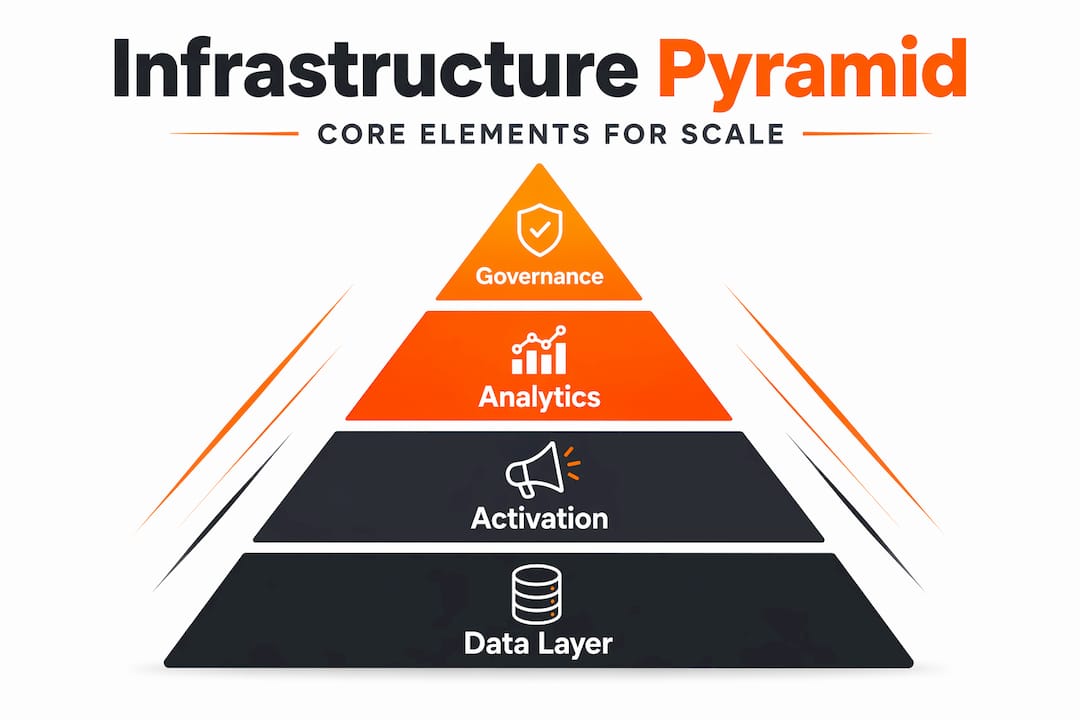
Think of it like the plumbing in a building. Individual pipes have no value unless they are correctly connected, properly maintained, and carrying the right flow. The same logic applies to your martech stack.
A robust infrastructure framework has four foundational layers:
- Data collection and management: Capturing customer data across every touchpoint and storing it in a unified, accessible format. CDP-style capabilities are central to this because they ingest, unify, and activate customer data across systems.
- Activation channels: The platforms through which you reach audiences, including email, paid media, your website, and content.
- Analytics and attribution: Systems that measure what is working, what is not, and where to invest next.
- Governance and compliance: The policies, ownership structures, and processes that keep the whole system running reliably and legally.
Here is how strong infrastructure compares to fragmented tool selection:
| Characteristic | Strong infrastructure | Fragmented tool selection |
|---|---|---|
| Data flow | Centralised and unified | Siloed across platforms |
| Measurement | Clear attribution | Inconsistent and unreliable |
| Team adoption | High, with defined ownership | Low, with tool fatigue |
| Scalability | Built for growth | Breaks under volume |
| Cost efficiency | Optimised and purposeful | Overspend with low ROI |
| Governance | Defined policies and compliance | Ad hoc and reactive |
Pro Tip: Most organisations overbuy tools and underintegrate them. Before adding any new platform to your stack, audit whether your existing tools are being used to their full potential. The answer is almost always no.
Core components: What makes a robust digital marketing infrastructure?
Having defined infrastructure, let’s examine the practical building blocks required for real-world impact.
The first and most foundational component is your unified data layer. This is your customer data platform (CDP) or CRM integration that brings together all data sources into a single, usable profile. CDPs ingest data from websites, mobile apps, CRM systems, email platforms, point of sale, loyalty programmes, support systems, and advertising platforms, then provide real-time activation to downstream tools. Without this layer, your marketing is essentially guesswork at scale.
The second component is your activation stack, which includes every channel through which you communicate with your audience. Email and SMS automation, paid search, paid social, organic content, and your website all fall here. These channels only perform well when they are being fed accurate, unified data from your data layer.
The third is analytics and attribution. This is where most businesses have the largest gaps. Knowing which campaigns generate revenue, and at what cost, requires proper tracking setup, consistent UTM tagging, and a reporting framework that connects spend to outcomes. Without solid data insights for marketers, you are essentially flying blind.
The fourth is data governance and compliance. In regulated industries like assisted living and senior care, this is non-negotiable. In e-commerce and luxury retail, it protects customer trust and brand reputation. Governance includes consent management, data retention policies, and defined accountability for system ownership.
| Component | Core function | Example platforms |
|---|---|---|
| Unified data layer | Ingest, unify, and activate customer data | HubSpot, Salesforce, Segment |
| Activation channels | Reach and engage target audiences | Klaviyo, Google Ads, Meta Ads |
| Analytics and attribution | Measure and optimise performance | GA4, Looker Studio, Northbeam |
| Governance and compliance | Maintain data integrity and legal compliance | OneTrust, GDPR frameworks |
Different industries require slightly different tooling priorities:
- Assisted living and senior care: CRM-led data management, consent-compliant email nurture sequences, and call tracking to bridge online and offline enquiries.
- E-commerce brands: Event tracking for full funnel attribution, product feed integration for shopping ads, and retention automation through Klaviyo or similar platforms.
- Luxury retreats: Personalisation layers that reflect guest history and preferences, combined with high-quality remarketing to warm audiences.
- Country sports and experience venues: Booking system integration, seasonal campaign triggers, and clear attribution between paid campaigns and confirmed bookings.
Data is not just about measurement. It is the fuel for personalisation, segmentation, and improved campaign performance over time. When you learn to turn marketing data into action, your entire infrastructure compounds in value. Each campaign teaches the system something new, and the system becomes progressively more effective.
Pro Tip: Centralising your data for measurement is the single most impactful step you can take if you want to prove ROI in a complex organisation. Build this layer first, before adding new activation channels.
Why most businesses underperform: Utilisation, adoption and governance
With essential components defined, let’s surface why so many digital marketing stacks fail to deliver on their promise.

The uncomfortable truth is that most businesses are paying for infrastructure they barely use. Martech underutilisation is a systemic problem across industries, with average utilisation hovering well below what most marketing leaders expect when they sign contracts. The tools sit. The licences renew. And the results stay flat.
There are three root causes behind this pattern:
- Tool overwhelm. When teams have too many platforms to manage, they default to the familiar few and ignore the rest. New tools get adopted enthusiastically, then quietly abandoned as day-to-day pressures take over. The stack grows, but the capability does not.
- Poor integration. Even well-chosen platforms fail when they cannot share data. Without proper API connections or middleware, teams end up manually exporting and importing data, which introduces errors, delays, and enormous inefficiency.
- Weak governance. No clear ownership means no one is accountable when systems break, data quality degrades, or compliance issues arise. Governance is not glamorous, but it is the difference between infrastructure that holds and infrastructure that crumbles under pressure.
“Most organisations’ marketing technology strategies are misaligned with business goals, creating a significant gap between investment and performance.”
Gartner Marketing Technology Survey
Only 15% of organisations qualify as high performers who meet strategic goals and demonstrate positive ROI from their marketing technology. That figure should stop you in your tracks. It means 85% of businesses are paying for systems that are not delivering at their potential.
Driving genuine adoption requires more than training sessions and internal emails. It requires understanding the strategic digital marketing trends that are shaping how infrastructure must evolve, and then building effective marketing workflows that embed tools into daily operating rhythms. When platforms become part of how work gets done rather than additions to it, adoption follows naturally.
For highly regulated sectors, like assisted living, this also extends to compliance marketing best practices that ensure your data handling and patient engagement meet legal and ethical standards. Governance and performance are not separate concerns. They reinforce each other.
Pro Tip: Appointing a single, named owner for your martech infrastructure, even if that person is not exclusively technical, dramatically increases adoption rates. Accountability drives usage. Usage drives results.
Optimising your infrastructure for growth
Knowing why underperformance happens, here is how to practically optimise your infrastructure for long-term scalability.
Start with an honest audit. Before you can improve your infrastructure, you need a clear picture of what you actually have:
- Map every tool in your current stack and its stated purpose
- Review actual usage data for each platform over the past 90 days
- Identify which integrations are working, which are broken, and which do not exist at all
- Pinpoint where data is siloed and where governance is unclear or absent
- Check whether infrastructure includes operationalisation and ongoing governance, not just tool selection
Once you have a clear view of the current state, follow these steps to build toward an optimised infrastructure:
- Clarify your business goals first. Every infrastructure decision should be traceable back to a specific growth outcome. Are you trying to increase occupancy at an assisted living facility? Scale an e-commerce brand to £100k per month? Improve booking rates for a luxury retreat? The goal shapes the stack.
- Map platforms to objectives. For each business goal, identify which platforms should be contributing and how. If a tool cannot be directly linked to a measurable outcome, question whether it belongs in your stack at all.
- Integrate for data flow. Prioritise getting your platforms talking to each other. Your CRM should feed your email platform. Your website analytics should flow into your reporting dashboard. Your ad platforms should have conversion tracking set up correctly. Data flow is the circulatory system of your infrastructure.
- Enforce operational standards. Define how each platform should be used, who is responsible for it, and how performance will be reviewed. This is not bureaucracy. It is the difference between an infrastructure that scales and one that collapses when your team grows or your campaigns increase in complexity.
For e-commerce brands, this process directly feeds higher conversion rates because better data and cleaner integrations mean smarter segmentation, better targeting, and less wasted ad spend.
Industry-specific examples worth noting:
- An assisted living group running campaigns across multiple facilities needs infrastructure that tracks each enquiry source, routes leads to the correct facility, and measures time-to-response as a KPI.
- A country sports venue running seasonal campaigns needs booking system data flowing directly into campaign performance reports so they can correlate ad spend with confirmed bookings, not just website visits.
- A luxury retreat brand needs CRM data driving personalised email sequences that reference past stays, preferences, and seasonal availability.
Regular performance reviews against industry benchmarks keep infrastructure honest. Incorporating digital video strategies into your activation mix can further enhance campaign performance once the foundational data and measurement layers are solid.
What most guides miss about digital marketing infrastructure
Here is the honest take: most infrastructure guides stop at tool selection. They give you a list of platforms, a diagram of how they connect, and send you on your way. That is not enough.
The businesses that actually scale are the ones that treat infrastructure as a living system, not a one-time implementation project. The tools matter less than the discipline around them. We have seen businesses running lean, well-integrated stacks of five or six platforms consistently outperform competitors spending three times as much on technology, simply because they had stronger governance, clearer ownership, and a genuine culture of data-driven decision making.
What separates scalable systems is not the sophistication of the technology. It is the consistency with which that technology is operated, reviewed, and improved.
Your martech tools are only as powerful as the processes and people driving them. A CDP with no data governance policy is a liability. An attribution model with no one responsible for maintaining it is noise. An email platform used only for monthly newsletters is an expensive spreadsheet.
The organisations that get genuine competitive advantage from their infrastructure are the ones that treat it as a strategic asset, not a cost of doing business. They review performance monthly. They audit integrations quarterly. They hold someone accountable for system health. And they align every platform decision back to a measurable business outcome.
Expert agency guidance can accelerate this maturity significantly, particularly for businesses that are scaling rapidly and do not have the internal resource to maintain that discipline consistently. But the mindset shift has to come first.
Partner with experts to build your scalable infrastructure
Building and optimising digital marketing infrastructure is genuinely complex work, and doing it well whilst running a business at the same time is a significant challenge.

At NU Life Digital, we help ambitious businesses across assisted living, e-commerce, luxury retreats, and country sports build the systems that drive real, measurable growth. From web design engineered to convert, through to AI integration and automation that replaces manual workflows with intelligent systems, everything we do is tied to one outcome: revenue growth. If you are ready to move from a pile of disconnected tools to a cohesive, scalable infrastructure, our consulting team can help you build the right strategy, the right stack, and the right processes to make it work.
Frequently asked questions
What are the essential elements of digital marketing infrastructure?
Key elements are unified customer data, activation channels, analytics, and strong governance processes. CDP-style capabilities sit at the centre because they ingest, unify, and activate customer data across your entire stack.
Why do most businesses fail to get ROI from their marketing tools?
Most businesses buy tools but neglect integration, utilisation, and governance, leading to consistently poor performance. Only 15% of organisations qualify as high performers who meet their strategic goals and demonstrate positive ROI from marketing technology.
How can I audit my digital marketing infrastructure?
Start by mapping all tools in your stack, checking which integrations are functioning, reviewing platform usage data, and confirming data flows for measurement. Martech infrastructure includes operationalisation and ongoing governance, not just what tools you have selected and connected.
What is the role of customer data in digital marketing infrastructure?
Unified customer data enables segmentation, personalisation, and far more effective marketing across every channel you operate. CDPs ingest, unify, and activate customer data across all sources to create a single, reliable source of truth for your marketing decisions.