
TL;DR:
- Effective ad targeting focuses on reaching the right audience at the right time with relevant messages, improving ROI and customer experience. Market changes like privacy legislation and cookie restrictions necessitate shifting towards first-party data and contextual targeting strategies. Rigid or overly granular targeting can backfire, making adaptability and compelling creative storytelling crucial for sustained growth.
Spending money on advertising and watching it disappear into the void is one of the most frustrating experiences in business. The instinct is always to cast the widest net possible, assuming more eyes mean more sales. But that logic is precisely what drains budgets and leaves marketing teams scratching their heads over poor returns. The real advantage comes not from reaching everyone, but from reaching the right people at the right moment with a message that actually resonates. This article breaks down what modern ad targeting really involves, the tangible benefits it delivers, where the genuine risks lie, and how to future-proof your approach in a world where privacy rules are reshaping everything.
Table of Contents
- What is ad targeting and how does it work?
- The core benefits of effective ad targeting
- Common risks and pitfalls in ad targeting
- Adapting your targeting strategy to the changing landscape
- What most marketers get wrong about ad targeting
- Connect your targeting strategy with expert support
- Frequently asked questions
Key Takeaways
| Point | Details |
|---|---|
| Higher return on investment | Focused ad targeting helps eliminate waste and boosts your marketing returns. |
| Privacy and relevance balance | Modern targeting methods like contextual targeting succeed where traditional tracking is limited. |
| Risks and management | Ethical concerns, privacy risks, and compliance must be managed for sustained success. |
| Adaptation is crucial | Continuously evolving your approach ensures results as measurement tools and privacy realities shift. |
What is ad targeting and how does it work?
Ad targeting is the practice of delivering your advertisements to specific groups of people based on defined criteria, rather than broadcasting them indiscriminately. It is the difference between shouting into a crowd and tapping someone on the shoulder who already has a reason to listen.
At its core, targeted paid advertising operates through several overlapping mechanisms:
- Demographic targeting: Reaching audiences based on age, gender, income level, occupation, or family status. An assisted living provider, for instance, would prioritise adults in their 50s and 60s researching care options for ageing parents.
- Behavioural targeting: Using data about browsing history, purchase behaviour, and online activity to serve ads to people who have shown relevant intent. An e-commerce brand selling premium outdoor gear would target users who have recently browsed camping or hiking content.
- Geographic targeting: Limiting ad delivery to specific locations, whether a country, city, or even a postcode radius. A luxury retreat in the Cotswolds does not benefit from advertising to audiences in Australia.
- Contextual targeting: Placing ads alongside content that is directly relevant to the product or service, regardless of who is viewing it. An ad for a senior care facility appearing on a webpage about NHS social care options is contextually aligned.
The landscape has shifted considerably in recent years. Third-party cookies, which powered much of behavioural tracking, are being phased out across browsers. Privacy legislation such as GDPR in the UK and Europe has tightened rules around how data can be collected and used. This has pushed many advertisers toward contextual approaches. As research confirms, when tracking becomes limited, contextual targeting remains a reliable way to reach relevant audiences without heavy reliance on third-party cookies.
For e-commerce brands, this shift means greater investment in understanding what users are reading rather than simply who they are. For luxury experience operators, it means placing ads on editorial content that their ideal client already consumes, travel magazines, high-end lifestyle blogs, and financial planning resources. For assisted living facilities, it means appearing in the content spaces where families are actively researching care decisions.
The core benefits of effective ad targeting
Understanding the concept is only useful if you can translate it into business outcomes. The case for precise targeting is not just theoretical. It changes the economics of your entire marketing operation.
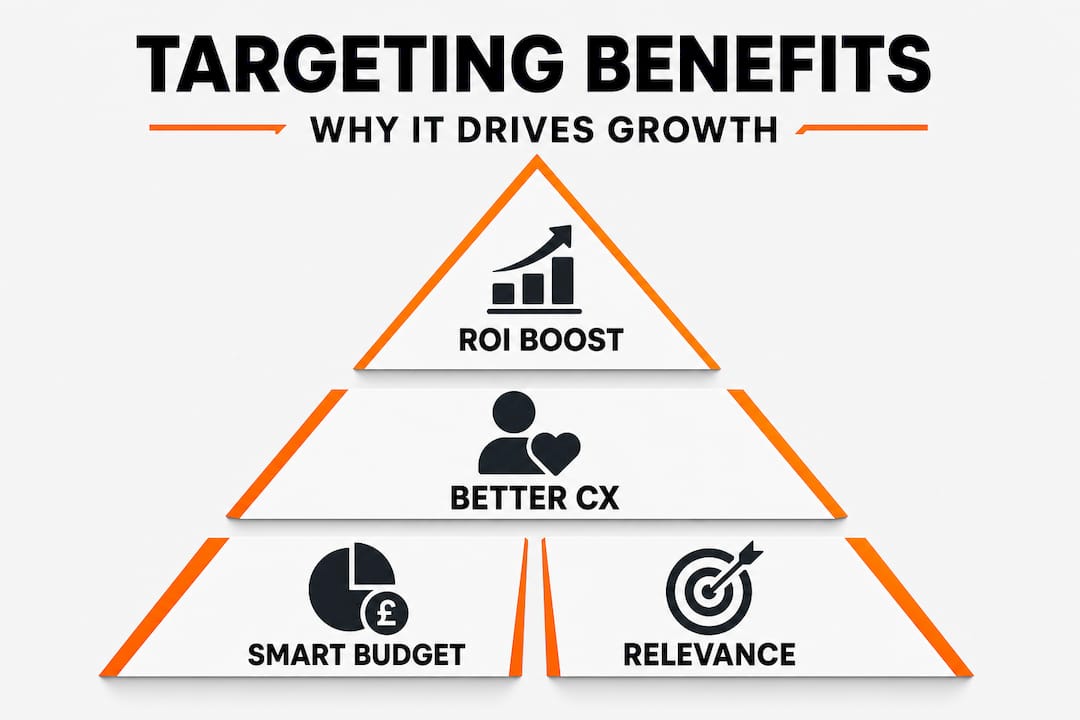
Improved return on investment
Every pound spent on an impression that reaches someone with zero interest in your offer is a pound wasted. Effective targeting reduces those wasted impressions dramatically. When you tighten the audience, your cost per qualified lead drops, your conversion rate increases, and the same budget produces measurably better results. You can explore detailed strategies for advertising ROI that reinforce this principle across different sectors.
Better customer experience
People respond better to ads that feel relevant. An ad that speaks directly to a problem you are currently experiencing feels useful rather than intrusive. Irrelevant ads, on the other hand, train audiences to ignore everything. Good targeting means your audience sees something that genuinely connects with their situation, which builds brand trust over time.

Smarter budget allocation
Rather than spreading spend thinly across a massive audience, targeted campaigns allow you to concentrate resources on segments with the highest likelihood of conversion. This is particularly powerful for businesses with seasonal peaks, like a luxury shooting venue running a campaign before peak season, or an assisted living facility targeting family decision-makers during typical care transitions in early spring.
Here is how the numbers tend to shift when targeting moves from poor to effective:
| Metric | Poorly targeted campaign | Effectively targeted campaign |
|---|---|---|
| Click-through rate (CTR) | 0.5% | 2.8% |
| Cost per lead | £85 | £24 |
| Conversion rate | 1.2% | 4.7% |
| Wasted impressions | 78% | 21% |
| Monthly ad spend | £3,000 | £3,000 |
The spend is identical. The outcome is completely different.
Pro Tip: If third-party tracking data is unavailable or restricted, shift to contextual targeting by mapping your ad placements to the specific content categories your ideal customer already engages with. A family researching assisted living options is likely reading NHS guidance pages, eldercare forums, and local community news. Meeting them there, even without cookie-based tracking, keeps your messaging relevant and compliant.
Sound ad spend optimisation is not about cutting budgets. It is about ensuring every pound is doing meaningful work.
Common risks and pitfalls in ad targeting
The benefits are real, but this is not a risk-free discipline. Marketers who ignore the downsides tend to create problems that erode trust and damage results over the long term.
Privacy concerns and tracking controversy
The use of personal data in advertising remains a genuinely contested area. Consumers are increasingly aware that their online behaviour is being monitored, and many find it uncomfortable. Targeted advertising carries real risk: it can create privacy risks and consumer resentment, and the societal benefits may be mixed or limited. That is not a fringe view. It reflects a growing body of research and public opinion.
Over-targeting and audience fatigue
When targeting becomes too granular, a few problems emerge. First, your potential audience shrinks so small that ad frequency spikes. Seeing the same ad seven times in a week is annoying, not persuasive. Second, hyper-specific targeting can feel intrusive to users who notice they are being followed across every website they visit. That sense of surveillance breeds resentment rather than engagement.
GDPR and regulatory compliance
For any business operating in the UK or EU, compliance with GDPR is non-negotiable. Collecting, storing, or using personal data without proper consent is not just ethically questionable; it carries significant financial penalties. This applies to how you build remarketing audiences, how your website collects data, and how your CRM handles customer information.
Key risks to monitor include:
- Using third-party data sources that have not obtained proper consent
- Running remarketing campaigns without compliant cookie consent mechanisms
- Storing audience data longer than necessary
- Failing to honour opt-out requests from users
“The challenge for marketers is not just making targeting more effective, but ensuring it operates within boundaries that users and regulators find acceptable. The two goals are not mutually exclusive, but they require intentional design.”
Addressing these risks is not optional. It is the foundation of a sustainable ad targeting strategy that holds up under scrutiny and maintains audience trust.
Adapting your targeting strategy to the changing landscape
Knowing the risks should not cause paralysis. It should drive smarter adaptation. The marketers who thrive in this environment are those who treat privacy constraints as a design challenge rather than a barrier.
Here is a practical comparison of how targeting approaches are shifting:
| Approach | Old method | New method |
|---|---|---|
| Data source | Third-party cookies | First-party data and contextual signals |
| Audience building | Purchased data lists | CRM data, email lists, on-site behaviour |
| Measurement | Last-click attribution | Multi-touch and modelled attribution |
| Tracking | Cross-site behavioural tracking | On-site engagement metrics |
| Personalisation | Individual-level targeting | Segment-level contextual relevance |
The path forward is not complicated, but it does require deliberate steps. Here is how to audit and adjust your approach:
- Audit your current data sources. Identify which parts of your targeting rely on third-party data and which are built on first-party signals. Prioritise the latter.
- Build your first-party data infrastructure. This means investing in email capture, loyalty programmes, and on-site engagement tools that give you genuine consent-based audience data. Using first-party data effectively is increasingly the differentiator between good and great campaigns.
- Test contextual placements. Run a structured test comparing your current behavioural targeting against contextual placements in relevant content categories. Measure CTR, cost per lead, and conversion rates across both.
- Redesign your measurement framework. Targeting strategy must be adjusted for measurement realities, as privacy changes and tracking loss can require contextual targeting and greater reliance on first-party data signals. Move away from purely last-click models.
- Review compliance regularly. Make GDPR compliance a quarterly review item, not an annual checkbox.
Pro Tip: Do not wait for your results to decline before making these changes. Businesses that begin migrating to first-party data strategies before performance dips maintain continuity, while those who wait scramble to recover. The best time to update your digital marketing strategy workflow is when things are working, not when they have already broken.
For assisted living operators, first-party data might come from content downloads, care guides, and webinar registrations. For e-commerce brands, it lives in email lists, purchase history, and on-site browsing data. For luxury retreat operators, it is in booking patterns, referral sources, and high-intent enquiry forms. Each sector has unique data assets; the key is building systems to collect and use them well. Applying thoughtful niche marketing strategies ensures that the data you gather maps directly to audience behaviour in your specific market.
What most marketers get wrong about ad targeting
After working with businesses across assisted living, e-commerce, and luxury sectors, a pattern emerges. The assumption is consistently the same: more data equals better targeting, and better targeting always equals better results. It is a logical chain that falls apart in practice.
The truth is that narrowing your targeting indefinitely creates diminishing returns. At some point, your audience becomes so small that you are paying premium CPMs to reach a tiny group repeatedly, rather than engaging a broader qualified segment at a sustainable frequency. More specificity is not always the answer. Sometimes the creative message matters far more than the precision of the audience definition. A genuinely compelling ad shown to a moderately targeted audience will often outperform a mediocre ad shown to a perfectly curated segment.
What actually drives sustainable growth is adaptability. The marketers who consistently win are not those with the most sophisticated targeting setup at a single point in time. They are the ones who monitor performance rigorously, learn from data quickly, and adjust without ego. Rigid targeting formulas built for a 2021 ad environment will not perform reliably in 2026. The tools change, the platforms change, and audience behaviour shifts faster than most strategies are updated.
The other consistent mistake is ignoring the role of creative storytelling. In assisted living marketing, the most effective campaigns we have seen do not lead with facility features or price points. They lead with the emotional reality of the decision, the relief of finding the right place for a loved one, the confidence of knowing they are safe. That kind of message resonates even when targeting is imperfect, because it speaks to something deeply human.
For e-commerce brands, the equivalent is moving beyond product specs to communicate how the product fits into the customer’s life. For luxury experiences, it is creating aspiration, not just describing the itinerary.
The real insight around campaign management is this: begin your strategic pivots before you see declining ROI. By the time results are clearly dropping, the market has already moved. Monitoring leading indicators, such as engagement trends, impression costs, and audience saturation, gives you the runway to adapt before the numbers go red.
Connect your targeting strategy with expert support
Getting ad targeting right requires more than a good strategy document. It requires the right infrastructure, the right data systems, and campaigns that are built to convert from the ground up.

At NU Life Digital, we build the full ecosystem behind your advertising, starting with the advertising strategies for ROI that ensure every pound of spend is working. We pair that with website design solutions engineered to convert the traffic your targeting brings in, and AI integration and automation that handles lead nurturing without manual overhead. Whether you are running an assisted living facility, scaling an e-commerce brand, or filling high-value retreats, we build targeting strategies that are grounded in data, compliant with privacy standards, and designed to scale.
Frequently asked questions
What is the difference between ad targeting and retargeting?
Ad targeting identifies new potential customers using data-driven criteria such as demographics, behaviour, or context, while retargeting focuses specifically on audiences who have previously interacted with your brand or website.
Is ad targeting still effective after privacy changes?
Yes, modern approaches remain highly effective. As contextual targeting research confirms, reaching relevant audiences without third-party cookies is entirely achievable by aligning ad placements with relevant content categories and using first-party data signals.
What are the privacy risks with ad targeting?
Targeted advertising can raise significant concerns around data collection and consent. Research highlights that targeted advertising can create privacy risks and consumer resentment if data use is not transparent, making compliance and clear consent mechanisms essential.
How can small businesses build effective ad targeting on a budget?
Small businesses can achieve strong results by focusing on first-party data collected through their own website and email lists. As MIT research notes, contextual targeting and first-party data signals are practical, cost-effective alternatives when broader tracking is restricted.