
TL;DR:
- Smart campaigns offer AI-driven, low-maintenance advertising suitable for small businesses.
- They use broad keyword themes and automated optimizations to target relevant searches.
- Businesses should transition to more advanced campaigns as their data and resources grow.
Running paid advertising without a clear system is one of the most common and costly mistakes business owners make. Whether you manage an assisted living facility trying to increase occupancy or an e-commerce brand pushing for consistent monthly revenue, the complexity of traditional ad platforms can feel paralysing. Smart campaign management offers a genuinely different approach: AI-driven, low-maintenance, and built around real business outcomes rather than technical expertise. This guide breaks down exactly how it works, who it suits, and how to get the most from it.
Table of Contents
- Understanding smart campaign management
- How smart campaign management works
- Smart campaign management vs Performance Max and traditional ads
- Practical strategies for maximising smart campaign results
- Our perspective: Why smart campaigns are the perfect starting point
- Take your campaign strategy further with expert support
- Frequently asked questions
Key Takeaways
| Point | Details |
|---|---|
| AI-powered simplicity | Smart campaign management removes manual complexity and leverages AI for measurable business actions. |
| Ideal for small brands | Assisted living and e-commerce businesses find fast, hands-off results using smart campaign strategies. |
| Monitor and evolve | Regular performance reviews and moving to advanced tools like Performance Max drive sustained growth. |
| Practical benchmarks | Use benchmarks like $70 CPL to track effectiveness and understand campaign value. |
Understanding smart campaign management
Smart campaign management is not just a buzzword. It refers specifically to Google Ads Smart Campaigns, an automated advertising solution designed for small businesses, including assisted living facilities and e-commerce brands, that requires minimal setup and uses Google’s AI to optimise ads across Search, Maps, YouTube, Gmail, and partner sites. Your goal might be phone calls, physical visits, or website actions. Smart campaigns are built to pursue whichever outcome matters most to your business.
For a facility manager juggling staffing rotas and family consultations, or an e-commerce owner managing inventory and fulfilment, the appeal is obvious. You do not need to master bidding strategies, quality scores, or audience segmentation from scratch. The AI handles the heavy lifting.
Key benefits at a glance:
- Minimal technical knowledge required to launch
- Automated ad placement across multiple Google surfaces
- Goal-focused optimisation rather than metric-chasing
- Suitable for local businesses with limited advertising budgets
- Faster setup compared to traditional Google Ads campaigns
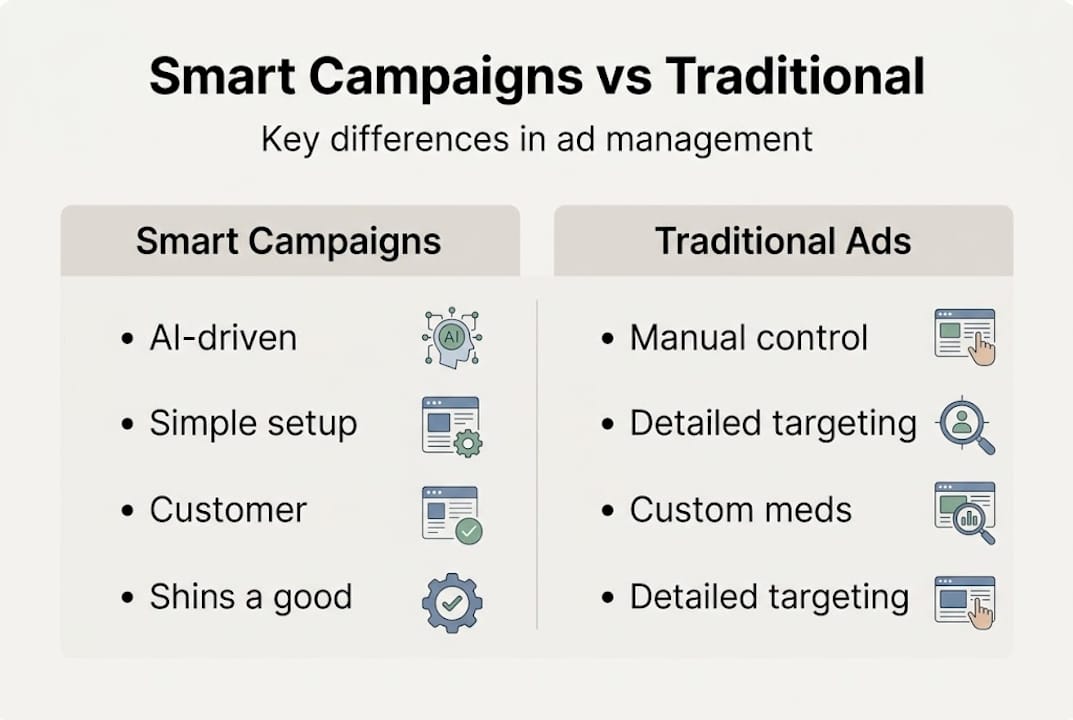
Here is a quick overview of how smart campaigns compare in terms of scope:
| Feature | Smart campaigns | Traditional campaigns |
|---|---|---|
| Setup time | Under 30 minutes | Several hours |
| Keyword management | Theme-based | Manual, granular |
| Ad placement | Automated across platforms | Manually selected |
| Optimisation | AI-driven | Manual or rule-based |
| Ideal for | Small businesses, local growth | Experienced advertisers |
For businesses exploring paid advertising ROI strategies, smart campaigns are often the most sensible starting point before scaling into more complex structures.
Statistic: Businesses using automated ad solutions consistently report faster time-to-launch and reduced management overhead compared to manually managed campaigns, freeing up owner time for core operations.
How smart campaign management works
Once you understand what smart campaign management is, the next question is: how does it actually function day-to-day? The mechanics are straightforward, but understanding them helps you make better decisions about setup and ongoing management.
Rather than asking you to select exact keywords, smart campaigns use keyword themes. These are broader topic signals that tell Google’s AI what your business is about and which searches are likely relevant. For example, an assisted living facility might use themes like “senior care near me” or “residential care home.” An e-commerce brand might use “handmade jewellery” or “eco-friendly skincare.” Google’s AI then determines which specific searches trigger your ads.
Here is how a typical smart campaign is created:
- Connect your Google Business Profile to improve local targeting and ad relevance
- Define your primary business goal (calls, website visits, or in-store visits)
- Select keyword themes relevant to your products or services
- Review AI-generated headline and description suggestions from the SmartCampaignSuggestService
- Set a daily budget based on Google’s recommendations or your own targets
- Launch and allow the AI to begin optimising within the first two weeks
The Google Ads Smart Campaigns system uses a single ad group per campaign, which keeps the structure clean and manageable. This is very different from traditional campaigns where you might manage dozens of ad groups, each with their own keywords, bids, and creatives.
Pro Tip: Connect your Google Business Profile before launching. Campaigns linked to a verified profile consistently perform better because Google can pull accurate business details, opening hours, and location data directly into your ads.
One of the most underrated aspects of smart campaigns is the AI’s ability to test and iterate on ad copy automatically. Rather than running A/B tests manually, the system rotates headlines and descriptions to identify which combinations drive the most conversions. This is particularly valuable for e-commerce brands where product messaging needs constant refinement.
Here is a comparison of how keyword management differs between approaches:
| Aspect | Smart campaigns | Traditional Google Ads |
|---|---|---|
| Keyword input | Broad themes | Exact, phrase, and broad match |
| Negative keywords | Limited control | Full control |
| Bid management | Fully automated | Manual or smart bidding strategies |
| Ad copy testing | Automated rotation | Manual A/B testing |
| Reporting depth | Summary level | Granular, query-level data |
Understanding ad spend optimisation becomes much easier once you see how smart campaigns remove the guesswork from budget allocation. The AI redistributes spend toward the placements and times of day that generate the best results, without you needing to intervene constantly. For businesses that want a structured advertising workflow without the complexity, this is a significant advantage.
Smart campaign management vs Performance Max and traditional ads
Choosing the right campaign type is one of the most important decisions you will make. Each option suits a different stage of business growth and a different level of marketing maturity.
Smart campaigns are ideal for businesses that are new to paid advertising or have limited time to manage campaigns actively. They prioritise simplicity and speed over granular control. Performance Max, Google’s more advanced automated campaign type, is built for businesses that already have conversion tracking in place and want to scale across all Google channels simultaneously. Traditional manual campaigns sit at the other end of the spectrum, offering the deepest level of control but requiring significant expertise and ongoing management time.
“The right campaign type is not the most sophisticated one. It is the one that matches your current resources, goals, and marketing maturity.”
When to use each campaign type:
- Smart campaigns: New advertisers, local businesses, assisted living facilities seeking enquiries, e-commerce brands testing a new market
- Performance Max: Established brands with conversion data, businesses scaling to £50k+ monthly revenue, those with dedicated marketing resource
- Traditional campaigns: Experienced advertisers who need granular control, businesses with complex product catalogues, those running highly competitive national campaigns
The Google Ads Smart Campaigns documentation is clear: smart campaigns are designed for hands-off local growth, but businesses should plan to graduate to Performance Max or full Google Ads as their needs evolve. A benchmark worth monitoring is your cost per lead (CPL). If your CPL is creeping above approximately £55 to £70 without improvement, it is usually a signal that you need more control than smart campaigns offer.
For assisted living facilities, the typical journey starts with smart campaigns targeting local searches, then progresses to Performance Max as occupancy grows and you have more data to feed the algorithm. For e-commerce brands, the same principle applies: start simple, gather data, then scale with a more sophisticated digital marketing workflow.
It is also worth noting that 2026 strategic marketing trends point toward increased AI integration across all campaign types, meaning the gap between smart campaigns and more advanced options is narrowing. However, the fundamentals of matching campaign complexity to business readiness remain unchanged.
Practical strategies for maximising smart campaign results
Understanding the theory is one thing. Getting consistent results from smart campaigns requires a set of deliberate habits and an honest approach to performance monitoring.
Strategies that make a measurable difference:
- Review keyword themes every two to four weeks. The AI works with what you give it. Stale or overly broad themes lead to wasted spend on irrelevant searches. Refine themes based on the search term reports available in your account.
- Monitor your CPL against realistic benchmarks. For assisted living facilities, a CPL of £55 to £70 is a reasonable starting target. For e-commerce, your target CPL should align with your average order value and margin.
- Keep your Google Business Profile updated. Google Ads Smart Campaigns pull data directly from your profile. Outdated information reduces ad relevance and wastes budget.
- Use call tracking. If your primary goal is phone enquiries, set up call tracking from day one. Without it, you are flying blind on one of your most important conversion points.
- Do not set and forget. Automation handles optimisation, but it cannot tell you whether your business goals have changed, your pricing has shifted, or a competitor has entered your market.
Pro Tip: For assisted living facilities, adding location-specific keyword themes such as the name of your town or borough significantly improves local relevance. Families searching for care options almost always include a location in their search.
A common pitfall is treating smart campaigns as entirely passive. The AI optimises within the parameters you set, but those parameters need to reflect your actual business situation. If you launch a campaign targeting “assisted living” without specifying your location or services, you will attract broad, low-quality traffic that rarely converts.
For e-commerce brands, the same principle applies to product specificity. Vague themes produce vague results. The more clearly you signal to the AI what you sell and who buys it, the more efficiently it can find buyers.
Statistic: Businesses that actively review and refine their smart campaign keyword themes report significantly better conversion rates than those who leave campaigns untouched after launch.
Exploring digital marketing for care homes reveals how targeted, locally focused campaigns consistently outperform generic national approaches for assisted living facilities. The assisted living growth engine framework combines smart campaigns with a conversion-focused website and AI-powered lead nurturing to create a genuinely scalable enquiry system.
Our perspective: Why smart campaigns are the perfect starting point
Here is the uncomfortable truth that most marketing agencies will not tell you: smart campaigns are not the final destination. They are the on-ramp.
We see too many small business owners either avoiding paid advertising entirely because it feels overwhelming, or jumping straight into complex campaign structures they are not ready to manage. Both approaches waste money and time. Smart campaigns solve the first problem elegantly. They lower the barrier to entry so that businesses can start generating data, learning what works, and building confidence in paid advertising without needing a full-time specialist.
What we find particularly valuable about smart campaigns is the test-and-learn opportunity they create. When an assisted living facility runs its first smart campaign, it learns which services generate the most enquiries, which locations produce the best leads, and what messaging resonates with families making care decisions. That intelligence is genuinely valuable, regardless of what campaign type you use next.
The transition to Performance Max or traditional campaigns should be driven by data, not impatience. We have seen businesses abandon smart campaigns after three weeks, convinced they were not working, only to discover later that the AI needed six to eight weeks to properly optimise. Patience in the early stages pays off.
The other reality worth acknowledging is that automation is not flawless. AI optimises for the signals it can measure. It cannot account for the nuance of your local reputation, the quality of your follow-up process, or the strength of your website once a visitor arrives. Human insight always adds value at the edges of what automation can do. That is why we advocate for niche marketing strategies that combine smart automation with deliberate human oversight, particularly for industries like assisted living where trust and relationship quality determine whether an enquiry becomes a resident.
Smart campaigns are the right starting point for most small businesses. The key is knowing when you have outgrown them.
Take your campaign strategy further with expert support
Smart campaign management gives you a solid foundation, but sustainable growth requires more than automated ads.

At NU Life Digital, we build complete growth systems for assisted living facilities and e-commerce brands that want consistent, scalable results. From custom web design engineered to convert enquiries and sales, to advanced strategies that boost online sales for ambitious product brands, we combine the right technology with genuine industry expertise. Our expert paid advertising service moves beyond smart campaigns into performance-driven strategies that maximise every pound of your ad spend. If you are ready to build a growth engine rather than just run ads, we would like to show you what that looks like for your business.
Frequently asked questions
What makes smart campaign management different from regular Google Ads?
Smart campaign management uses AI for automated optimisation and simplified setup, focusing on business goals rather than complex manual controls, making it far more accessible for time-constrained business owners.
Can assisted living facilities use smart campaign management for local marketing?
Yes. Google Ads Smart Campaigns are designed for small businesses including assisted living facilities, and can target local searches to generate calls, visits, or website enquiries from families seeking care.
When should my e-commerce brand switch from smart campaigns to Performance Max?
Shift to Performance Max once you have consistent conversion data and need deeper optimisation across multiple Google channels. As the Google Ads documentation notes, smart campaigns suit hands-off local growth, while Performance Max suits brands ready to scale.
Are smart campaigns really automated, or do I need to manually optimise?
Smart campaigns automate most aspects including bidding, ad rotation, and placement, but regular review of keyword themes, budget, and performance benchmarks is essential to avoid wasted spend and missed opportunities.
Recommended
- Top strategies to optimise e-commerce brands for higher conversions – Nu Life Digital
- Structured paid advertising: A step-by-step growth guide – Nu Life Digital
- Paid advertising strategies that drive maximum ROI – Nu Life Digital
- Proven ways to boost online sales for ambitious e-commerce brands – Nu Life Digital