
TL;DR:
- A clear, disciplined marketing strategy is essential for sustainable business growth.
- Strategy focuses on long-term goals, audience understanding, and resource efficiency.
- Technology and AI are tools to amplify strategy, which must be established first.
Most business owners assume that spending more on ads or adopting the latest AI tool will fix sluggish revenue. It rarely does. The businesses that consistently grow, whether they run an assisted living facility or an e-commerce brand, share one common trait: they operate from a clear, disciplined marketing strategy rather than a series of disconnected tactics. Technology and ad budgets are amplifiers. Without a coherent strategy behind them, they amplify noise rather than results. This guide breaks down what a genuine marketing strategy looks like, why it drives sustainable growth, and how to build one that works for your specific sector.
Table of Contents
- What is a marketing strategy and why is it crucial?
- How marketing strategy impacts business growth
- Key elements of effective marketing strategy
- Technology, AI, and the fundamentals of strategy
- The real reason strategy trumps tactics (and what nobody tells you)
- How Nu Life Digital supports your strategic growth
- Frequently asked questions
Key Takeaways
| Point | Details |
|---|---|
| Strategy drives growth | A clear marketing strategy is essential for predictable, sustainable business success. |
| Retention boosts revenue | Focusing on existing customers yields stronger profitability than always chasing new ones. |
| Measurement matters | Tracking north star KPIs and balanced metrics keeps marketing focused and effective. |
| AI supports, not replaces | Artificial intelligence enhances good strategy but cannot substitute for strong fundamentals. |
| Leadership is key | Effective marketing leadership and strategic clarity are more important than any new tool or trend. |
What is a marketing strategy and why is it crucial?
A marketing strategy is not a campaign, a social media calendar, or a list of channels you plan to use. It is the overarching framework that determines why you are marketing, to whom, and how every activity connects to a long-term business objective. Tactics sit underneath strategy. A Google Ads campaign is a tactic. Deciding to own the premium segment of the assisted living market in your region is strategy.
This distinction matters enormously when you are trying to scale revenue. Without strategic clarity, every marketing decision becomes reactive. You chase trends, copy competitors, and measure success by vanity metrics like impressions or follower counts rather than occupancy rates or revenue per customer.
Strategy is not just a plan — it is a long-term approach that balances branding, resource allocation, and retention-focused activity. That balance is what separates businesses that grow predictably from those that lurch between busy periods and quiet ones.
Here is what a strong marketing strategy delivers:
- Direction: Every team member and every pound of budget is pointed at the same goal
- Consistency: Your brand message, tone, and positioning remain coherent across every channel
- Measurable goals: You define success before you spend, not after
- Sustainable results: Growth compounds rather than spiking and crashing
- Resource efficiency: You stop wasting budget on channels that do not serve your audience
“CMOs who prioritise branding and retention over pure acquisition consistently report stronger long-term ROI than those focused on short-term campaign wins.”
For assisted living operators, this might mean building a strategy around trust, community reputation, and family referrals rather than simply running Facebook ads. For e-commerce brands, it might mean owning a specific product category in the minds of a defined customer segment. The channel mix changes. The strategic logic does not.
If you want to see how this translates into action, a well-structured digital strategy workflow is a practical starting point for any business serious about growth.
How marketing strategy impacts business growth
The difference between strategic and reactive marketing is not subtle. It shows up in your revenue figures, your customer retention rates, and your ability to weather slow periods without panic.
Here is how strategy transforms growth in practice:
- Identify your audience precisely. Not just demographics, but motivations, objections, and the specific moment they are ready to buy or enquire.
- Set KPIs before you spend. Define what success looks like in measurable terms: occupancy rate, average order value, customer lifetime value.
- Choose channels based on audience behaviour. Not on what is trendy or what a competitor is doing.
- Execute consistently. Strategy requires patience. Most businesses abandon approaches before they have time to compound.
- Review and iterate. Use data to refine, not to restart from scratch every quarter.
| Factor | Strategic marketing | Reactive marketing |
|---|---|---|
| Consistency | High, planned in advance | Low, changes frequently |
| ROI | Measurable and improving | Unpredictable |
| Customer retention | Central to the approach | Often overlooked |
| Resource use | Efficient and focused | Scattered and wasteful |
| Long-term brand value | Compounds over time | Rarely built |
Retention, not just acquisition, drives revenue. Disciplined strategies outperform one-off tactics precisely because they treat existing customers as a growth asset rather than a by-product of acquisition campaigns.

For an assisted living facility, a retained family referral network is worth far more than a one-time ad click. For an e-commerce brand, a repeat customer who spends three times more over 12 months than a new customer is the real growth engine. Both sectors benefit from the same strategic principle, applied differently.
Pro Tip: Calculate your customer lifetime value before setting your acquisition budget. If a retained customer is worth £1,200 over two years, you can justify spending far more to acquire and keep them than a single transaction suggests.
Exploring niche marketing strategies built around retention and audience specificity will give you a sharper framework for applying this in your sector.
Key elements of effective marketing strategy
Knowing that strategy matters is one thing. Knowing what it actually contains is another. Effective marketing strategy is built from a specific set of components, each of which reinforces the others.
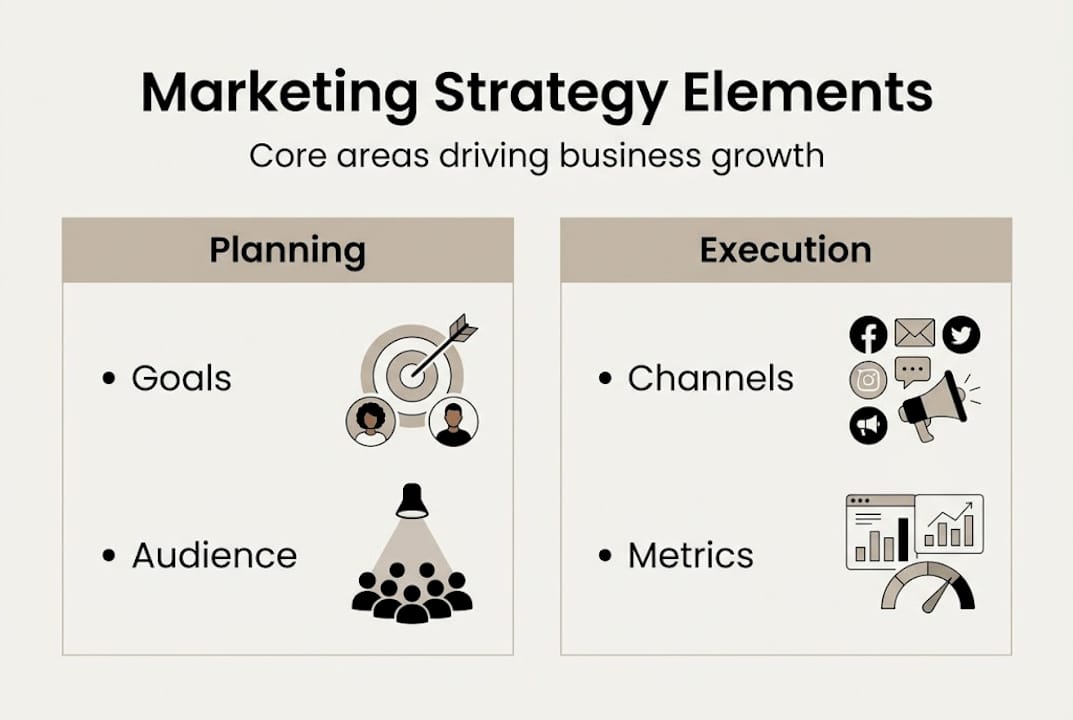
Marketing measurement leaders use north star KPIs, marketing mix modelling, and a balance of short and long-term investment to drive consistent results. That is not complexity for its own sake. It is discipline applied systematically.
| Strategic element | Why it matters | Impact |
|---|---|---|
| North star KPI | Aligns team on one primary success metric | Reduces wasted effort |
| Measurement framework | Tracks what actually drives revenue | Improves budget decisions |
| Retention vs acquisition balance | Maximises lifetime value | Increases revenue per customer |
| Leadership buy-in | Ensures strategy is resourced properly | Prevents tactical drift |
| Channel mix | Reaches audience where they are | Improves conversion rates |
For both assisted living and e-commerce businesses, the strategic essentials look like this:
- A clearly defined target audience with documented motivations and objections
- A north star metric that reflects real business health, not vanity
- A measurement system in place before campaigns launch
- A channel mix chosen for audience fit, not convenience
- Leadership commitment to long-term brand building alongside short-term performance
Pro Tip: Before adding AI tools or complex attribution modelling, make sure you can answer this question: do you know which channel drove your last ten conversions? If not, start with measurement basics first.
Leadership alignment is frequently underestimated. When senior decision-makers treat marketing as a cost rather than an investment, strategy gets cut at the first sign of pressure. That is when reactive tactics take over and growth stalls.
Keeping up with 2026 marketing trends is useful, but only when you have the strategic foundation to evaluate which trends are relevant to your specific business.
Technology, AI, and the fundamentals of strategy
There is enormous pressure on business owners right now to adopt AI tools, marketing automation platforms, and data analytics systems. Some of these tools are genuinely powerful. But the mistake most businesses make is reaching for the tool before defining the strategy.
“AI enhances marketing activities, but strong fundamentals and clear objectives must come first.”
Think of AI as a multiplier. If your strategy is sound, AI can accelerate results significantly. If your strategy is unclear, AI will simply help you do the wrong things faster.
Common pitfalls to avoid:
- Investing in AI in analytics before you have clean, reliable data to feed it
- Automating customer journeys before you understand what your customers actually need at each stage
- Using AI-generated content without a clear brand voice or positioning to guide it
- Prioritising tool adoption over team training and strategic alignment
- Measuring AI performance by activity rather than by revenue impact
The logical order for integrating technology into your marketing strategy is:
- Define your goals and north star KPI clearly
- Build a measurement framework that captures the right data
- Map your customer journey from first awareness to repeat purchase or referral
- Identify where manual processes create bottlenecks or drop-offs
- Select technology that addresses those specific bottlenecks
- Test, measure, and iterate before scaling
When choosing AI tools for your business, the question should never be “what can this tool do?” It should be “what specific problem does this solve within our strategy?” That shift in thinking is what separates businesses that use AI technologies effectively from those that spend budget on impressive-sounding software that never moves the needle.
The real reason strategy trumps tactics (and what nobody tells you)
Here is the uncomfortable truth most marketing guides skip over. The businesses we see struggle most are not short on tools, platforms, or even budget. They are short on strategic leadership and the willingness to commit to a direction long enough for it to work.
AI hype has made this worse. When every platform promises to automate your growth, it becomes tempting to believe that the right software will replace the hard thinking. It will not. We have seen assisted living operators invest heavily in chatbots and CRM systems while their core brand positioning remained completely undefined. The technology ran efficiently and delivered nothing meaningful.
Discipline is not glamorous. Committing to a retention-first strategy, building brand trust over 18 months, and resisting the urge to chase every new tactic is genuinely difficult. But it is what works. A proper strategy analysis before any tool adoption would have saved those businesses significant time and money. The businesses that grow sustainably are not the ones with the most tools. They are the ones with the clearest thinking.
How Nu Life Digital supports your strategic growth
Understanding the value of strategy is the first step. Executing it properly is where most businesses need support.

At NU Life Digital, we work with assisted living operators and e-commerce brands to build the strategic foundations that make every marketing investment work harder. From expert web design engineered to convert, to AI integration that supports rather than replaces your strategy, everything we do is tied to measurable growth. If you are ready to stop guessing and start building a marketing system that compounds over time, explore our digital strategy help and see how we approach growth for ambitious businesses.
Frequently asked questions
What is the difference between marketing strategy and tactics?
Marketing strategy is the high-level plan for long-term growth, while tactics are the specific actions to achieve those aims. Clear strategic direction consistently beats isolated campaigns over time.
Why is retention more important than acquisition for revenue?
Retaining existing customers increases lifetime value and reduces marketing spend, making it more valuable than focusing solely on new clients. Retention drives revenue more reliably than acquisition-only approaches.
How does AI fit into marketing strategy?
AI can optimise and enhance strategy execution, but strong basics and clear goals must come first. AI enhances, but basics first is the principle that prevents wasted investment in tools without direction.
What is a north star KPI in marketing?
A north star KPI is a key metric that aligns your entire team on long-term marketing success and is tracked consistently above all others. North star KPIs drive consistent results by keeping focus on what genuinely matters to business growth.