
TL;DR:
- Search traffic is declining due to AI-powered zero-click results and changing search behaviors.
- E-E-A-T signals and human-authored, authoritative content are now crucial for visibility in 2026.
- Technical SEO, structured data, and hybrid human-AI strategies are essential for long-term success.
Search has changed more in the past 18 months than in the previous decade. 68% of Google searches now end without a single click, meaning the traffic you once counted on is quietly disappearing. AI-powered results, zero-click answers, and entirely new ranking signals have made many familiar tactics not just ineffective but potentially harmful. If you are still optimising the way you did in 2022, you are not just falling behind. You are playing a game that no longer exists. This guide breaks down the most important SEO trends for 2026, the challenges they create, and the practical steps you can take to stay visible and competitive.
Table of Contents
- Understanding the new SEO landscape
- The central role of E-E-A-T and human content
- Optimising for AI-powered and zero-click search
- Technical and structural optimisation for future growth
- Why hybrid human-AI SEO is the only sustainable path forward
- Partner with experts for your next SEO breakthrough
- Frequently asked questions about SEO trends in 2026
Key Takeaways
| Point | Details |
|---|---|
| AI search dominance | Zero-click and AI-driven results reshape how SEO delivers value in 2026. |
| E-E-A-T required | Building Experience, Expertise, Authoritativeness, and Trust signals is non-negotiable for SEO success. |
| Human content wins | Original, human-authored resources outperform AI-generated content by driving authority and trust. |
| Optimise for citations | Strategies must ensure your brand is referenced in AI answers and rich results, not just clicked. |
| Technical SEO matters | Site health, structured data, and compliant tracking fuel organic growth and e-commerce revenue. |
Understanding the new SEO landscape
The search engine results page you knew has been replaced by something fundamentally different. Google’s AI Overviews now sit at the top of millions of results, summarising answers before users ever see a list of links. This is not a minor update. It is a structural shift in how information is delivered and consumed.
Zero-click searches now dominate, with 68% of Google searches ending without a visit to any website. For e-commerce brands and service businesses, that is a direct hit to organic traffic. The old model of ranking in position one and watching visitors pour in is no longer reliable on its own.
Search queries themselves are also getting longer and more conversational. Users are asking full questions rather than typing short keywords. This reflects how people interact with AI tools, and it means your content needs to match the intent behind a question, not just the words in it.
“Traditional rankings matter less now. What matters is whether your content is cited, referenced, or surfaced inside AI-generated answers.”
This shift puts enormous pressure on businesses to rethink what visibility actually means. Being on page one is still valuable, but being the source an AI cites is quickly becoming just as important. Staying across 2026 digital marketing trends is no longer optional for growth-focused businesses.
Here is a snapshot of how the landscape has shifted:
| Signal | 2022 priority | 2026 priority |
|---|---|---|
| Keyword density | High | Low |
| Backlink volume | High | Moderate |
| E-E-A-T signals | Moderate | Critical |
| AI citation potential | Not applicable | Essential |
| Zero-click optimisation | Not applicable | High |
The businesses winning in this environment are those who have updated their core SEO strategies to reflect these new realities. Those still chasing old metrics are burning budget without results.
Key shifts to understand right now:
- AI Overviews reduce click-through rates even for top-ranked pages
- Long-tail, conversational queries are growing faster than short keywords
- Being cited in AI responses requires trust signals, not just rankings
- E-E-A-T is now the dominant filter for both algorithmic and AI-driven visibility
The central role of E-E-A-T and human content
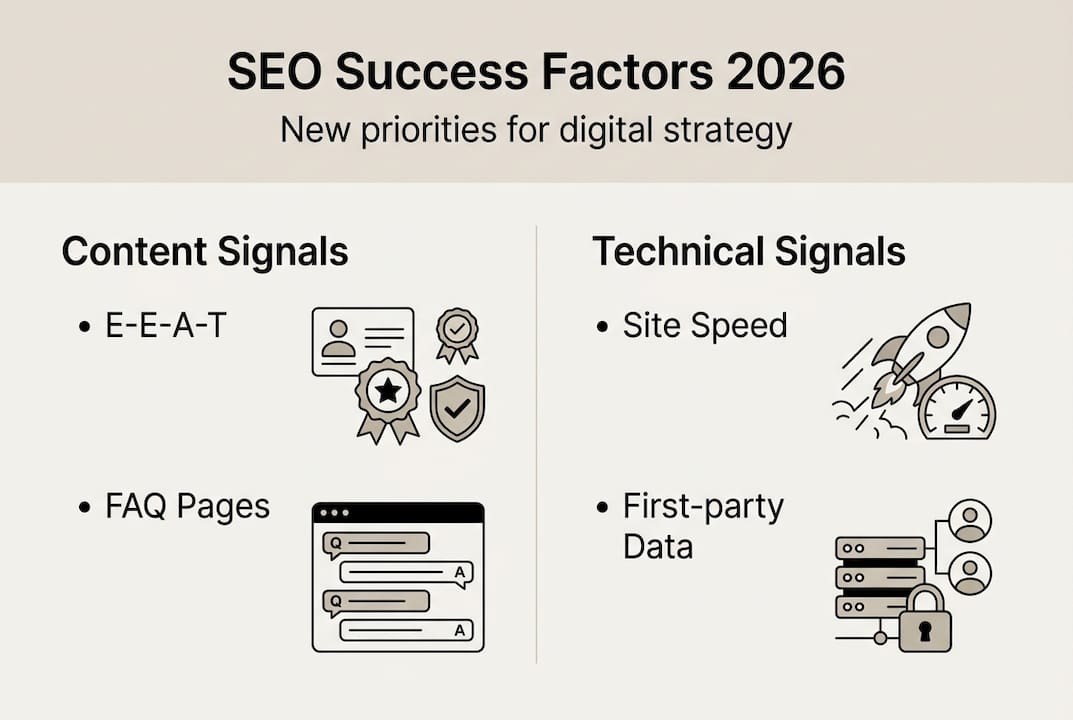
E-E-A-T stands for Experience, Expertise, Authoritativeness, and Trustworthiness. Google introduced the extra “E” for Experience in 2022, and by 2026 it has become the single most important framework for determining whether your content earns visibility. E-E-A-T is the dominant ranking framework in 2026, and it applies equally to classic search results and AI-generated responses.
Let us break each pillar down with practical examples:
- Experience means demonstrating first-hand knowledge. A case study from your own client work, a photo from a real project, or a review from a verified customer all signal experience.
- Expertise is about depth. Author bios with credentials, detailed how-to guides, and technical accuracy all contribute.
- Authoritativeness is built through mentions, backlinks, and being referenced by credible sources in your industry.
- Trustworthiness covers everything from HTTPS and clear contact details to transparent pricing and honest reviews.
Here is where many businesses make a critical mistake. They assume AI-generated content can tick these boxes efficiently. It cannot. Human-written content outperforms AI-generated content, with 66% of SEO professionals reporting it as the top positive impact activity in 2026. The nuance, lived experience, and editorial voice that humans bring simply cannot be replicated at scale by a language model.
| Content type | E-E-A-T signal strength | AI citation potential |
|---|---|---|
| AI-only blog post | Low | Low |
| Human-written with data | High | High |
| Case study with results | Very high | Very high |
| Generic product description | Very low | Very low |
Pro Tip: Add a short author bio to every article you publish. Include the author’s relevant experience, a professional photo, and links to their credentials. This single change can meaningfully improve your E-E-A-T signals without overhauling your entire content strategy.
Strong content marketing for SEO in 2026 means publishing fewer pieces but making each one genuinely authoritative. A single well-researched article with real data, original insights, and a named expert author will outperform ten generic posts every time. Combine that with strong conversion optimisation tips and you have content that both ranks and converts.

Optimising for AI-powered and zero-click search
Generative Engine Optimisation, or GEO, is the practice of structuring your content so that AI systems are more likely to cite it in their generated responses. It is the natural evolution of traditional SEO, and it requires a different mindset. You are no longer just optimising for a ranking. You are optimising to be the source.
With 68% of searches ending without clicks, the goal shifts from driving traffic to building brand presence across every touchpoint, including AI-generated answers, featured snippets, knowledge panels, and voice results.
Practical ways to stay visible in a zero-click world:
- Write clear, direct answers to common questions within your content
- Use structured FAQ sections with concise, factual responses
- Claim and optimise your Google Business Profile for knowledge panel inclusion
- Target featured snippet positions with well-formatted definitions and lists
- Build citations from authoritative sources in your industry
- Use schema markup to help AI systems understand your content structure
Pro Tip: Create a dedicated FAQ page that mirrors the exact questions your customers ask in sales calls or enquiry forms. Write answers in plain language, under 60 words each. This format is highly compatible with AI citation patterns and featured snippet selection.
Here is how different content formats perform in AI-driven search:
| Content format | Zero-click visibility | AI citation likelihood |
|---|---|---|
| Long-form narrative | Moderate | Moderate |
| Structured FAQ | High | Very high |
| Data-backed statistics | High | High |
| Product page only | Low | Very low |
| Expert opinion with source | Very high | Very high |
Exploring integrating AI in SEO can help you identify where your content gaps are and which formats your audience is actually searching for. Pairing that insight with reliable SEO strategies gives you a framework that works across both traditional and AI-driven results.
Technical and structural optimisation for future growth
All the great content in the world will underperform if your technical foundations are weak. In 2026, 89% of e-commerce SEO experts prioritise Core Web Vitals, mobile-first usability, and site architecture as foundational ranking factors. These are not optional extras. They are the baseline.
Structured data, or Schema markup, is particularly important right now. Structured data enables AI extraction for rich results, helping search engines and AI systems understand exactly what your page is about, who wrote it, what it costs, and what action a user should take. For e-commerce and service businesses, this is a direct revenue lever.
“Businesses that invest in technical SEO fixes see measurable returns. Technical fixes yield 38% organic revenue growth in documented case studies.”
Your technical SEO checklist for 2026:
- Audit Core Web Vitals across all key pages, particularly on mobile
- Implement Schema markup for products, services, reviews, and FAQs
- Migrate to server-side tracking to maintain data accuracy post-cookie
- Build a clear internal linking architecture that guides both users and crawlers
- Ensure all pages load in under 2.5 seconds on mobile networks
- Conduct a full crawl audit to identify and fix broken links, duplicate content, and indexing issues
First-party data collection is also becoming critical. As third-party cookies disappear, businesses that have invested in email lists, loyalty programmes, and on-site data capture will have a significant advantage. This feeds directly into smarter retargeting and more accurate attribution.
Regular technical SEO audits are the fastest way to identify what is holding your site back. Combined with a clear strategic marketing growth plan, technical improvements compound over time into significant competitive advantages.
Why hybrid human-AI SEO is the only sustainable path forward
Here is the uncomfortable truth that many agencies will not tell you. Fully automated AI-driven SEO does not work long-term. It produces content that looks complete but lacks the editorial authority, real-world insight, and genuine trust signals that both Google and AI systems are now trained to detect and reward.
42% of SEO teams use AI assistants, but the highest performers use them to accelerate human thinking, not replace it. AI is brilliant for research, pattern spotting, and content briefs. Humans are essential for voice, judgement, and credibility. The moment you remove the human layer entirely, your content becomes indistinguishable from the millions of other AI-generated pages competing for the same space.
The businesses we see winning in 2026 are publishing less but publishing better. They invest in AI marketing technology to work faster, but they never outsource the thinking. Quality over quantity is not a content philosophy. In 2026, it is a survival strategy.
Partner with experts for your next SEO breakthrough
If you are ready to put these new SEO strategies into practice, there is no need to go it alone. The trends covered in this guide require a combination of technical skill, content strategy, and AI integration that takes time to build in-house.
At NU Life Digital, we help ambitious businesses implement exactly these kinds of future-ready systems. From our web design experts who build sites engineered for both conversion and technical SEO, to our AI integration and automation specialists who put intelligent workflows in place, through to our eCommerce solutions that turn traffic into revenue, we build the full growth engine. If 2026 is the year you get serious about SEO performance, let us help you do it properly.
Frequently asked questions about SEO trends in 2026
What is E-E-A-T and why is it so important in 2026 SEO?
E-E-A-T is the dominant ranking framework in 2026, standing for Experience, Expertise, Authoritativeness, and Trustworthiness. Google uses these signals to determine which content earns visibility in both classic results and AI-generated answers.
How do zero-click searches affect my website traffic?
With 68% of searches ending without a click, you must shift focus toward brand visibility in AI answers, featured snippets, and knowledge panels rather than relying solely on click-through traffic.
Should I use AI tools or stick to human-written content?
The strongest results come from hybrid workflows where AI accelerates research and drafting, but human expertise, voice, and judgement shape the final output. 42% of teams use AI assistants while keeping quality as the primary filter.
Which technical SEO practices still matter most in 2026?
Core Web Vitals, mobile-first design, internal site architecture, and structured data for rich results remain foundational, with 89% of e-commerce experts treating them as non-negotiable for revenue growth.