
Most business owners assume paid advertising is expensive guesswork. In reality, it’s the fastest, most measurable way to generate qualified leads and scale revenue. Unlike organic methods that take months to gain traction, paid campaigns deliver immediate visibility and trackable returns. For assisted living facilities and e-commerce brands, this means predictable growth, not hope-based marketing. You’ll learn exactly why paid advertising outperforms slower channels, how to interpret sector-specific performance benchmarks, and the strategic steps that separate profitable campaigns from wasted budgets.
Table of Contents
- Key takeaways
- How paid advertising captures high-intent audiences quickly
- Evaluating return on ad spend: benchmarks and sector differences
- Common myths and how to align strategy for paid advertising success
- Practical steps for leveraging paid advertising in assisted living and e-commerce
- Explore expert digital marketing solutions for your business
- Frequently asked questions about paid advertising
Key Takeaways
| Point | Details |
|---|---|
| High intent targeting | Paid advertising intercepts users at the moment they intend to act, delivering immediate enquiries and measurable returns through pay per click. |
| Immediate visibility and lead generation | Paid campaigns provide rapid exposure and trackable lead generation, unlike organic methods that take months to show results. |
| ROAS benchmarks vary by sector | Industry benchmarks show strong profitability in e commerce, with Google Shopping delivering 4.2x ROAS on average and top performers above 7x. |
| Strategic alignment and testing | Success comes from aligning messaging with the funnel and ongoing testing plus retargeting to boost effectiveness and return on investment. |
How paid advertising captures high-intent audiences quickly
Paid advertising works because it intercepts people at the exact moment they’re ready to act. Someone searching “assisted living near me” or browsing luxury skincare products isn’t casually exploring. They’re signalling intent. Pay-per-click models ensure you only spend when users click, making every pound accountable. This precision separates paid ads from organic strategies that build presence over time but lack immediacy.
Google Ads in senior living typically achieve click-through rates between 3% and 7%, generating immediate enquiries. Organic SEO, whilst valuable for long-term authority, usually takes six months or more to deliver comparable visibility. The difference isn’t just speed. Paid campaigns provide granular data on cost per click, conversion rates, and return on ad spend from day one. Organic channels offer traffic growth but obscure which specific efforts drove which results.
E-commerce brands benefit even more dramatically. A product ad appearing during a Google Shopping search converts browsers into buyers within minutes. Organic listings might appear eventually, but paid placements guarantee top-of-page visibility regardless of domain authority or content history. For businesses needing cash flow now, not next quarter, this immediacy is non-negotiable.
Pro Tip: Allocate budget to platforms where your audience actively searches or browses. Assisted living facilities see strongest returns on Google Search and local service ads. E-commerce brands often split between Google Shopping for demand capture and Meta for discovery and retargeting.
Consider this fundamental truth:
Paid advertising reaches audiences at the moment they show high intent to buy or enquire, delivering measurable ROI through pay-per-click models that organic channels cannot match for speed or precision.
The mechanics are straightforward. You define your audience by demographics, interests, search terms, or behaviours. Platforms serve your ads to matching users. You pay only when someone clicks. This model eliminates wasted impressions and focuses spending on genuine interest. Organic marketing builds brand equity over time, but when you need leads this month, paid advertising is the only viable path.
Evaluating return on ad spend: benchmarks and sector differences
Understanding what good performance looks like prevents both under-investment and unrealistic expectations. E-commerce benchmarks show Google Shopping delivers 4.2x ROAS on average, meaning every pound spent returns £4.20 in revenue. Top performers exceed 7x. Meta ads average 2.5x ROAS but remain essential for broader brand engagement and retargeting warm audiences. These figures aren’t aspirational. They’re industry standards based on 2026 data.

Cost per acquisition varies by platform and sector. Google Shopping averages £38.40 CPA in e-commerce, whilst Meta sits at £43.80. The difference reflects intent levels. Google captures users actively searching for products. Meta introduces products to audiences who fit ideal customer profiles but weren’t necessarily hunting right then. Both play distinct roles in a balanced strategy.
| Platform | Average ROAS | Average CPA | Best use case |
|---|---|---|---|
| Google Shopping | 4.2x | £38.40 | Demand capture for high-intent product searches |
| Google Search | 4.0x | £42.00 | Service enquiries and information-driven searches |
| Meta (Facebook/Instagram) | 2.5x | £43.80 | Brand discovery, retargeting, visual product showcasing |
| TikTok | 3.1x | £35.20 | Younger demographics, viral product potential |
Assisted living sectors face different dynamics. Sales cycles extend over weeks or months as families research options and visit facilities. Emotional factors dominate decisions. A single click rarely converts immediately into an admission. This doesn’t mean paid ads fail in senior living. It means measuring success requires tracking enquiry quality, tour bookings, and lifetime value rather than instant purchases.
Pro Tip: Track blended ROAS including customer lifetime value to fully assess paid ad effectiveness. An e-commerce customer worth £500 over two years justifies higher initial acquisition costs than a £50 one-time purchaser.
Sector-specific benchmarks matter because they set realistic goals. A 2.5x ROAS might disappoint an e-commerce brand but represent excellent performance for a high-ticket service business. Assisted living facilities with average resident values exceeding £50,000 annually can profitably spend £2,000 per admission. E-commerce brands selling £30 products need sub-£10 acquisition costs to maintain margin.
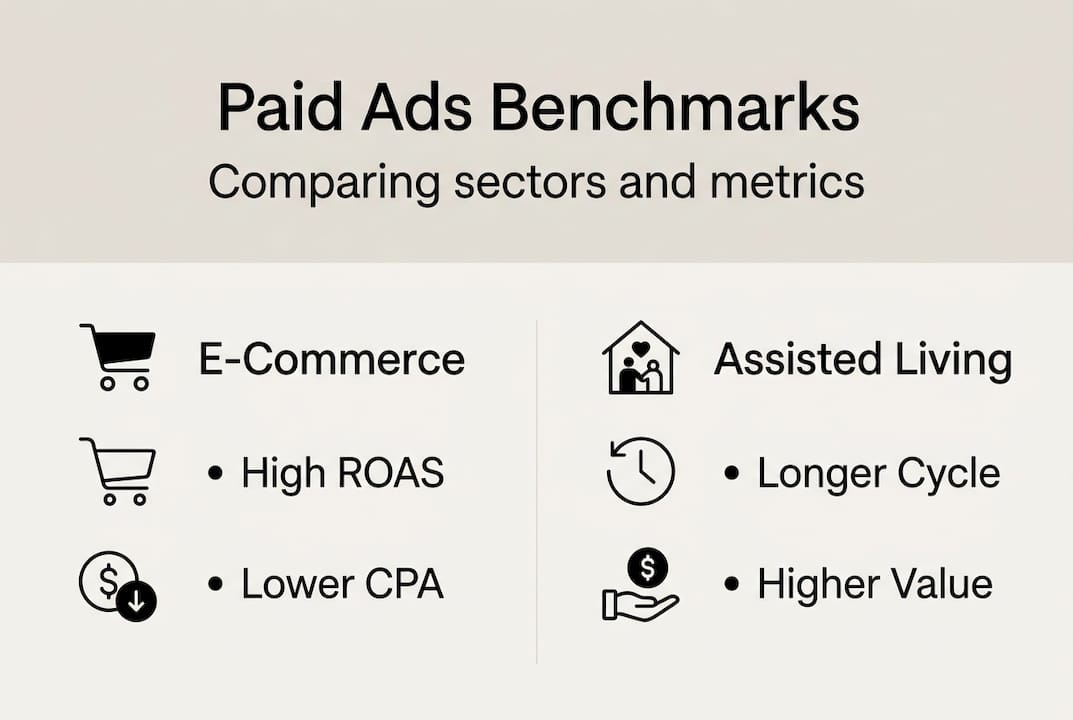
The key insight: ROAS alone doesn’t determine success. Profit margin, repeat purchase rates, and customer lifetime value create the complete picture. A 3x ROAS with 20% margin yields less profit than a 2x ROAS with 50% margin. Always calculate actual profit per acquisition, not just revenue multiples.
Common myths and how to align strategy for paid advertising success
Many business owners believe AI targeting automatically optimises campaigns without human strategy. This myth causes failures more often than platform limitations. AI requires quality data signals to learn from. Without proper conversion tracking, clear offers, and sufficient volume, algorithms guess rather than optimise. Manual oversight remains essential for interpreting results and adjusting strategy.
Another misconception: scaling budgets and adding more creatives automatically improve results. Reality is harsher. Pouring money into poorly aligned messaging amplifies waste. If your landing page doesn’t convert visitors, doubling ad spend just sends more people to a broken funnel. Strategy must precede scale. Fix the fundamentals first.
Assisted living campaigns especially require emotional resonance. Families choosing care facilities need reassurance, empathy, and trust signals. Generic ads about “quality care” or “experienced staff” fail because they lack specificity and emotional connection. Effective senior living ads address specific fears, showcase real staff and residents, and guide families through a complex decision with compassion.
Follow these steps to align paid ad strategy properly:
- Fix messaging to address actual audience pain points and desires, not generic benefits
- Test multiple creatives including images, video, and copy variations to identify what resonates
- Optimise landing pages for conversion with clear calls to action and trust signals
- Set up retargeting campaigns to re-engage visitors who didn’t convert initially
- Scale cautiously, increasing budgets only after proving consistent profitability at smaller spend levels
Pro Tip: Retargeting previous website visitors or leads significantly increases conversion likelihood. These audiences already know your brand and need gentle reminders rather than cold introductions.
The strategic alignment principle applies across sectors. E-commerce brands must match ad creative to product benefits and customer motivations. A luxury skincare brand emphasises transformation and self-care. A budget home goods retailer highlights value and practicality. Mismatched messaging confuses audiences and tanks conversion rates regardless of targeting precision.
Another critical myth: more platforms equal better results. Spreading budgets thinly across Google, Meta, TikTok, LinkedIn, and Pinterest dilutes impact. Master one or two platforms first. Achieve consistent profitability. Then expand. Jumping between platforms chasing lower costs usually means never optimising any channel properly. Depth beats breadth in paid advertising.
Success requires honest assessment of what’s working. If campaigns aren’t profitable after reasonable testing periods, the problem lies in offer, messaging, or funnel, not platform choice. Learning from real optimisation case studies reveals that strategic fixes, not budget increases, drive breakthrough improvements.
Practical steps for leveraging paid advertising in assisted living and e-commerce
Implementing effective paid advertising requires methodical planning and continuous optimisation. Start with budget allocation. E-commerce brands should allocate 35-45% to Google Shopping and Search for demand capture, and 25-35% to Meta for discovery and retargeting. This split balances high-intent conversions with broader audience building. Remaining budget can test emerging platforms like TikTok or Pinterest depending on product fit.
Assisted living campaigns benefit from different platform emphasis. Google Search captures families actively researching care options. Local service ads appear in map results when people search nearby facilities. Meta works well for retargeting and showcasing facility culture through video tours and resident testimonials. LinkedIn can reach adult children researching options for ageing parents, though costs run higher.
Testing frameworks separate guesswork from data-driven decisions. Run A/B splits comparing ad creatives, offers, and landing page variations. Test one variable at a time to isolate what drives performance changes. Common tests include headline variations, image versus video, discount offers versus value propositions, and long-form versus short-form landing pages. Let each test run until reaching statistical significance, typically 100-200 conversions minimum.
Integration with CRM systems ensures leads don’t fall through gaps. Automated lead capture from ad platforms into your CRM enables immediate follow-up and tracks which campaigns generate highest-quality enquiries. For assisted living, this means knowing which ads lead to facility tours and admissions. For e-commerce, it reveals which campaigns drive repeat purchases and highest lifetime value customers.
| Factor | Assisted living approach | E-commerce approach |
|---|---|---|
| Primary platforms | Google Search, Local Service Ads, Meta | Google Shopping, Meta, TikTok |
| Key metrics | Tour bookings, enquiry quality, admission rate | ROAS, CPA, repeat purchase rate |
| Creative focus | Emotional reassurance, facility culture, staff expertise | Product benefits, lifestyle fit, social proof |
| Funnel complexity | Multi-touch, weeks-long consideration | Often single-session purchase decisions |
| Budget testing period | 60-90 days for meaningful data | 14-30 days sufficient for initial signals |
Campaign setup checklist ensures nothing critical gets missed:
- Define specific, measurable goals tied to business outcomes, not vanity metrics
- Choose platforms based on where your audience actively searches or browses
- Design creative that addresses audience motivations and pain points directly
- Launch with sufficient budget for platforms to gather meaningful performance data
- Analyse results weekly, looking for patterns in time of day, audience segments, and creative performance
- Refine targeting by excluding poor performers and increasing bids on high converters
Blended ROAS measurement accounts for full customer value. An e-commerce customer acquired at £40 who spends £80 initially shows 2x ROAS. If they purchase twice more over the next year for another £120, true ROAS reaches 5x. Track cohorts over time to understand real profitability, not just first-purchase returns.
High-converting web design amplifies paid advertising results. Traffic from ads hitting poorly designed landing pages wastes budget. Every element, from headlines to form fields to trust signals, must guide visitors toward conversion. Mobile optimisation is non-negotiable, as most paid traffic now comes from smartphones.
Avoid broad targeting until you’ve proven success with narrow audiences. Start with your best customer profile. Test. Optimise. Scale what works. Then expand to adjacent audiences. Broad targeting early burns budgets teaching algorithms with expensive mistakes. Narrow targeting front-loads learning with your highest-probability converters.
Explore expert digital marketing solutions for your business
Implementing everything you’ve just learned requires expertise, time, and continuous optimisation. Most business owners lack the bandwidth to manage campaigns whilst running daily operations. That’s where specialist support transforms results.

NU Life Digital builds complete growth systems for ambitious businesses in assisted living and e-commerce. We don’t just run ads. We engineer high-converting websites, optimise e-commerce platforms, and create paid advertising campaigns that deliver measurable ROI from day one. Our digital agency services combine strategy, design, and execution so you get results, not excuses. Whether you’re scaling to £100k monthly revenue or increasing facility occupancy, we provide the systems and expertise that turn marketing spend into predictable growth. Partner with specialists who understand your sector’s unique challenges and deliver campaigns that actually convert.
Frequently asked questions about paid advertising
What budget should I allocate to paid ads compared to organic marketing?
Start with 60-70% of digital marketing budget on paid advertising if you need immediate leads and revenue. Organic efforts build long-term assets but take six months minimum to deliver comparable results. Balance shifts toward organic once paid campaigns prove consistent profitability.
How quickly can I expect results from paid advertising?
E-commerce campaigns often show initial signals within 7-14 days and meaningful data within 30 days. Assisted living requires 60-90 days due to longer consideration cycles. Immediate traffic begins day one, but optimisation needs sufficient conversion data to guide decisions.
Is paid advertising suitable for highly emotional sectors like assisted living?
Absolutely, when executed with empathy and strategic messaging. Families researching senior care need reassurance, not hard sells. Effective campaigns showcase facility culture, address specific concerns, and guide decision-making with compassion. Paid ads excel at reaching families at critical research moments.
How important is testing multiple creatives and landing pages?
Critical for sustained success. Audiences respond differently to messaging, images, and offers. Testing reveals what resonates rather than guessing. Expect 30-50% performance variance between best and worst creatives. Continuous testing prevents stagnation as audience preferences and competitive landscape evolve.
Can I rely solely on AI targeting for best performance?
No. AI requires quality data signals, clear conversion tracking, and strategic oversight. Algorithms optimise toward the goals you set, but can’t determine if those goals align with business profitability. Manual analysis of audience segments, creative performance, and funnel metrics remains essential for interpreting results and guiding strategy.
What metrics matter most for measuring paid advertising success?
Track cost per acquisition, return on ad spend, and customer lifetime value as primary indicators. Secondary metrics include click-through rate, conversion rate, and cost per click for diagnosing performance issues. Avoid vanity metrics like impressions or reach that don’t tie directly to revenue or qualified leads.