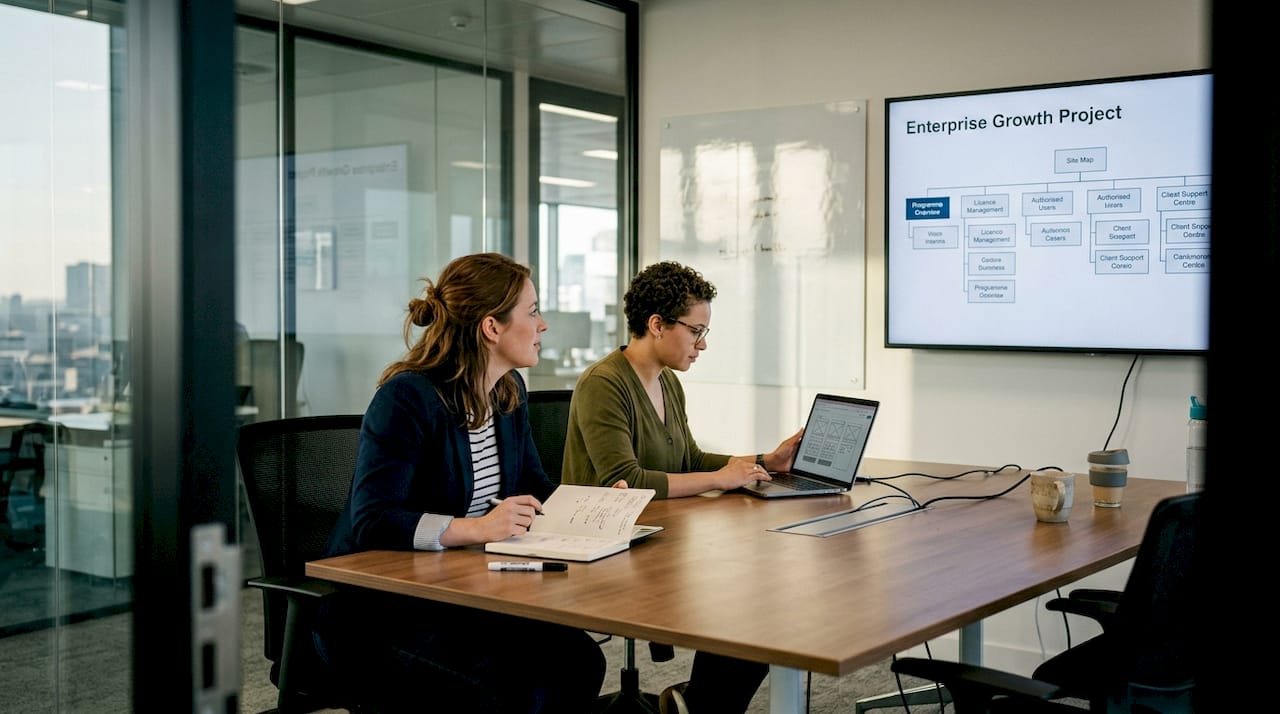
TL;DR:
- Enterprise website design emphasizes scalability, integration, security, and strategic outcomes over aesthetics.
- Effective enterprise sites improve user experience, increase conversions, and support business growth in care and e-commerce sectors.
- Emerging technologies like AI, headless CMS, and automation boost personalization and operational efficiency.
Your website is not a brochure. That assumption costs businesses thousands in lost revenue every year. For assisted living facilities trying to fill occupancy and e-commerce brands chasing consistent monthly sales, a poorly structured website is not just a missed opportunity — it is an active barrier to growth. Enterprise website design changes that equation entirely. It moves your digital presence from passive to purposeful, from decorative to functional, and from generic to strategically aligned with your specific business goals. This article breaks down what enterprise design actually means, what it requires, and how it directly drives results for organisations in care and commerce.
Table of Contents
- Defining enterprise website design: more than just scale
- Key elements of successful enterprise website design
- The role of website design in assisted living and e-commerce growth
- Modern trends and technologies shaping enterprise website design
- The real challenge: avoiding complexity for its own sake
- Take the next step with expert website design
- Frequently asked questions
Key Takeaways
| Point | Details |
|---|---|
| Purpose-driven design | Enterprise website design is about aligning digital platforms with core business objectives, not just visual appeal. |
| Integration and scalability | Successful enterprise websites seamlessly integrate with business systems and can grow alongside organisational needs. |
| Measurable impact | The effectiveness of enterprise web design is best judged by real business outcomes, from conversion rates to customer trust. |
| Innovation with intent | Adopt new technologies only when they enhance usability, experience, and business value. |
Defining enterprise website design: more than just scale
The word “enterprise” gets thrown around loosely in digital marketing. Many assume it simply means a large website with lots of pages. That misses the point entirely. Enterprise website design refers to a purposeful, integrated approach to building digital platforms that support complex business operations, serve diverse user groups, and scale reliably as an organisation grows.
At its core, enterprise website design integrates complex systems, security, branding, and scalability into a single cohesive platform. This is fundamentally different from a standard small business website, which might prioritise aesthetics or basic contact functionality. Enterprise builds are engineered around outcomes.
Here is what separates enterprise websites from generic builds:
- Scalability: The architecture supports significant traffic growth without performance degradation.
- Security: Advanced protocols protect user data, financial transactions, and sensitive records.
- System integration: CRM platforms, booking tools, analytics dashboards, and payment gateways connect seamlessly.
- Compliance: Industry regulations, accessibility standards, and data protection laws are built into the design from the start.
- Multidisciplinary management: Enterprise sites require ongoing collaboration between designers, developers, content strategists, and marketing teams.
“The difference between a standard website and an enterprise platform is not page count — it is the depth of strategy, integration, and governance behind every decision.”
For organisations that want to transform their online presence into a genuine growth engine, understanding this distinction is the first step. Applying enterprise UX principles from the outset ensures that complexity serves users rather than confusing them. The goal of professional web design at this level is always clarity at scale.
Key elements of successful enterprise website design
Knowing what enterprise design is matters less than knowing what makes it work. Decision-makers often invest in a rebuild without a clear framework for what success looks like. That leads to expensive sites that still underperform. Here are the elements that genuinely move the needle.
Accessibility and mobile responsiveness are non-negotiable. A site that fails on a mobile device or excludes users with disabilities is losing conversions before a single word is read. Enterprise UX design principles consistently show that accessible, responsive design increases engagement across all user segments.

Content management systems (CMS) at the enterprise level allow teams to update, localise, and govern content without relying on developers for every change. This agility matters enormously in fast-moving sectors like e-commerce.
Integration with CRM and automation tools is where enterprise sites earn their keep. When a visitor fills in an enquiry form and that data flows directly into your CRM, triggers a follow-up sequence, and flags a sales alert, you have turned a passive page into an active sales tool. Effective web design strategies for trust confirm that sites optimising user experience, performance, and brand alignment consistently outperform those that do not.
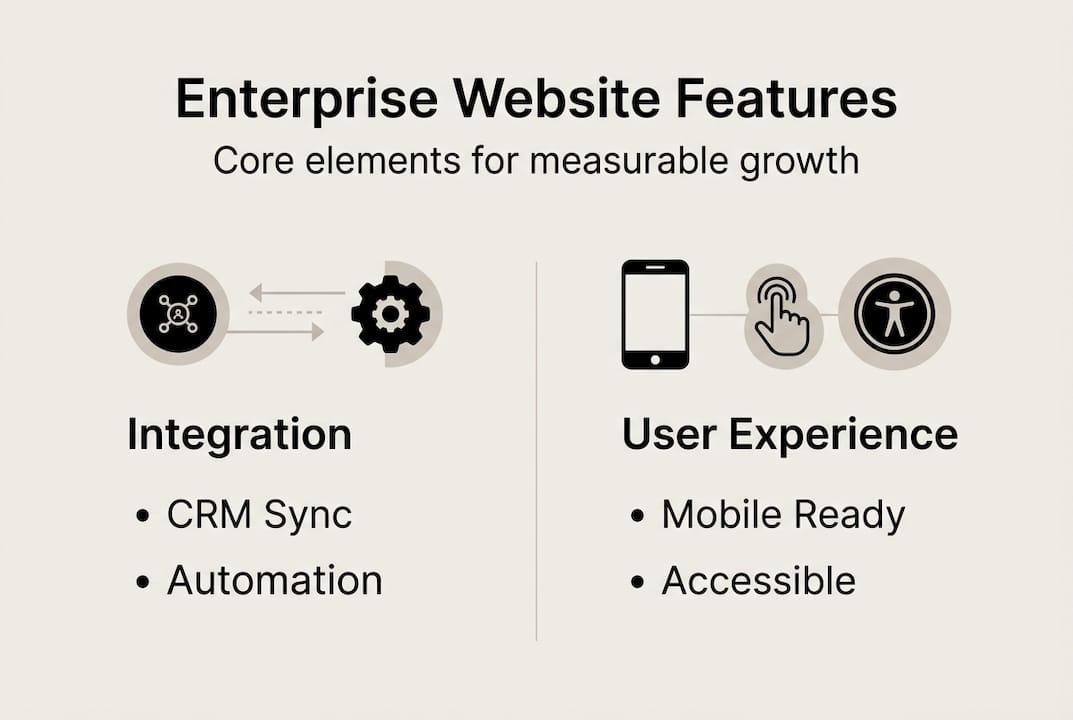
| Feature | Standard website | Enterprise website |
|---|---|---|
| CRM integration | Rarely included | Core requirement |
| Security protocols | Basic SSL | Advanced, layered security |
| Content governance | Single editor | Role-based access and workflows |
| Performance under load | Variable | Engineered for scale |
| Accessibility compliance | Optional | Built-in from the start |
Pro Tip: Before commissioning any enterprise build, map out every system your website needs to connect with. A clear integration list prevents costly retrofitting later.
Brand consistency across every digital touchpoint is another pillar. When a user moves from your homepage to a product page to a checkout flow, the visual language, tone, and trust signals must remain coherent. Inconsistency erodes confidence. Even small mismatches in font, colour, or messaging can raise subconscious doubt in a user who is deciding whether to trust you with their money or their loved one’s care. Consider how effective header layouts contribute to that first impression of coherence.
The role of website design in assisted living and e-commerce growth
Principles are useful. Results are better. Here is how enterprise website design translates into tangible business impact for the two sectors where it matters most.
For assisted living facilities, the stakes are uniquely high. Families searching for care options are often under emotional stress. They are making decisions that affect someone they love. A website that feels cluttered, slow, or confusing communicates exactly the wrong message. Trust signals, clear navigation, and accessible design are not nice-to-haves — they are conversion essentials. Effective design directly boosts conversions and builds trust, which is critical for assisted living providers trying to increase occupancy.
WCAG compliance (Web Content Accessibility Guidelines) deserves special attention here. Many families researching care options include older adults themselves. A site that meets accessibility standards is not just legally sensible — it is commercially smart.
For e-commerce brands, the performance metrics are more immediate. Page load speed, checkout friction, and mobile experience directly correlate with revenue. Consider these benchmarks:
- A one-second delay in page load time can reduce conversions by up to 7%.
- Mobile commerce accounts for more than 60% of e-commerce traffic globally.
- Simplified checkout flows can increase completed purchases by over 35%.
- Personalised product recommendations drive an average of 26% of revenue for leading e-commerce brands.
Pro Tip: For e-commerce brands, run a conversion audit before redesigning. Identify where users drop off in your current funnel — then design the new site to solve those specific problems, not just look better.
The enterprise e-commerce design approach combines speed, reliability, and user-centred journeys to turn traffic into revenue. Platforms like Shopify for enterprise illustrate how scalable infrastructure supports ambitious growth targets. Whether you are managing 500 SKUs or 50,000, the architecture must support the business without breaking under pressure.
Modern trends and technologies shaping enterprise website design
Enterprise website design in 2026 looks very different from what it did five years ago. The pace of change is accelerating, and organisations that ignore emerging technologies risk falling behind competitors who embrace them strategically.
AI-driven personalisation is arguably the most significant shift. Rather than serving every visitor the same homepage, enterprise sites now use behavioural data to surface relevant content, products, or services in real time. A returning visitor to an assisted living site might see testimonials from families in their region. A repeat e-commerce customer might see restocked items from their previous orders. This is not science fiction — it is available now and delivering measurable results.
AI and automation are revolutionising enterprise websites by enhancing user experience, personalisation, and operational efficiency. The practical applications include:
- AI chatbots that handle initial enquiries 24 hours a day, qualifying leads before a human ever gets involved.
- Headless CMS architecture, which separates content from presentation, allowing organisations to deliver consistent experiences across web, mobile, and voice interfaces.
- Predictive analytics that identify which pages are underperforming and suggest improvements based on user behaviour patterns.
- Voice search optimisation, increasingly important as smart speakers and voice-activated devices become standard in both home and care environments.
- Automated A/B testing, which continuously refines page elements without requiring manual intervention.
According to Forrester’s research on AI in the enterprise, organisations investing in AI-driven digital experiences are seeing measurable gains in customer satisfaction and operational efficiency. The data points in one direction: automation is not a future consideration — it is a present competitive advantage.
For decision-makers, the critical question is not whether to adopt these technologies, but which ones solve genuine problems for your users. Chasing every new feature without a clear use case is where enterprise projects go wrong.
The real challenge: avoiding complexity for its own sake
Here is an uncomfortable truth that most agencies will not tell you: the biggest risk in enterprise website design is not doing too little — it is doing too much.
We see it regularly. Organisations invest heavily in feature-rich platforms loaded with integrations, animations, and personalisation engines. Then they wonder why their enquiry rate has not improved. The answer is usually that the complexity served the technology, not the user.
Bespoke features should add business value, not just complexity. That principle sounds obvious, but it is routinely ignored when stakeholders get excited about what a platform can do rather than what their users actually need. The best enterprise sites we have seen are deceptively simple on the surface. Every element earns its place by solving a specific problem or guiding a specific behaviour.
The organisations that get the most from enterprise design are those that start with user research, build around genuine friction points, and treat every new feature as something that must justify its existence. Continuous feedback loops — real user testing, session recordings, heatmaps — keep the site honest. Purposeful web design is not about restraint for its own sake. It is about ensuring that every decision connects back to a measurable outcome. Complexity should serve clarity, not replace it.
Take the next step with expert website design
Armed with a clear sense of what enterprise website design is and what it should be, here is how you can apply these insights immediately.
At NU Life Digital, we build enterprise website design solutions engineered around real business outcomes, not just visual appeal. Whether you are an assisted living facility looking to increase occupancy or an e-commerce brand targeting consistent monthly revenue growth, we design and build platforms that convert.
Our enterprise e-commerce builds are structured for scale, speed, and revenue. Our assisted living solutions focus on trust, accessibility, and website conversion for assisted living at every stage of the enquiry journey. If you are ready to move beyond a website that simply exists and build one that actively grows your business, book a discovery call with our team today.
Frequently asked questions
How does enterprise website design differ from standard website design?
Enterprise website design focuses on scalability, system integration, and strategic business alignment, whereas standard designs prioritise basic online presence with minimal infrastructure. The distinction lies in depth of strategy and technical governance.
What features are essential for an enterprise website in assisted living or e-commerce?
Must-haves include secure data management, WCAG accessibility compliance, seamless CRM integration, and intuitive navigation. Trust and conversion depend on reliable, accessible design that guides users confidently toward action.
Does AI really make a difference in enterprise website performance?
Yes. AI and automation enhance personalisation, streamline lead handling, and surface data-driven insights that improve engagement and conversion rates over time.
How is enterprise website design measured for success?
Conversion rates, bounce rates, session duration, and lead quality are the primary indicators. Conversion metrics are core to understanding whether your enterprise website is delivering genuine return on investment.