You’re investing heavily in your website, but conversions are flat. Traffic arrives, visitors browse, and then they leave without taking action. For business owners in assisted living, e-commerce, luxury retreats, and niche experience industries, this is a costly problem. The good news is that it’s rarely a traffic problem. It’s a systems problem. A structured, repeatable website conversion workflow gives you the framework to identify exactly where visitors drop off, what changes to test, and how to scale what works. This guide walks you through every phase, from setup to scaling, so you can build a process that delivers consistent, measurable growth.
Table of Contents
- Understanding the website conversion workflow
- Preparation and setup: laying the foundation
- Executing the workflow: research to testing
- Reporting, scaling, and iterating: making improvements stick
- Why most conversion workflows fail—and what really works
- Supercharge your conversion workflow with expert help
- Frequently asked questions
Key Takeaways
| Point | Details |
|---|---|
| Follow a structured workflow | A repeatable, six-phase workflow delivers more reliable conversion gains than sporadic tweaks. |
| Focus on data and quick wins | Clean data and targeting high-impact areas accelerate conversion improvements. |
| Prioritise ongoing testing | Regular sprints and iterative experiments drive growth long after website launch. |
| Analysing results is crucial | Review every experiment’s outcome and double down on what works for compounding returns. |
Understanding the website conversion workflow
Conversion rate optimisation (CRO) is the practice of systematically increasing the percentage of website visitors who take a desired action, whether that’s completing a booking form, making a purchase, or submitting an enquiry. Most businesses approach it backwards. They spot a problem, make a change, and hope for the best. A proper workflow changes that entirely.
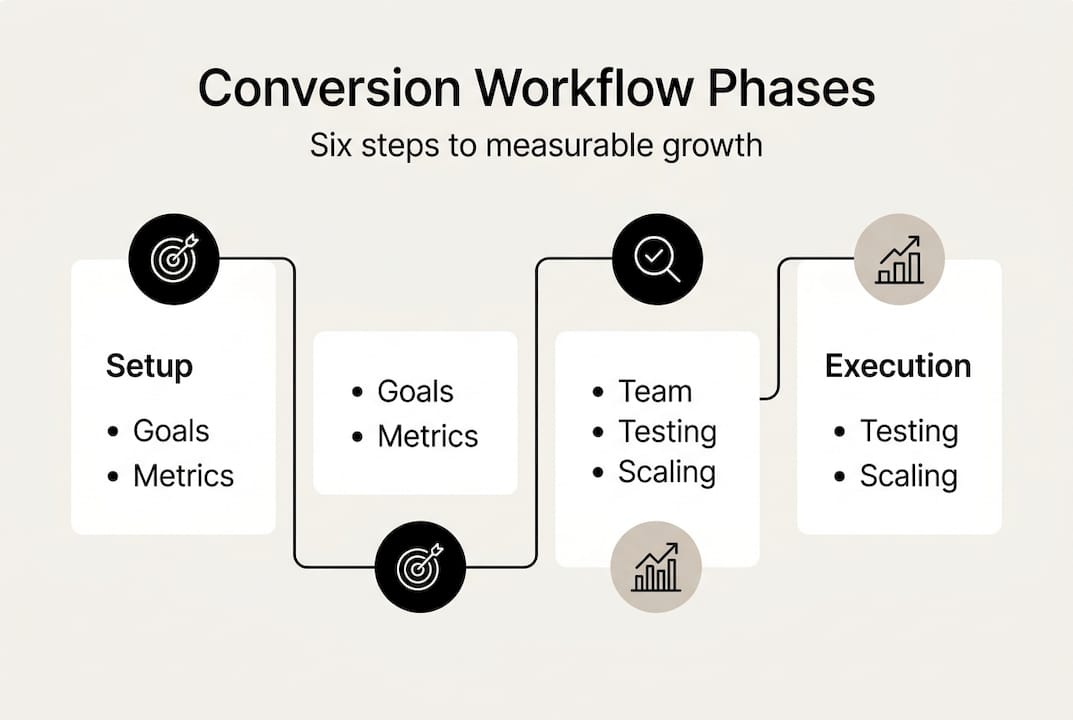
A structured 6-phase CRO process covers: Setup (defining metrics and ensuring data hygiene), Research (funnel mapping, heatmaps, and user tests), Hypothesis (generating testable ideas using ICE or PIE prioritisation), Design and Implementation (refining value propositions, CTAs, forms, and trust signals), Testing (running A/B or multivariate tests with appropriate sample sizes), and Reporting and Scale (analysing results, implementing winners, and iterating). Each phase feeds the next. Skip one and the whole thing loses integrity.
Here’s why this matters for your business specifically. An effective strategy workflow treats your website as a living system, not a static brochure. When you follow a defined process, every change you make is traceable, every result is measurable, and every lesson compounds over time.
“A repeatable, data-driven approach to conversion consistently outperforms ad hoc tweaks because it removes guesswork and replaces it with evidence.”
The six phases at a glance:
| Phase | Core activity |
|---|---|
| Setup | Define goals, clean data, install tracking |
| Research | Heatmaps, session recordings, user surveys |
| Hypothesis | Prioritise test ideas using ICE or PIE scoring |
| Design and implementation | Update CTAs, forms, layouts, trust signals |
| Testing | Run A/B or multivariate experiments |
| Reporting and scale | Analyse results, roll out winners, plan next sprint |
Key benefits of following the workflow:
- Every change is backed by evidence, not instinct
- You build a library of learnings that informs future decisions
- Teams stay aligned because the process is transparent
- Results compound over time rather than plateauing
This is the foundation. Everything else builds on it.
Preparation and setup: laying the foundation
Once you understand the major phases, the first step is getting your house in order. Preparation is where most businesses cut corners, and it’s exactly why their CRO efforts stall before they gain momentum.
Start by defining your primary and secondary conversion goals. For an e-commerce brand, the primary goal might be completed purchases, with secondary goals including add-to-cart events and newsletter sign-ups. For an assisted living facility, the primary goal is likely an enquiry form submission, with secondary goals such as brochure downloads or phone call clicks. Be specific. Vague goals produce vague results.

Next, ensure your data hygiene and metric definitions are clean before you run a single test. Dirty data means you’ll make decisions based on fiction. Check that your analytics tags are firing correctly, that your tracking covers all key pages, and that you’re compliant with GDPR and cookie consent requirements.
Here’s a practical toolkit to get started:
| Tool | Use case |
|---|---|
| Google Analytics 4 | Traffic analysis, funnel tracking, goal completions |
| Hotjar or Microsoft Clarity | Heatmaps, session recordings, user feedback |
| Google Optimize or VWO | A/B and multivariate testing |
| Google Tag Manager | Tag management and tracking deployment |
| Looker Studio | Custom dashboards and reporting |
Essential setup checklist:
- Confirm all conversion goals are tracked and firing correctly
- Set up funnel visualisation for your key user journeys
- Create baseline benchmarks for conversion rate, bounce rate, and average session duration
- Ensure cookie consent is properly configured
- Brief your team on the workflow and their responsibilities
For further conversion optimisation tips on structuring your setup phase effectively, it’s worth reviewing how your current site handles the user journey before you begin testing anything.
Pro Tip: Build a single, simple dashboard that surfaces your five most important metrics. When everyone on the team looks at the same numbers daily, decisions get faster and more consistent.
Executing the workflow: research to testing
With solid prep, you can confidently move into the core action steps of the workflow. This is where the real work happens, and where most of the value is generated.
Step-by-step execution:
- Map your conversion funnel from first visit to completed action
- Run heatmap and session recording analysis to spot friction points
- Conduct user surveys or on-site polls to understand visitor intent
- Identify your top three barriers to conversion
- Generate test hypotheses using the ICE framework (Impact, Confidence, Ease)
- Prioritise the highest-scoring hypotheses and build your test queue
- Design and implement changes for your first experiment
- Run the test until you reach statistical significance
The research, hypothesis, and testing phases are where you’ll uncover the insights that actually move the needle. Funnel mapping reveals where visitors abandon the journey. Heatmaps show where attention goes and where it doesn’t. User tests expose assumptions you didn’t know you were making.
For e-commerce brands, e-commerce conversion growth often starts with the checkout page. It’s the highest-value, highest-friction point in the funnel and usually the quickest win. For luxury retreats, the booking enquiry form is the equivalent. Fix the bottleneck first, then work backwards.
Common pitfalls to avoid:
- Testing too many variables at once, which makes it impossible to identify what caused the result
- Ending tests too early before reaching statistical significance
- Ignoring mobile users, who often behave very differently from desktop visitors
- Treating every test as a win or loss rather than a learning opportunity
Repeatable 90-day sprints that follow an audit-hypothesise-test-scale cycle consistently outperform one-off changes. The businesses that see the best results from conversion and business growth strategies are those that commit to the process rather than chasing individual wins.
Pro Tip: Use the ICE scoring method to prioritise your test ideas. Score each hypothesis on Impact (how much could it improve conversions?), Confidence (how sure are you it will work?), and Ease (how quickly can you implement it?). Focus on high-scoring ideas first to build momentum.
Reporting, scaling, and iterating: making improvements stick
Testing isn’t the end. How you act on results determines your long-term growth. This phase is where most businesses either compound their gains or waste them.
When a test concludes, the first question is whether the result is statistically significant. A 95% confidence level is the standard threshold. If you haven’t reached it, the result is inconclusive and you need more data. Don’t implement changes based on inconclusive tests. It’s one of the most common and costly mistakes in CRO.
Use a reporting table to document every experiment:
| Test | Hypothesis | Result | Confidence | Action |
|---|---|---|---|---|
| CTA button colour | Red increases clicks | +12% conversion | 97% | Implement |
| Form length | Shorter form reduces drop-off | +8% completion | 95% | Implement |
| Hero headline | Benefit-led copy converts better | Inconclusive | 72% | Retest |
Key metrics to monitor on an ongoing basis:
- Overall conversion rate by channel and device
- Micro-conversion rates (add to cart, form start, brochure download)
- Bounce rate on key landing pages
- Average order value or enquiry quality
- Revenue per visitor
“The businesses that grow fastest aren’t the ones who run the most tests. They’re the ones who learn the most from each one.”
The reporting and scaling phase closes the loop. Winners get rolled out site-wide. Learnings feed the next sprint. The cycle repeats. Over time, this compounds. A 5% improvement in conversion rate this quarter, followed by another 7% next quarter, adds up to transformational growth across a year. For businesses serious about maximising their ROI, this iterative approach is far more reliable than any single campaign.
Why most conversion workflows fail—and what really works
Here’s the uncomfortable truth: most businesses don’t have a conversion workflow at all. They have a list of things they’ve tried. There’s a significant difference.
Ad hoc tweaks feel productive. You change a button colour, update a headline, move a form higher on the page. But without a repeatable structure, you have no idea which change did what, or whether any of them actually worked. You’re busy, but you’re not improving.
The businesses that genuinely grow through CRO treat it like a product development cycle. They run structured sprints, document everything, and build institutional knowledge over time. For assisted living operators, this might mean discovering that families convert better when they see staff credentials before pricing. For a luxury retreat, it might mean that a single testimonial video on the booking page outperforms a full gallery. These insights only emerge through a disciplined process.
The shortcut from busy work to real CRO is simple: stop making changes and start running experiments. Every change becomes a hypothesis. Every hypothesis gets tested. Every result gets documented. This is exactly the thinking behind web design for assisted living that actually drives enquiries rather than just looking polished.
Supercharge your conversion workflow with expert help
Building and maintaining a structured conversion workflow takes time, expertise, and the right tools. If you’re running an assisted living facility, an e-commerce brand, or a luxury retreat, your focus needs to be on delivering your service, not becoming a CRO specialist overnight.

At NU Life Digital, we build growth engines for ambitious businesses. Our team handles everything from professional web design engineered to convert, to full CRO workflow implementation and ongoing testing. Whether you need a complete site overhaul or targeted optimisation strategies to improve what you already have, we bring the process, the tools, and the expertise to make it happen. Get in touch with our team today and let’s build a conversion workflow that actually moves the needle for your business.
Frequently asked questions
What is a website conversion workflow?
A website conversion workflow is a repeatable process for optimising your site to boost leads, sales, or enquiries, based on systematic research, testing, and improvement. A structured 6-phase CRO process ensures every change is evidence-led rather than guesswork.
What are the most common mistakes when trying to improve website conversions?
The most common mistakes are making random changes instead of using a repeatable workflow, and neglecting to measure results scientifically. Repeatable 90-day sprints consistently outperform one-off changes because they build cumulative learning.
How long does it take to see results from CRO workflows?
Many businesses see initial improvements within 90 days when using structured sprints and focusing on high-impact areas first. Structured sprint cycles that prioritise quick wins like checkout or booking forms tend to produce the fastest early results.
What tools do I need to create a conversion workflow?
At minimum, you need web analytics software, basic user feedback tools, and an A/B testing platform. Proper metric definitions and data hygiene are just as important as the tools themselves.